
Chinese scientists carry out experiment that confirms Bohr and refutes Einstein’s idea of quantum mechanics

A team of researchers from Universidade of Ciência and Tecnologia of China successfully carried out an experiment that reproduces a theoretical proposal from The study, published in the magazine Physical Review Letters, confirms the foundations of quantum mechanics defended by Niels Bohr. The results demonstrate that complementary properties of subatomic particles cannot be observed simultaneously.
The work used advanced technologies to capture a single atom and manipulate individual photons. Essa configuration allowed us to directly test the principle of complementarity, which establishes fundamental limits on quantum measurement. Practical execution reinforces that the wave and corpuscular nature do not manifest themselves at the same time.
- Use of optical tweezers to trap rubidium atoms;
- Quantum entanglement between photon and atom momentum;
- Adjustable control of momentum uncertainty to observe transition between behaviors.
Scientists have observed that, by obtaining precise information about the particle’s path, the interference pattern disappears completely.
Details of the experiment carried out
The researchers, led by Jian-Wei Pan, built an apparatus capable of detecting tiny impulses transmitted by a single photon. Eles cooled a rubidium atom to temperatures close to absolute zero and held it in place with laser beams. Essa technique allowed monitoring variations in the movement of the atom when hit by the photon.
Adjustments to the intensity of the optical tweezers changed the atom’s degree of freedom. Quando the atom was looser, it registered the photon’s trajectory better, but this blurred the interference pattern. On the other hand, when fixing the atom with greater rigidity, the wave pattern became clear, but without information about the path.
This controlled variation exactly reproduced the theoretical predictions of Bohr. The experiment reached the so-called quantum limit, where classical effects are minimized.
Origin of the debate between Einstein and Bohr
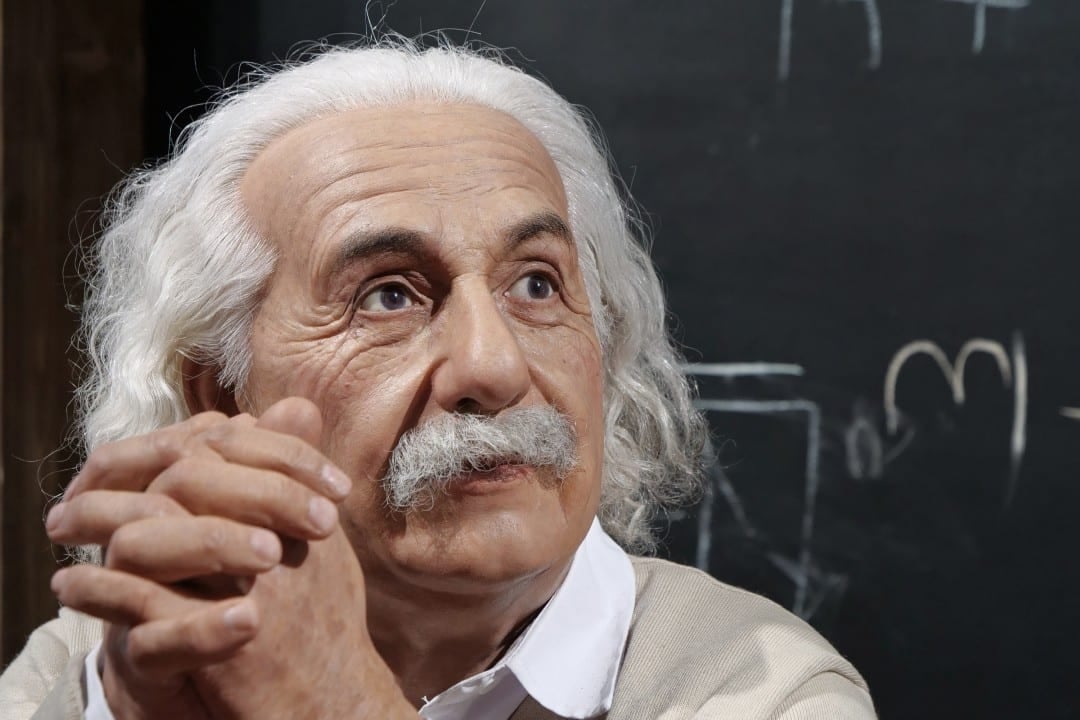
The intellectual confrontation began in 1927, when Einstein proposed a variation of the double slit experiment. Ele imagined an initial slit sensitive to the particle momentum, followed by the traditional double slit. Segundo Einstein, this would allow us to simultaneously observe particle and wave behavior.
Bohr countered that the uncertainty principle of Heisenberg would prevent such an observation. Qualquer Attempting to measure the momentum accurately would introduce uncertainty in the position, erasing the interference pattern. The debate lasted for decades, with no direct experimental performance at the time.
Einstein defended a more deterministic view of quantum reality. Ele believed that the theory was incomplete and that hidden variables would explain the apparently random phenomena.
Innovative technical configuration
The Chinese team used quantum entanglement to link the momentum of the photon to that of the atom acting as the slit. A test laser monitored the atom’s recoil, revealing information about the photon’s trajectory. At the same time, the double slit produced the characteristic wave interference pattern.
The researchers adjusted the depth of the optical trap to vary the momentum uncertainty. At looser settings, the atom’s recoil provided clear data about the path, but the interference fringes became indistinct. In tighter traps, the opposite occurred.
This tunability made it possible to map the transition between classical and quantum regimes. The data collected aligned perfectly with the equations of quantum mechanics.
Context of the principle of complementarity
Niels Bohr introduced the concept of complementarity to explain wave-particle duality. Propriedades like position and momentum, or path and interference, are mutually exclusive in accurate measurements. Essa idea forms the basis of the Copenhague interpretation of quantum mechanics.



The principle does not imply technological limitation, but an intrinsic characteristic of quantum nature. Medições change the state of the system, forcing it to manifest one or another property.
Decades of indirect experiments already supported this view. However, direct realization of the scenario proposed by Einstein offers more rigorous validation.
Implications for quantum technologies
The experimental platform developed opens the way for advanced studies in quantum decoherence. Esse phenomenon, responsible for the loss of coherence in quantum systems, represents a main obstacle for practical quantum computing. Compreender Better interactions between entanglement and decoherence can lead to more stable qubits.
Precise control over single atoms also benefits quantum sensors and secure communication networks. Tecnologias based on quantum cryptography gain reinforcement by confirming fundamental measurement limits.
Researchers highlight that the device is highly adjustable. Isso facilitates investigations into quantum-classical transitions in other contexts.
Advances in fundamental physics
The study represents a milestone in implementing a century-old thought experiment with unprecedented precision. Ele reinforces that counterintuitive aspects of quantum mechanics persist even at extreme scales. The visibility of interference directly depends on the degree of entanglement between photon and slit.
This relationship, expressed in modern terms, illuminates mechanisms underlying complementarity. The results distinguish genuine quantum effects from classical heating in atomic motion.
The achievement occurs at a symbolic moment, with global advances in quantum technologies. Ela consolidates the understanding that subatomic reality operates under rules that are different from the classical ones.
Future research perspectives
Scientists plan to extend the platform to explore interactions between superposition and entanglement. Questões open questions about mutual influence between these properties can be addressed directly. The system is also used to test predictions in high-precision regimes.
Other international teams follow the progress, inspired by the tunability of the device. Colaborações can accelerate discoveries in quantum metrology and simulations of complex systems.
The experiment demonstrates the ability to manipulate quantum states with unprecedented control. Isso positions Chinese research at the forefront of quantum experimental physics.
Veja Tambem em News (EN)

Research reveals that parents are unaware of how their children use artificial intelligence

Samsung releases new system update with new features for Galaxy Watch 4 users

Digital retail reduces the value of the Galaxy S25 5G smartphone with bank bonuses and device exchange

Amazon’s wireless CarPlay adapter has a 50% discount and high approval ratings from drivers

Zach Cregger’s new Resident Evil ignores games and focuses on an unprecedented story with new characters

Rumor suggests that Nintendo is preparing a special edition of the Switch 2 with a remake of Ocarina of Time

Apple accelerates production of the iPhone 17e and develops new Air model with dual camera system

Epic Games platform releases twelve high-budget games at no permanent cost for PC users

PlayStation 5 Pro price drop accelerates digital retail sales and eliminates global stocks

New Galaxy Watch 9 firmware appears on server and confirms progress in software development

Apple’s commemorative project tests cell phone with 1.1 millimeter edge and curved screen for 2027
