
Colossal dimensions of the Solar System defy human intuition and reveal impressive cosmic scales


Sistema Solar spans distances ranging from hundreds of thousands to trillions of kilometers, defying everyday human perception. Essas scales, measured primarily in astronomical units, highlight how Sol’s gravitational domain extends far beyond the visible planets. Cientistas emphasize that such proportions place Terra as an almost insignificant point in the cosmic context.
The average distance from Terra to Lua reaches around 384 thousand kilometers, enough space to line up 30 planets like ours. Já Marte is approximately 220 million kilometers away on average, requiring months of travel even with advanced technology. Essas initial comparisons already illustrate how dimensions grow exponentially when moving away from Sol.
Neptune, the most distant planet, orbits about 4.5 billion kilometers away, marking the conventional limit of planetary Sistema Solar. The Voyager 1 probe, launched in 1977, has already surpassed 25 billion kilometers in January 2026, still under partial solar influence.
Planetary distances in astronomical units
The astronomical unit (AU) serves as the basis for measuring distances in Sistema Solar, corresponding to the average of 149.6 million kilometers between Terra and Sol. Essa measurement facilitates accurate comparisons between planetary orbits.
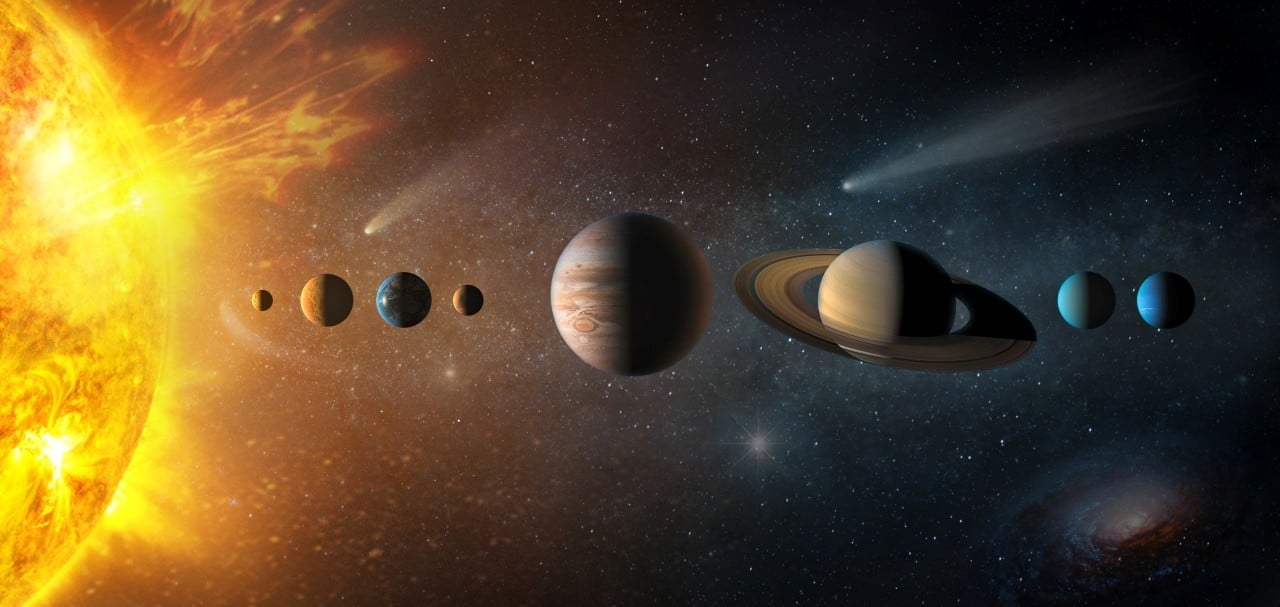
The inner planets are relatively close, while the outer planets require much larger scales. Aqui are the approximate average distances from Sol:
- Mercury: 0.39 AU (about 58 million km)
- Venus: 0.72 AU (108 million km)
- Earth: 1 AU (149.6 million km)
- Mars: 1.52 AU (227 million km)
- Jupiter: 5.2 AU (778 million km)
- Saturn: 9.5 AU (1.4 billion km)
- Uranus: 19.2 AU (2.9 billion km)
- Neptune: 30 AU (4.5 billion km)
These values vary due to elliptical orbits, but reveal the exponential growth of distances.
Heliosphere as a sun protective bubble
The heliosphere represents the region where the solar wind dominates the interstellar medium, extending beyond the planets. Voyager 1 crossed its outer boundary, the heliopause, in 2012, at about 122 AU.
Currently, in 2026, the probe reaches approximately 170 AU, equivalent to more than 25 billion kilometers. Sinais radio takes more than 23 hours to reach Terra, demonstrating the isolation of these distances.
The heliosphere protects the Sistema Solar from galactic cosmic radiation. Sua’s shape, influenced by the movement of Sol in the galaxy, resembles an asymmetric bubble.
Oort cloud and gravitational boundary
The Nuvem of Oort constitutes the reserve of long-period comets, forming a spherical shell around the Sistema Solar. Sua internal portion starts between 2 thousand and 5 thousand AU, while the external portion can reach 100 thousand AU or more.
This region equates to distances of up to almost a light year, approaching halfway to Proxima Centauri. Objetos there remain weakly bound to solar gravity, occasionally disturbed by passing stars.
It would take Voyager 1 tens of thousands of years to cross it, highlighting the slowness of current space travel. The cloud remains hypothetical in parts, observed indirectly through comet trajectories.
Methods for measuring cosmic distances
Astronomers use radar for nearby bodies such as Lua and inner planets, reflecting radio signals to calculate round-trip times. Para distant objects employ stellar parallax, measuring apparent displacements against the stellar background.
The astronomical unit has been refined by missions such as the Venus transit and modern probes. Spatial Telescópios, like Gaia, maps positions with millimeter precision on larger scales.
- Parallax → Base for distances up to thousands of AU
- Planetary transits → Refinam the exact AU
- Radar echo → Precisão for asteroids and moons
- Spectroscopy → Velocidades and indirect orbits
These combined techniques allow us to map Sistema Solar with minimal error.
Everyday comparisons that illustrate the vastness
A car trip to Lua, at a constant 100 km/h, would take months without interruption. Para Marte, the time would exceed years, even under ideal conditions.
If Sol were reduced to the size of an orange, Terra would orbit meters away, while Netuno would be hundreds of meters away. The outer Nuvem of Oort would reach kilometers on this scale.
Light from Sol takes 8 minutes to reach Terra, but more than 5 hours for Netuno. Na Voyager 1, sunlight lingers for days, weakening drastically.
Why these scales confuse human perception
Human experience is limited to terrestrial scales, where maximum distances rarely exceed thousands of kilometers. The brain evolved to process pedestrian or vehicle speeds, not spatial speeds.
Scientists admit that visualizing trillions of kilometers requires abstract models, as we intuit linear, not exponential, distances. Essas proportions humiliate by showing planetary insignificance.
Transition to larger cosmic structures
In addition to Nuvem of Oort, Proxima Centauri is 4.24 light years away, equivalent to more than 270 thousand AU. Via Láctea measures about 100,000 light-years in diameter, housing billions of stars.
Grupo Local brings together dozens of galaxies, inserted in superclusters like Laniakea, hundreds of millions of light years away. The observable universe reaches 93 billion light years.
Here are ascending scales:
- System Solar (Cloud of Oort) → Até 1 light year
- Nearest star → 4.24 light years
- Via Láctea → 100 thousand light years
- Observable Universe → 93 billion light years
These progressions reinforce how Sistema Solar represents only the beginning of the cosmic scales.
Voyager 1 as a current exploratory milestone
The Voyager 1 probe continues to operate in 2026, sending data from the interstellar medium. Sua trajectory demonstrates human technological limits in relation to solar distances.
Nuclear power gradually declines, predicting total shutdown in the coming decades. Instrumentos record particles and magnetic fields beyond the heliosphere.
The exact position varies daily, but remains the most distant human object. Sua golden plate carries messages for possible extraterrestrial encounters.
Implications of scales in modern astronomy
Understanding these dimensions helps in the search for exoplanets and the origin of comets. Telescópios like James Webb observe distant systems on similar scales.
The vastness encourages future missions such as interstellar interceptors. Ela also contextualizes the rarity of known life, spread across an immense cosmos.
Recent research refines models of Nuvem from Oort, suggesting spiral shapes due to galactic influences. NASA’s computational Simulações enhances these visions.
Sistema Solar, with its impressive scales, serves as a portal to understanding the larger universe. Suas distances, measured with increasing precision, continue to reveal cosmic complexity.



