
Interstellar visitor 3I/ATLAS surprises with symmetrical jets in unprecedented images from the Hubble telescope


New observations by Telescópio Espacial Hubble have provided an unprecedented view of comet 3I/ATLAS, the third object confirmed to originate outside our own Sistema Solar. Images captured at the end of 2025 revealed a structure of jets of material with remarkable symmetry and persistence, a behavior distinct from our system’s native comets, intriguing astronomers from NASA and Agência Espacial Europeia (ESA).
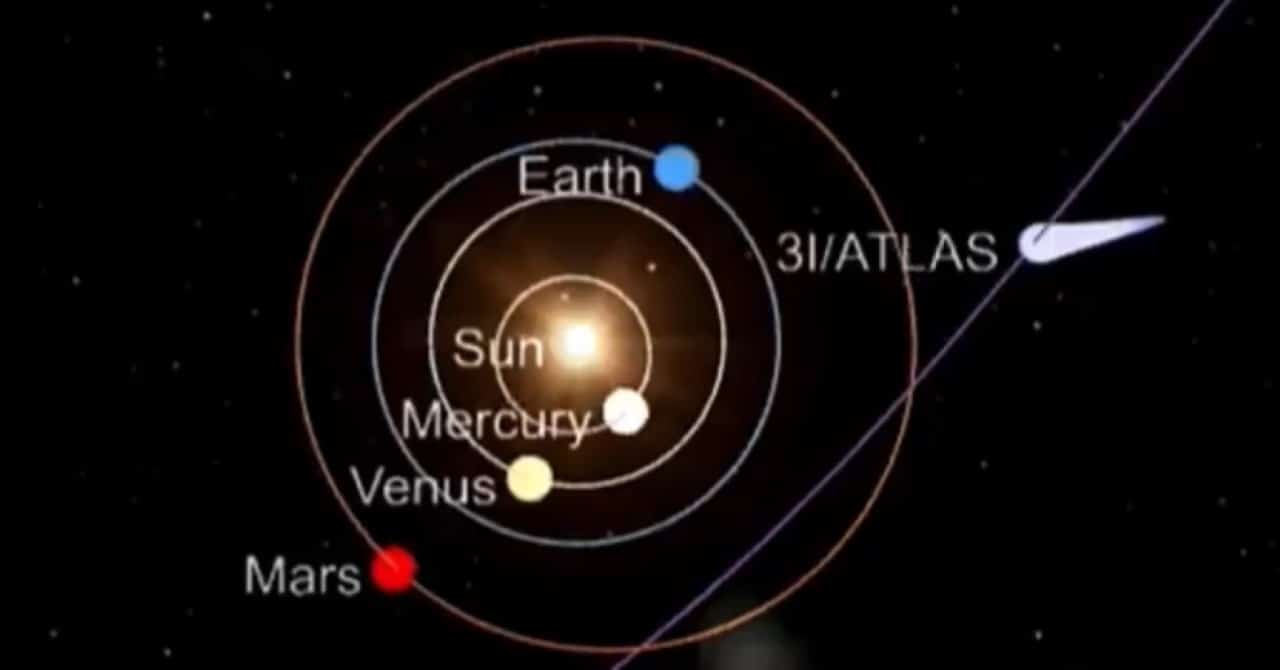
The celestial object, which travels at an impressive speed of 58 kilometers per second, made its closest approach to Terra on December 19, 2025, passing at a safe distance of approximately 270 million kilometers. Essa record speed, combined with its hyperbolic trajectory, was the definitive confirmation of its interstellar nature, ensuring that it would only cross our system before continuing its journey through the cosmos.
Since its discovery in July 2025, the comet has been a priority target for the scientific community. Analysis of the collected data suggests that 3I/ATLAS is estimated to be between 7 and 13 billion years old, making it potentially older than Sol itself, offering a rare window into the study of primordial material from other parts of the galaxy.
The detection of the third interstellar visitor
The initial identification of 3I/ATLAS occurred on July 1, 2025, through the ATLAS astronomical survey system (Asteroid Terrestrial-impact Last Alert System), located on Chile and funded by NASA. The program, designed to detect objects near Terra that could pose a threat, recorded a fast-moving point of light. Preliminary analysis of its orbit immediately revealed a sharp hyperbolic trajectory, a clear indicator that the object was not gravitationally bound to Sol and was therefore coming from outside Sistema Solar.
Confirmation of its extrasolar origin quickly mobilized the global astronomical community. Telescópios Earth and space-based sources were redirected to track the comet in a coordinated effort to collect as much data as possible during its brief passage. The object’s high speed represented a technical challenge, requiring constant adjustments to the instruments to maintain focus. Após confirmation, he was officially classified as the third known interstellar visitor, following in the footsteps of 1I/’Oumuamua (2017) and 2I/Borisov (2019).
Detailed observations by Hubble
The most crucial observation sessions were conducted by Telescópio Espacial Hubble between November and December 2025.
The records revealed two columns of material being ejected from the comet’s nucleus. Diferente of the diffuse and irregular jets commonly seen in comets from Cinturão of Kuiper or Nuvem of Oort, these emissions were remarkably collimated and symmetrical.
This structure persisted over multiple observations, suggesting unusual mechanical stability in the comet’s nucleus, estimated to be between 600 and 800 meters in diameter. The analysis indicated that the core’s rotation is synchronized in a way that maintains the precise orientation of the jets.
Current models describing ice sublimation and outgassing in comets cannot fully explain the observed cohesion and symmetry. Cientistas hypothesize that the conditions of its formation in a distant interstellar environment may have resulted in this unique composition and behavior.
Chemical composition and intense activity
The spectroscopic analysis, which decomposes the comet’s light to identify its composition, revealed a predominance of carbon dioxide (CO2) and an intense production of water. Observatórios and SOHO (Solar and Heliosférico Observatory) have measured astonishing material release rates, with volumes equivalent to filling an Olympic-sized swimming pool in a matter of seconds. Essa intense activity confirmed the natural character of the object, ruling out more exotic theories.
The abundance of CO2 is in line with theories about the formation of celestial bodies in very cold and dense regions of the galaxy. The detected elements suggest that 3I/ATLAS originated in an environment prior to the formation of most of the stars that make up the Via Láctea disk, reinforcing the idea that it is a cosmic relic from a distant past.
Trajectory and passage through Sistema Solar
Comet 3I/ATLAS crossed Sistema Solar on a trajectory that kept it far from the planets, eliminating any risk of collision. Sua extreme speed prevented the gravity of Sol from capturing it, ensuring its definitive exit in the following months. The passage was followed by observatories around the world as the comet moved through the constellation Câncer until January 2026.
The minimum distance of 270 million kilometers from Terra was an ideal window of opportunity. The relative proximity allowed the instruments to collect detailed data about its coma (the atmosphere around the nucleus) and tail, providing valuable information about the primordial material that makes up the object. The constant sublimation of ice has continually exposed material that has remained unchanged since its formation billions of years ago.
The intense cometary activity was maintained throughout its approach to Sol. Este active behavior was one of the main points of interest, as it allowed an in-depth study of its composition, something that was not possible with the first interstellar visitor, ‘Oumuamua.
The search for artificial signals
Following the protocol for unusual interstellar objects, the Breakthrough Listen project used the powerful Telescópio of Green Bank, on Virgínia Ocidental, to “listen” for comet 3I/ATLAS. On December 18, 2025, the radio telescope was pointed at the object, scanning a wide range of radio frequencies for any signal that could indicate a technological origin.
After a thorough analysis of almost half a million signal candidates, the team concluded that there were no emissions of artificial origin. Todas the suspicious detections were quickly identified as interference from satellites or other terrestrial sources, reinforcing the classification of 3I/ATLAS as an entirely natural celestial body. The validation of the negative results by international teams ended speculation about the possibility of it being an alien probe.
Differences in relation to ‘Oumuamua and Borisov
The arrival of 3I/ATLAS enriches the comparative study of interstellar visitors. Ele proved markedly different from its predecessors. The first, 1I/’Oumuamua, intrigued scientists due to its extremely elongated shape and total lack of visible cometary activity, which generated intense debate about its nature. The second, 2I/Borisov, on the other hand, behaved very similarly to a comet from our own Sistema Solar, with a composition and activity considered typical. 3I/ATLAS positions itself on a new level, combining intense cometary activity, like Borisov, with a totally atypical jet structure, which does not resemble anything previously observed. Essa diversity among the three known visitors highlights that planetary systems across the galaxy can produce a much greater variety of objects than previously imagined.
New perspectives for astronomy
The 3I/ATLAS study represents a unique opportunity to directly analyze material from another star system, providing concrete data on planetary formation processes in distant environments of the galaxy. The stability of their jets and their chemical composition challenge existing models and will force scientists to refine theories about the evolution of comets and the cohesion of their nuclei. The safe passage and detailed data collected also help solidify rapid response protocols for future events, with space agencies already planning dedicated missions to intercept and closely study the next interstellar visitor that crosses our path.



