
Search for alien life on comet 3I/ATLAS turns up silent after detailed radio analysis


A detailed scan by astronomers from the Breakthrough Listen project at the interstellar object 3I/ATLAS found no evidence of artificial radio signals. The observations, conducted on December 18, 2025 with the powerful Green Bank radio telescope at Estados Unidos, represent the most sensitive search for alien technology ever made on a visitor from outside our Sistema Solar. The object, which travels at impressive speed, was monitored intensively during its closest approach to Terra.
The procedure took place one day before 3I/ATLAS reached its closest point to our planet, at a safe distance of approximately 269 million kilometers. Mesmo with the ability to detect very low power transmitters, equivalent to a common cell phone, the detailed analysis of four different frequency bands did not reveal any reliable technosignature, indicating that the object has a natural origin.
Although the result was negative for the search for extraterrestrial intelligence, the 3I/ATLAS study provides valuable scientific data on the composition of materials formed in other stellar systems. The absence of artificial signals reinforces the hypothesis that the visitor is a comet, but surveillance of future interstellar objects remains a priority for the scientific community, which remains prepared for any possibility.
The methodology behind silent scanning
To ensure the accuracy of the results, the Green Bank team used a robust observation technique, alternating the telescope’s pointing between 3I/ATLAS and adjacent regions of the sky. Esse method, known as “nodding”, is crucial for differentiating potential cosmic signals from radio-frequency interference (RFI) generated here at Terra, such as that coming from satellites, telephone networks and other human sources. The scanned frequency bands, between 1 and 12 GHz, were chosen because they are considered an ideal “window” for possible interstellar communications, where the galaxy’s background noise is relatively low. Essa meticulous approach ensured that any detected signal could be attributed with high confidence to the object.
The volume of data collected was immense, totaling terabytes of information that needed to be processed by complex algorithms. Inicialmente, the system identified hundreds of thousands of signal candidates, a common number in this type of search. However, after rigorous filters were applied to remove terrestrial contamination, almost all were discarded. Apenas nine events of interest remained for further analysis, but subsequent investigations confirmed that they too originated from human sources. The total absence of persistent narrowband emission originating from 3I/ATLAS establishes a strict limit on the existence of any transmitter on board the object.
The unique profile of the third interstellar visitor
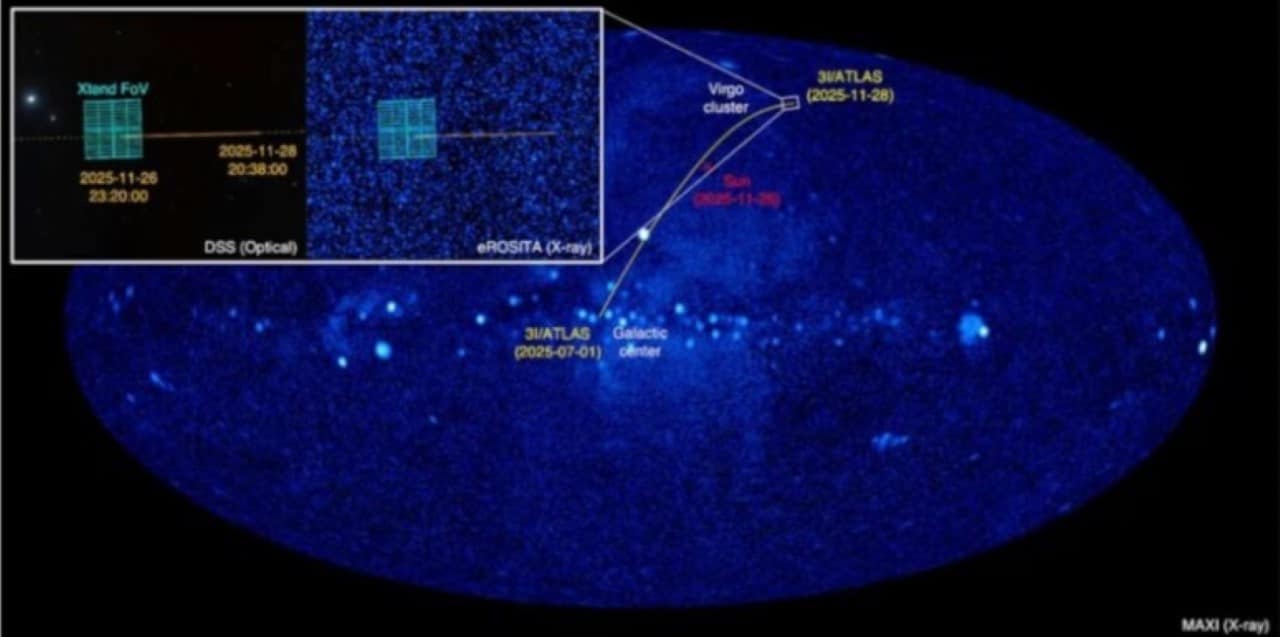
Discovered on July 1, 2025 by the ATLAS astronomical survey system (Asteroid Terrestrial-impact Last Alert System), 3I/ATLAS was quickly identified as the third interstellar object to cross our Sistema Solar. Sua’s sharply hyperbolic trajectory is definitive proof that it is not gravitationally bound to Sol and that, after its passage, it will return to the vast space between the stars. What distinguishes it from previous visitors is its extraordinarily high speed, around 58 km/s, and its pronounced cometary activity. Desde the beginning, the object displayed a bright coma and tail, formed by the sublimation of ices as it approached the heat of Sol. Essa characteristic fundamentally differentiates him from the enigmatic ‘Oumuamua, the first interstellar visitor, who did not have a visible coma, generating intense debates about his true nature. Observações optics indicate that the nucleus of 3I/ATLAS is compact, with a diameter estimated at a few kilometers, and does not have the extremely elongated shape that was inferred for ‘Oumuamua.
Comparison with ‘Oumuamua and Borisov
The first interstellar visitor, ‘Oumuamua, detected in 2017, intrigued scientists for its anomalous behavior. Viajando at 26 km/s, it did not exhibit the coma of gas and dust expected from a comet, even though it had a non-gravitational acceleration, which led to speculation about its composition and origin.
The second object, 2I/Borisov, discovered in 2019, looked much more familiar. With a speed of 32 km/s, it behaved exactly like a long-period comet from our own Sistema Solar, displaying a clear coma and tail, which allowed astronomers to study its chemical composition in detail.
The 3I/ATLAS stands out from both. Sua superior speed and intense cometary activity suggest that it may have been ejected from its home star system with more energy, perhaps by a gravitational interaction with a giant planet. Cada one of these visitors offers a unique piece to the puzzle of planetary formation elsewhere in the galaxy.
Global efforts and lack of detections
The 3I/ATLAS observation campaign was not limited to the Green Bank telescope, involving international collaboration.
Other cutting-edge observatories, such as the MeerKAT radio telescope array on África on Sul and the Allen Telescope Array on Estados Unidos, have also pointed their antennas at the object.
The results were consistent on all fronts: no detections of artificial signals were reported by any of the independent teams.
This cross-confirmation strengthens the conclusion that 3I/ATLAS is a purely natural phenomenon, offering a valuable testbed for global technosignature detection systems.
Continued scientific importance
Even without signs of technology, the study of 3I/ATLAS is of immense importance for astrophysics. Analysis of the light reflected by its coma allows scientists to determine the chemical composition of primordial material from another star system, revealing the diversity of “ingredients” for planet formation in the galaxy.
As the object continues its journey away from Sol, optical and space telescopes will continue to monitor its brightness and behavior. Esses long-term data will help refine models on the evolution of comets and the dynamics of distant planetary systems, making the most of this rare research opportunity.
What are technosignaturas and why look for them
Technosignatures are any measurable evidence of technology that could be detected from a distance. In the context of radio astronomy, the main focus is on narrowband radio signals, as natural astrophysical processes tend to emit radiation over a wide range of frequencies, while communications technologies tend to concentrate energy in very specific channels.
The search for interstellar objects is motivated by the hypothesis that they could be artificial probes sent by other civilizations to explore the galaxy, an idea popularized by ‘Oumuamua. Embora the probability is low, the potential for a discovery justifies directing the most sensitive instruments on the planet towards these passing targets.
The record sensitivity of observation
The capabilities of the Green Bank radio telescope during this campaign were remarkable, setting a new standard for searching for signals from interstellar objects. The sensitivity achieved was enough to detect a transmitter with a power of just 0.1 watt, which means that if 3I/ATLAS carried a device with the same power as a common smartphone, it would have been detected, even hundreds of millions of kilometers away. Esse level of precision demonstrates the technological advancement of SETI projects (Search for Extraterrestrial Intelligence) and the seriousness with which the search is conducted.



