
Avi Loeb calculates whether interstellar comet 3I/Atlas has artificial gas-based propulsion


The interstellar comet 3I/Atlas, discovered in July 2025, continues to generate debates in the scientific community due to characteristics observed in its trajectory and composition. Astrophysicist Avi Loeb, from Universidade Harvard, presented recent calculations that assess whether the object has artificial propulsion, based on the behavior of the gas and dust in its anti-tail.
These analyzes come after observations that show the anti-tail extending hundreds of thousands of kilometers towards Sol. Loeb highlights that data collected in the months following perihelion, which occurred in October 2025, allows us to test the nature of the object.
- The anti-tail consists mainly of larger dust particles.
- The gas released naturally stops at shorter distances due to pressure from the solar wind.
- Observations with telescopes such as Hubble and ground-based instruments confirm the extent of the structure.
Recent anti-tail observations
The 3I/Atlas anti-tail was recorded in images from December 2025, showing a collimated structure towards Sol. Essas observations, captured by terrestrial and space telescopes, reveal that the extension reaches hundreds of thousands of kilometers.
Loeb explains that dust particles of around 10 micrometers can be dragged by the gas near the nucleus and reach speeds sufficient to form this long structure. However, the natural gas must stop about 5,000 kilometers from the core, balanced by the pressure of the solar wind.
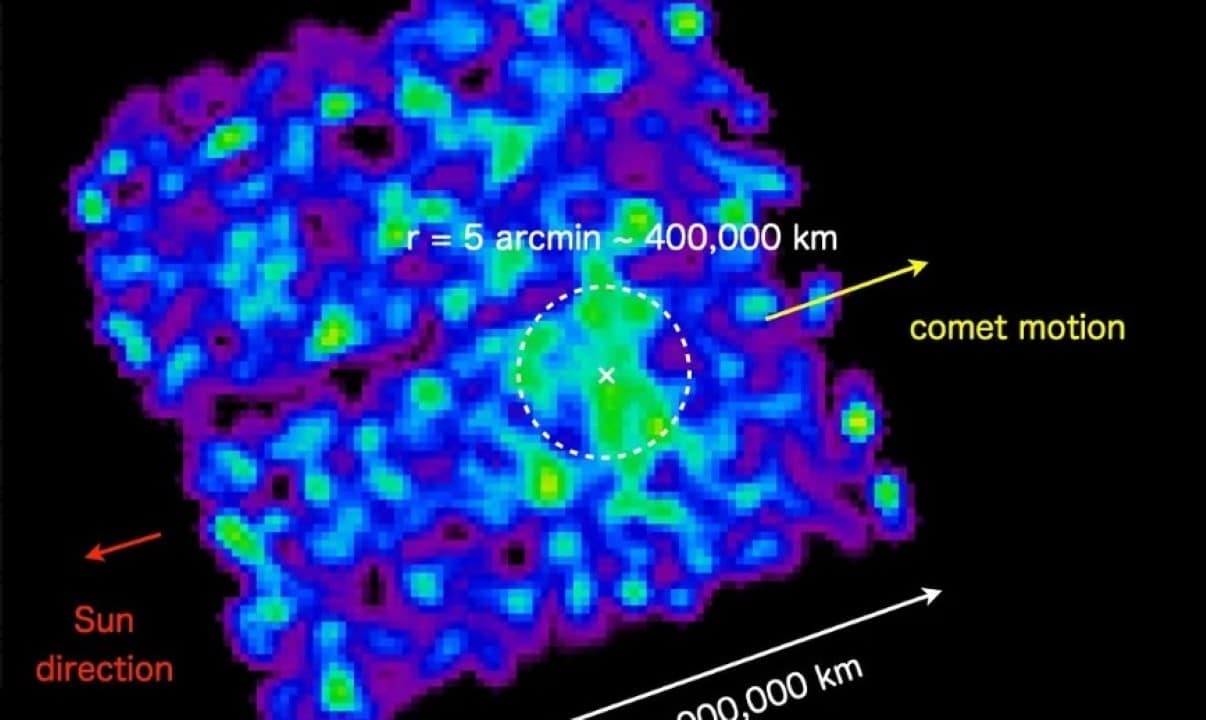
Avi Loeb calculations on gas
Loeb’s calculations indicate that, if 3I/Atlas is a natural comet, the gas flow in the anti-tail should not exceed 5 thousand kilometers from the nucleus. At greater distances, the structure should contain only dust, with no significant presence of gas.
The astrophysicist suggests that the detection of molecules like CO2 along the anti-tail could indicate something different. In chemical propulsion scenarios, gas could reach 25 thousand kilometers, while ion engines would allow up to 100 thousand kilometers.
These tests can be carried out with telescopes such as Keck, VLT, ALMA or space observatories such as James Webb. Additional Dados from December 2025 reinforce the need for spectroscopic analyzes to map the distribution of gas and dust.
Searches for artificial signals
Observations carried out on December 18, 2025 with Telescópio Green Bank, under the Breakthrough Listen program, did not detect artificial radio signals from 3I/Atlas. The searches covered bands from 1 to 12 GHz, with sufficient sensitivity to identify low-power transmitters.
The results indicate the absence of narrow emissions that could suggest technology. Para comparison, the detected threshold power was lower than that of an ordinary cell phone.
África teams from Sul and Suécia analyzed the data, concluding that there is no evidence of isotropic transmitters above 0.1 W.
Trajectory and general characteristics
3I/Atlas passed perihelion in October 2025, about 1.4 astronomical units from Sol, and approached Terra on December 19, at approximately 269 million kilometers. Sua hyperbolic trajectory confirms origin outside of Sistema Solar, making it the third interstellar object identified.
Observations show gaseous coma and dust tails typical of comets, with increased activity near Sol. The object now heads towards a distant approach to Júpiter in March 2026, before definitively leaving Sistema Solar.
Dust and composition analyzes
Studies indicate that the dust in the anti-tail has larger particles than are common in Sistema Solar comets. Essa characteristic explains the observed extension, as 10 micrometer particles better resist solar deceleration.
The coma has a reddish color, suggestive of dust, similar to the previous interstellar comet 2I/Borisov. Dados spectroscopy detected substances such as cyanide and nickel vapor, common in comets.
Continuous Monitoring Perspectives
Monitoring of 3I/Atlas continues with ground- and space-based telescopes until mid-2026, when the object will become indistinguishable. Campanhas international organizations coordinated by the UN’s Rede of Alerta of Asteroides have collected valuable data on interstellar composition.
Future observations may clarify the exact distribution of gas and dust in the anti-tail. Esses efforts contribute to the understanding of visiting objects from interstellar space.



