
CIA neither confirms nor denies the existence of records about the interstellar comet 3I/ATLAS


Agência Central of Inteligência of Estados Unidos (CIA) responded to a request based on Lei of Liberdade of The response, dated December 31, 2025, was sent to researcher John Greenewald Jr. and uses the well-known formula Glomar, applied in sensitive cases.
The comet, discovered on July 1, 2025 by the ATLAS system in Chile, is the third confirmed object of interstellar origin to visit the solar system, after 1I/’Oumuamua and 2I/Borisov. NASA classified 3I/ATLAS as a natural body in a press conference held on November 19, 2025, highlighting that it poses no risk to Terra.
The CIA’s position contrasts with NASA’s public statement and raises questions in the scientific community about the handling of the issue by American government agencies. Recent Observações continue to record the behavior of the comet, which has already passed perihelion in October 2025 and is moving away from Sol again.
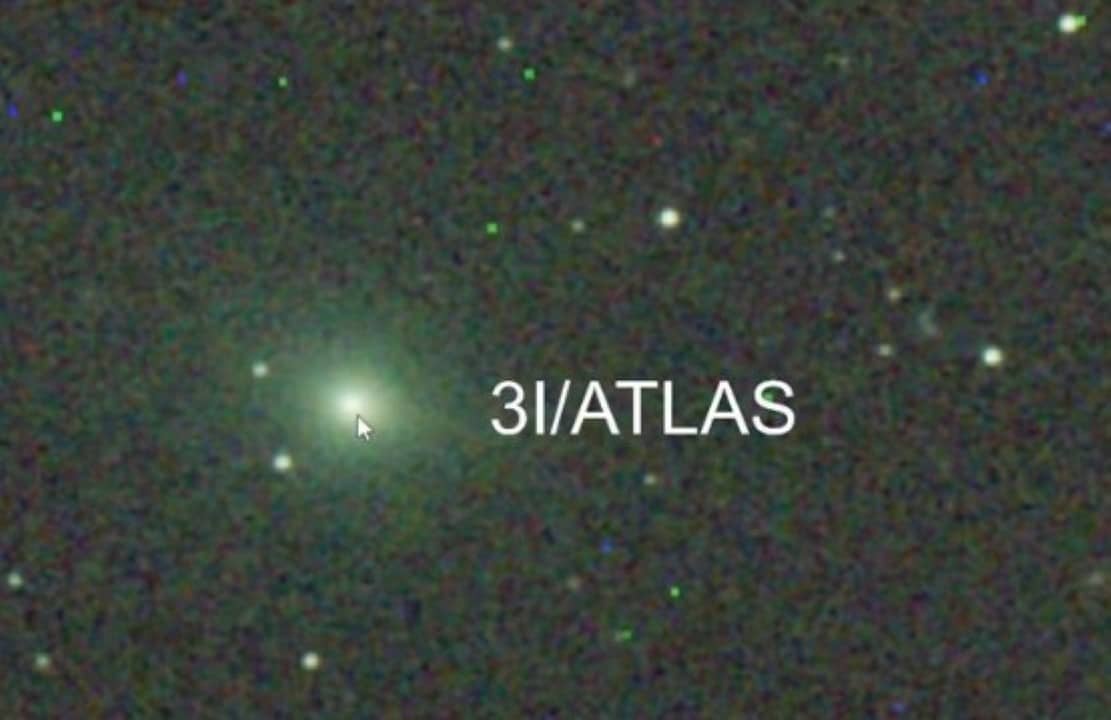
3I/ATLAS reached the closest distance to Terra on December 19, 2025, allowing detailed images by ground-based and space-based telescopes. Projetos as well as Virtual Telescope, in Itália, captured the object displaying a prominent anti-tail, a structure formed by particles directed towards Sol.
Discovery and trajectory of the object
Astronomers initially identified 3I/ATLAS as an object on a hyperbolic trajectory, characteristic of bodies that are not gravitationally bound to Sol. Confirmation of interstellar origin occurred a few weeks after detection, with calculations indicating a speed exceeding 68 km/s in relation to the solar system.
The comet passed through perihelion at about 1.4 astronomical units from Sol, a safe distance that avoided total disintegration. Observações from the Parker Solar Probe probe and telescopes like Green Bank recorded data on its composition and activity during closest approach.
Characteristics observed in 3I/ATLAS
The object presented an anti-tail jet both before and after perihelion, a phenomenon considered rare in common comets. Imagens from Virtual Telescope Project on December 30, 2025 showed this clearly visible structure, composed of larger particles that resist solar radiation pressure.
Spectroscopic analyzes revealed a predominance of nickel in relation to iron in the expelled gases, a composition that differs from patterns observed in comets in the solar system. The alignment of the rotation axis with an accuracy of 8 degrees in relation to the solar direction also caught the attention of researchers.
Other aspects include:
- Orbital alignment of 5 degrees with the ecliptic plane, flatter than expected for interstellar objects;
- Maintenance of the jet directed to Sol even after a gravitational deflection of 16 degrees at perihelion;
- Absence of detectable radio signals in observations of December 18, 2025 by Telescópio Green Bank;
- Presence of elongated ionic tail recorded in November 2025.
These characteristics generated detailed studies, but NASA maintained the classification as a natural comet in all official communications.
Official position of the space agency
NASA officials stated in a press conference on November 19, 2025 that 3I/ATLAS is definitely of natural origin, based on data collected by multiple missions. Imagens shared during the event showed the object with behavior typical of comets passing through the inner solar system.
The agency highlighted that there is no evidence of technology or artificial origin, reinforcing that the observed anomalies are within the expected variation for interstellar bodies. Observações continued to be released publicly, including X-ray data that helped map the composition of the coma.
CIA request for information and response
John Greenewald Jr. filed the FOIA request in November 2025, requesting records about 3I/ATLAS produced from June 1 of that year. The CIA response, received on December 31, invoked national security exceptions to justify the Glomar formula.
The agency argued that confirming or denying the existence of documents could reveal information protected by law. The researcher has 90 days to appeal the decision, an option already announced publicly.
Scientific debate about anomalies
Astrophysicist Avi Loeb, from Universidade Harvard, listed several characteristics of 3I/ATLAS that he considers inexplicable in the light of known comets. In a recently published article, he questioned why the CIA would adopt a classificatory response to an object declared natural by NASA.
Loeb suggested that intelligence agencies can monitor low-probability but high-impact events, even when experts consider the threat unlikely. Ele compared the situation to the need for vigilance against rare risks, without implying confirmation of artificial origin.
Additional research has ruled out technological radio signals in specific bands during the limited observation window. Loeb advocated broader monitoring to cover different directions and periods, considering the nature of interstellar travel.
The comet will continue to be visible through professional telescopes as it heads towards Nuvem from Dados collected so far contribute to the understanding of objects coming from other star systems.
Recent observations indicate that 3I/ATLAS maintains activity even at greater distances from Sol, with tails still detectable. Projetos international organizations follow the object’s retreat into deep space, collecting valuable information about interstellar composition.
Recent observations and available images
Virtual Telescope Project captured composite images of 3I/ATLAS on December 30, 2025, showing the anti-tail jet heading toward Sol. The 120-second exposures revealed details of the structure, confirming the persistence of the phenomenon after perihelion.
Ground-based telescopes at Europa and Américas recorded the object in the constellation of Câncer, hundreds of millions of kilometers from Terra. The current distance allows only professional observations, but the data is shared openly with the astronomical community.
Context of known interstellar objects
3I/ATLAS is the third confirmed visitor from outside the solar system, following a hyperbolic trajectory that will take it back to interstellar space. Sua speed and direction indicate origin in another star, possibly billions of years ago.
Comparisons with ‘Oumuamua and Borisov show significant variations in form, composition, and behavior. The core estimated to be between 10 and 30 kilometers in diameter makes 3I/ATLAS larger than previous ones, facilitating detailed studies.
The current passage represents a unique opportunity to collect data on primordial material from other systems. Astrônomos hope that future missions will allow direct interception of similar objects.



