
Discovery of gromada SPT2349-56 reveals gas five times hotter than predicted in the early universe

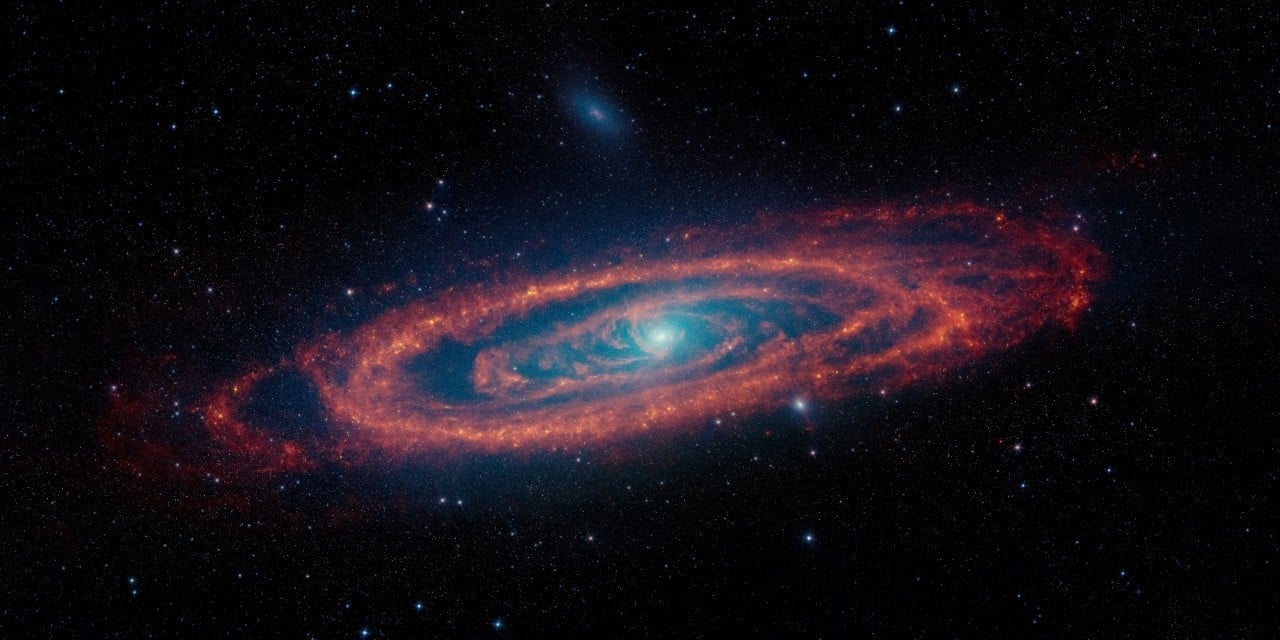
Astronomers have identified acircle of galaxiescalled SPT2349-56, which has gas among its components with temperatures much higher than expected for the initial period of the universe. The Essa structure, observed as it was about 12 billion years ago when the cosmos was just 1.4 billion years old, reveals a superheated intragroup medium, detected through the Sunyaev-Zeldovich effect.
The study, published in the journal Nature, used data from the ALMA radio telescope array to analyze distortions in the cosmic microwave background caused by hot gas. Pesquisadores confirmed that the gas reaches thermal energy levels at least five times greater than those predicted by current models of cosmic evolution.
This discovery indicates that intense energetic processes were acting earlier than previously imagined, possibly altering the understanding of how the great structures of the universe were formed.
Gromme observation SPT2349-56
A grommet SPT2349-56it was initially detected in 2010 by South Pole Telescope, on Antártida. Subsequent Observações revealed that it contains more than 30 active galaxies, with star formation rates thousands of times higher than today’s Via Láctea.
These galaxies move in trajectories that suggest imminent collisions, characterizing a protogram in the consolidation phase. The core of the structure has a diameter comparable to the halo of Via Láctea, concentrating intense activity in a compact region.
Hot gas detection method
The scientists applied the Sunyaev-Zeldovich thermal effect to measure intragroup gas. Esse phenomenon occurs when photons from the cosmic microwave background interact with high-energy electrons in hot gas, producing detectable distortions.
In the case of SPT2349-56, the recorded signal was exceptionally strong, indicating temperatures exceeding 10 million kelvins. Inicialmente, the team considered the possibility of error, but extensive checks confirmed the robustness of the data.

Temperatures beyond forecasts
Established cosmological models predict that the heating of the intragroup environment occurs gradually, through gravitational interactions over billions of years. In young structures like SPT2349-56, cooler, less energetic gas was expected.
The analysis showed, however, that the gas is at least five times hotter than projected, even exceeding levels observed in many current gromatures. Essa discrepancy suggests additional heating mechanisms acting early in the universe.
Role of supermassive black holes
Researchers have identified at least threesupermassive black holesin the gromada, whose energetic jets can inject heat into the surrounding gas. Essa activity of active galactic nuclei represents a significant non-gravitational energy source.
The presence of these objects indicates that feedback from black holes was influencing the evolution of gromatures much earlier than predicted. Tal process contributes to explaining the accelerated heating observed in the structure.
- Intense star formation in more than 30 galaxies.
- Ongoing galactic collisions.
- Black hole jets heating the medium.
- Strong distortions in the cosmic background.
Observations with ALMA
The Atacama Large Millimeter/submillimeter Array (ALMA) provided crucial data for detecting the thermal signal. Esse telescope array, located in the Atacama desert at Chile, allows high-resolution observations at millimeter wavelengths.
The measurements revealed a large thermal reservoir in the intragroup environment of the protogromada. ALMA’s sensitivity captured details that previous instruments did not record in such distant objects.
International research team
The work was led by Dazhi Zhou, PhD candidate at University of British Columbia, at Canadá. Scott Chapman, of Dalhousie University, contributed analysis during the period in National Research Council of Canada.
The collaboration involved institutions from several countries, combining expertise in observational cosmology and simulations. The results highlight the importance of multi-instrument observations for advances in astrophysics.
Early formation of cosmic structures
Galaxy clusters represent the largest gravitationally bound structures in the universe. Sua formation involves gradual accumulation of matter, with heating of the gas by gravitational collapses.
SPT2349-56 demonstrates that hot gas reservoirs existed in very ancient times. Isso points to faster and more energetic assembly of structures compared to standard simulations.
This evidence reinforces recent observations of galaxies and massive black holes in the early universe. Juntas, they suggest revisions to established cosmic evolution timelines.
Scientific publication details
The paper details the detection of the Sunyaev-Zeldovich effect at redshift 4.3, the highest recorded for hot intragroup gas. The authors emphasize the need for new models that incorporate early feedback from black holes.
The research paves the way for future studies with telescopes like the James Webb. Essas investigations may clarify interactions between star formation, nuclear activity and dynamics of young gromatures.
Characteristics of protogromada
SPT2349-56 is classified as a protogrom, or grom in initial formation. Sua mass and density indicate potential to evolve into one of the massive structures observed in the local universe.
The concentration of active galaxies in a limited volume amplifies internal energetic processes. Essa rare configuration offers a unique window into the universe 12 billion years ago.




