
Interstellar comet 3I/ATLAS exhibits unusual acceleration as it leaves the Solar System, NASA reveals


A visitor from another star system, comet 3I/ATLAS, is exhibiting intriguing behavior as it begins its long journey back to deep space. Nasa confirmed that the object is experiencing non-gravitational acceleration, a phenomenon driven by the ejection of gases and dust from its surface heated by Sol. Este event offers scientists a rare opportunity to study the composition of celestial bodies formed around other stars.
Discovered in July 2025, 3I/ATLAS is the third interstellar object ever detected crossing our cosmic neighborhood. Sua’s hyperbolic trajectory, which prevents it from being captured by Sol’s gravity, is the main evidence for its extrasolar origin. Atualmente, the comet travels at speeds exceeding 200,000 kilometers per hour, and its continuous study is carried out by a fleet of space and ground-based telescopes.
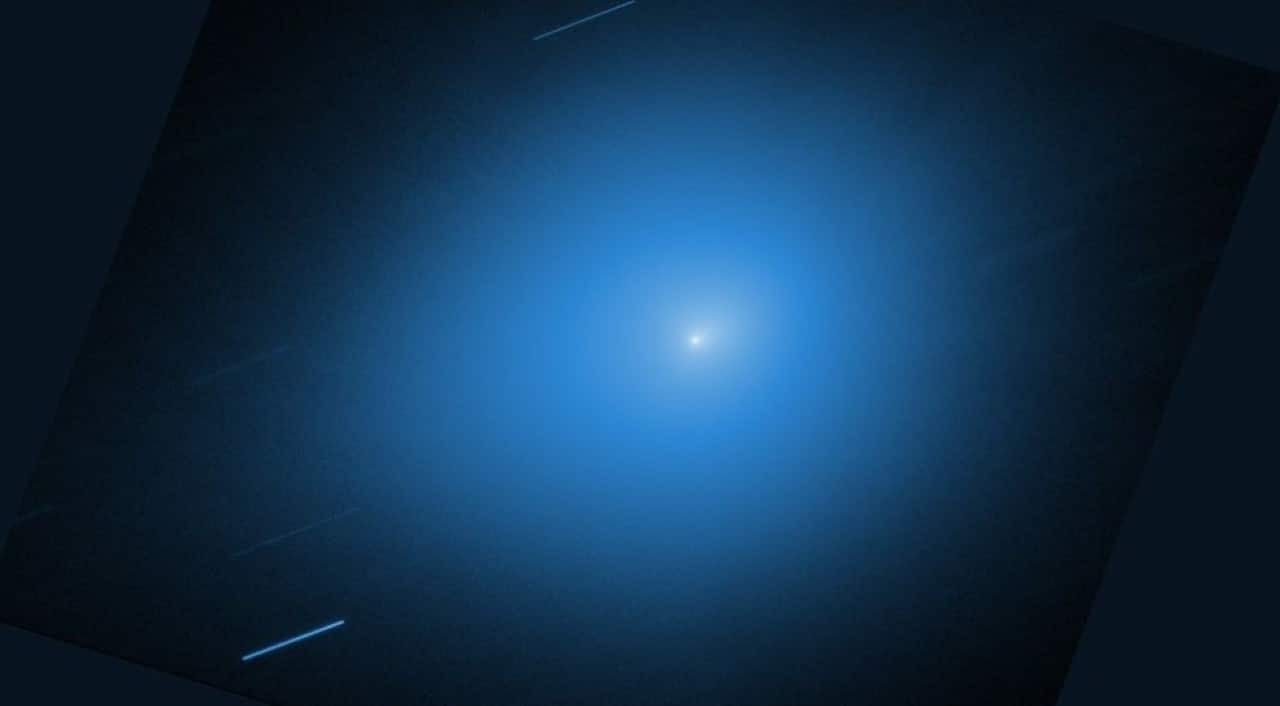
Analyzing this subtle but measurable acceleration is crucial to differentiating its nature from that of other visitors, such as the enigmatic ‘Oumuamua. In the case of 3I/ATLAS, the presence of a visible coma and tail confirms that the extra thrust is generated by known cometary processes, providing valuable data on the dynamics and composition of comets from other parts of the galaxy.
Identification of an extrasolar traveler
Comet 3I/ATLAS was officially identified on July 1, 2025 by the powerful telescopes of the ATLAS project (Asteroid Terrestrial-impact Last Alert System), an initiative funded by Nasa and designed to scan the sky for objects close to Terra. Quase that immediately, analysis of its orbit revealed a sharp hyperbolic trajectory, a clear sign that the object was not gravitationally bound to our Sol and therefore originated in interstellar space.
Since the first observations, 3I/ATLAS has shown signs of activity, displaying a diffuse coma, which is the cloud of gas and dust surrounding the nucleus. Essa activity, detected even when the comet was a considerable distance from Sol, indicated the presence of volatile ices sublimating on its surface. The approach of Marte in October 2025 allowed several probes orbiting the red planet to also capture valuable images and data of the cosmic visitor.
The phenomenon of non-gravitational acceleration
The Nasa monitoring team detected that the trajectory of comet 3I/ATLAS cannot be explained solely by the gravity of Sol and the planets. The object is receiving a small but constant additional thrust. Essa “non-gravitational acceleration” is caused by the sublimation of ices on the surface of the comet’s nucleus. As the ice turns directly into gas due to solar heat, the jets of ejected material act as tiny thrusters, pushing the comet and subtly changing its speed and direction.
This “rocket” effect is common in comets from our own Sistema Solar, but its precise measurement in an interstellar object is of great scientific importance. The strength of this impulse depends on the composition, shape and rotation of the comet’s nucleus. By quantifying this acceleration, astronomers can infer physical characteristics of the 3I/ATLAS core, such as the distribution of its volatile materials and its internal structure. The phenomenon contrasts with the acceleration of ‘Oumuamua, which had no visible coma or tail, leaving its nature up for debate.
A coordinated observation campaign
To maximize data collection on this rare visitor, Nasa organized a broad observational campaign that involved some of the most advanced astronomical instruments available. Telescópio Espacial Hubble was deployed to capture high-resolution images at different times, including in July, November and December 2025.
Other space missions have also contributed valuable observations from unique viewpoints. The Psyche probe, on its journey to the asteroid belt, and the Lucy mission, on its way to the Trojan asteroids of Júpiter, managed to record the comet. In the orbit of Marte, the MAVEN probe used its instruments to study the comet’s interaction with the space environment. The collaboration extended to observatories such as SOHO and STEREO, which monitored the object as it passed closest to Sol, providing a complete view of its behavior. Essa synergy between different missions allowed the construction of a detailed three-dimensional profile of 3I/ATLAS activity.
Chemical composition and clues to its origin
Spectroscopic analyzes of the gas and dust ejected by 3I/ATLAS revealed a rich and complex chemical composition, offering clues about the environment in which it formed. The data indicates an enrichment in highly volatile elements, such as carbon dioxide (CO2) and carbon monoxide (CO), compared to the amount of water. The Essa feature suggests that the comet originated in a very cold region of its home star system, possibly further from its star than the comets of Nuvem and Oort are from our Sol.
The presence of other elements, such as nickel and iron in a gaseous state, was also confirmed, pointing to long exposure to cosmic radiation during its millennial journey through interstellar space. The dust in its coma displays a reddish color, which is indicative of the presence of complex organic compounds. Although many of these elements are found in comets of our Sistema Solar, the relative proportions in 3I/ATLAS are unique, highlighting the chemical diversity that exists in Via Láctea. Cada discovery about its composition is like opening a time capsule, revealing the conditions of planetary formation in a distant corner of the galaxy.
Observations from Terra
After a period in which it was very close to Sol from our point of view, which made its observation difficult, comet 3I/ATLAS once again became the target of ground-based telescopes. Recent Imagens, captured in December, show the development of an extensive conventional tail, with some estimates indicating that it already extends more than 50 thousand kilometers into space. The comet’s moderate brightness allows amateur astronomers with suitable equipment to follow it.
Currently positioned in the constellation of Leão, the object is visible in the pre-dawn sky. Campanhas international astrometrics continue to refine the calculations of its orbit, confirming that there is no risk of collision with Terra. Sua closest approach to our planet occurred safely on December 19, 2025, at a distance of approximately 270 million kilometers, an ideal time to carry out detailed spectroscopic studies from ground-based observatories.
Future of the comet and its scientific legacy
The 3I/ATLAS journey through our Sistema Solar is far from over. Após passes Terra, the comet will head towards a distant encounter with Júpiter in March 2026. The gas giant’s immense gravitational force will slightly alter its trajectory, giving it one last “push” out of the system, but it will not be enough to capture it in a solar orbit. Nas following decades, around 2030, the object will reach deep interstellar space, continuing its solitary journey through the galaxy.
Scientists will continue to monitor it for as long as possible, extracting as much information as possible before its brightness dims to the point where it becomes undetectable by our instruments. The 3I/ATLAS study, along with data from ‘Oumuamua and 2I/Borisov, is helping to reinforce understanding of how frequently these interstellar travelers cross our system and the vast diversity of chemical composition that exists between different star systems.
Implications for planetary formation
The in-depth study of comet 3I/ATLAS has implications that go beyond simply cataloging a cosmic visitor. Cada data collected on their composition and behavior serves as a piece in the puzzle of planetary formation in other star systems. By comparing the chemistry of 3I/ATLAS with that of comets from our own Cinturão of Kuiper and Nuvem of Oort, scientists can test and refine theoretical models about how planets and smaller bodies form in different galactic environments. The abundance of carbon monoxide, for example, can indicate specific characteristics of the protoplanetary disk where it was born, such as temperature and density. Este visitor offers a direct sample of material from another planetary “construction site”, a source of information that would be impossible to obtain otherwise, allowing a rare glimpse into the architecture of alien solar systems.



