
Interstellar comet 3I/ATLAS has a natural origin and unique chemical composition, NASA confirms

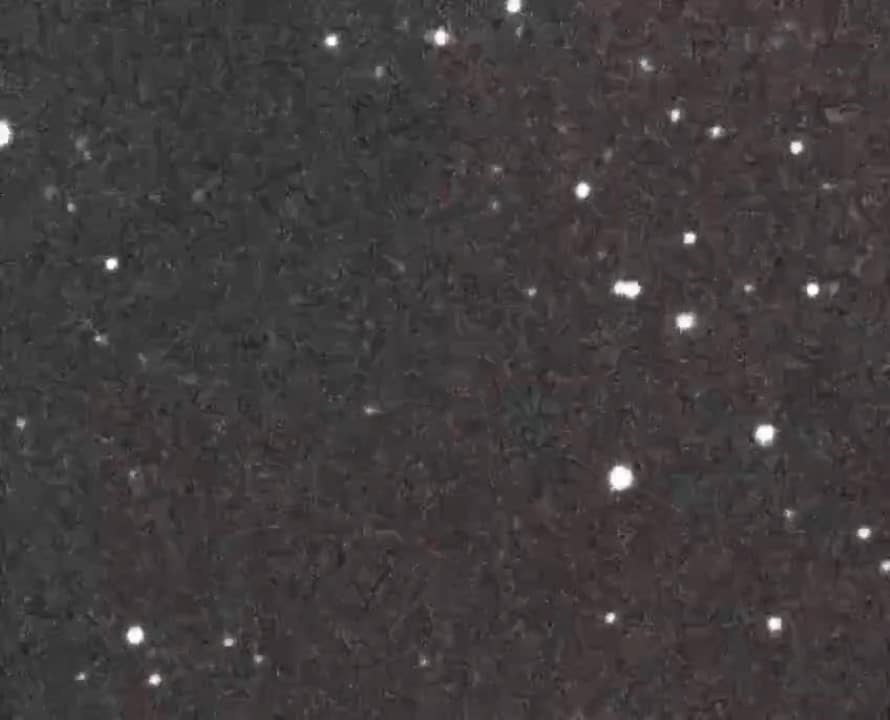
An observation campaign involving more than 20 space missions confirmed the natural origin of the interstellar comet 3I/ATLAS, the third object of its kind to be detected crossing our solar system. The analyses, coordinated by the North American space agency, ruled out speculation about a possible technological origin that circulated on social networks and provided an unprecedented glimpse into the composition of a celestial body coming from another star system.
The object was discovered on July 1, 2025 by the astronomical survey system ATLAS (Asteroid Terrestrial-impact Last Alert System), located at Chile. Desde then, a task force of scientists and engineers mobilized a fleet of ground- and space-based telescopes to collect as much data as possible during its passage. The comet’s trajectory keeps it at a safe distance, with its closest approach to Terra being around 270 million kilometers, eliminating any risk of collision.
The 3I/ATLAS flyby represents a rare scientific opportunity to study materials from outside our solar system. Initial data already reveals characteristics that differentiate it from native comets, offering valuable clues about the conditions that exist in its stellar system of origin, which is believed to be older than ours. Full analysis of the information collected is expected to continue for months as the comet continues its journey back into deep space.
Proven natural origin
During a press conference, space agency officials emphasized that all evidence points to a completely natural object. Amit Kshatriya, NASA associate administrator, stated that 3I/ATLAS exhibits the typical appearance and behavior of a comet, with a diffuse coma and a tail of dust and gas formed by the sublimation of ices as it approaches Sol. Nenhum of the instruments used in the campaign detected any type of technological signature or artificial emission.
Nicky Fox, of Diretoria of The absence of unexplained maneuvers or trajectory changes solidifies the assessment that it is a natural phenomenon, a relic of another planetary system that was ejected into interstellar space millions or billions of years ago.
An unprecedented observation campaign
The mobilization to study 3I/ATLAS was one of the most complex and coordinated observational efforts in the history of space exploration. The main challenge arose shortly after the discovery: the comet was positioned on the opposite side of Sol in relation to Terra, making direct observation from ground-based observatories extremely difficult. Para To circumvent this obstacle, the space agency took advantage of the privileged location of several probes spread across the solar system. Mais of 20 missions, including orbiters on Marte, probes en route to asteroids and solar observatories, have been redirected to point their instruments at the visitor. Essa distributed approach allowed scientists to collect data from multiple angles simultaneously, a process compared to watching a sporting event from different points in a stadium to get a complete view of the action. The combination of these perspectives was fundamental to building an accurate three-dimensional model of the comet’s coma and tail, in addition to mapping the distribution of its materials.
Chemical composition points to distinct star system
The most revealing analyzes came from Telescópio Espacial James Webb, which used its powerful infrared instruments to break down the light reflected by the comet. The spectrometers on Webb recorded a ratio of carbon dioxide to water significantly higher than that found in comets in our solar system. Essa’s chemical signature suggests that 3I/ATLAS formed in a very cold region of its original star system, possibly further from its parent star than the comets of Nuvem and Oort are from our Sol.
Another intriguing discovery was the presence of gas with a high proportion of nickel in relation to iron, an unusual characteristic for objects in our system. The dust ejected by the comet also showed particularities, with grains of a different size than the local standard and a peculiar behavior: initially, the particles were directed towards Sol before being pushed by solar radiation, an effect that lasted longer than usual.
These chemical and physical details indicate that the comet originated in an environment with formation conditions different from those that prevailed at the beginning of our solar system. Acredita It is believed that intense radiation from its home star or nearby stars played a crucial role in shaping its composition, making it a valuable sample of a different planetary environment.
Contributions from multiple space missions
The Mars Reconnaissance Orbiter probe (MRO), orbiting Marte, was one of the first to obtain an image, capturing the comet as a fuzzy white sphere from a distance of 145 million kilometers. The MAVEN mission, also at Marte, used its ultraviolet spectrograph to detect the vast cloud of hydrogen surrounding the comet, a product of the breakdown of water molecules by sunlight, 20 million miles away.
En route to its main target, the Psyche probe managed to register the object as a faint smudge 53 million kilometers away in September. Sua’s unique position in space provided a crucial vantage point for the three-dimensional models being developed by scientists at Terra.
The Lucy mission, which explores the Trojan asteroids of Júpiter, observed the comet’s coma and tail from a perspective almost opposite to that of Terra, an essential data for understanding the object’s complete structure. Até Even the SOHO solar observatory, positioned between Terra and Sol, managed to identify the comet in October, despite its relatively low luminosity.
Telescópio Espacial Hubble provided crucial visible-light images that made it possible to estimate the size of the comet’s nucleus at between 427 meters and 5.6 kilometers. Essas images also revealed that the coma, the atmosphere of gas and dust surrounding the nucleus, had an unusual pear shape in some observations, possibly due to the irregular shape of the nucleus or jets of material being expelled from its surface.
Window to the formation of other worlds
The high speed with which 3I/ATLAS entered the solar system is strong evidence of its long journey through interstellar space. Analysis of its trajectory and composition suggests that it was ejected from a star system older than ours. Isso turns the comet into a time capsule, carrying primordial material that could reveal how planets form elsewhere in the galaxy. Estudar this material is a unique opportunity to test and refine planetary formation models, directly comparing the “recipe” of another system with ours.
The chemical diversity found in 3I/ATLAS reinforces the idea that the building blocks of life and planets can vary significantly from one star system to another. Continued analysis of data collected by this global observation campaign promises to provide even more insights into the history and evolution of planetary systems beyond our own, helping to answer fundamental questions about our own origin and the solar system’s place in the cosmos.
Structure and size of the cometary nucleus
Thanks to the detailed observations of Telescópio Espacial Hubble, it was possible to establish a size range for the 3I/ATLAS core. Estimates indicate a diameter that varies between 427 meters and 5.6 kilometers. Essa uncertainty is due to the difficulty of distinguishing the solid core from the glowing cloud of gas and dust that surrounds it. The shape of the coma, described as similar to a pear, suggests that the core may be irregular and that the release of material does not occur uniformly across its surface, but rather through active jets in specific regions.



