
Unprecedented discovery: Hubble identifies relic of failed galaxy called Cloud-9

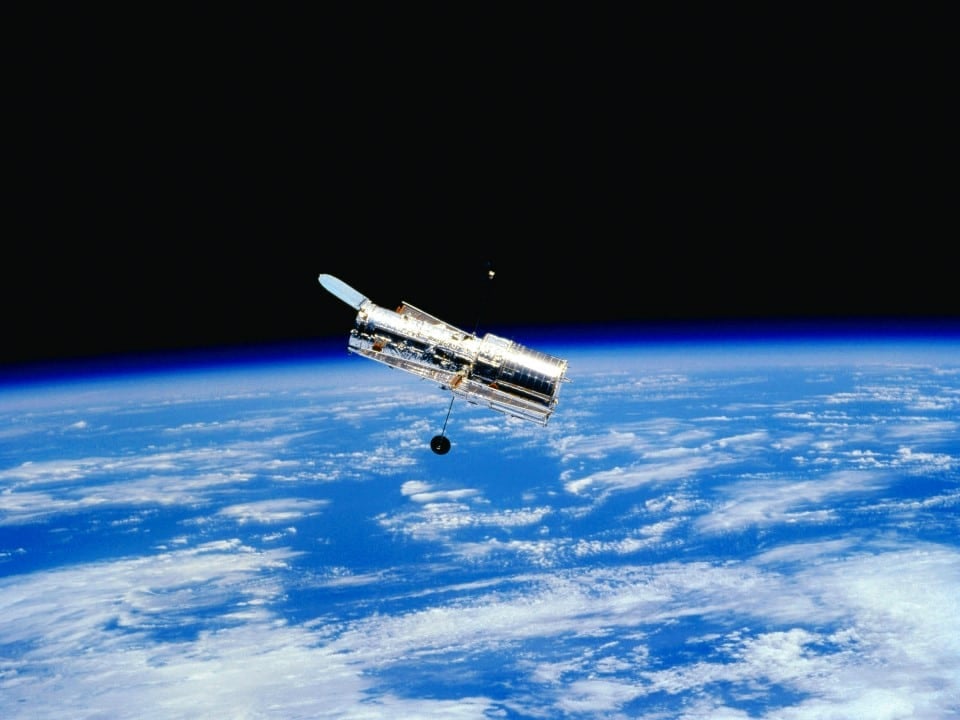
The Hubble space telescope has identified the first confirmed example of a starless gaseous cloud, dubbed Cloud-9. The Essa structure, rich in neutral hydrogen and dominated by dark matter, represents a relic of the early stages of galaxy formation.
The discovery, published in the magazine The Astrophysical Journal Letters, occurred after detailed observations that confirmed the total absence of stars in the cloud. Pesquisadores from institutions such as Space Telescope Science Institute and Universidade Milano-Bicocca led the study, which combines optical data from Hubble with previous radio detections.
Cloud-9 is close to the spiral galaxy Messier 94, about 14 million light-years from Terra. Sua has a compact and spherical shape, with a diameter of approximately 4,900 light years, differentiating it from other known clouds.
- The cloud contains gas equivalent to about a million solar masses.
- Its total mass, dominated by dark matter, reaches about five billion solar masses.
- Radio observations indicate slight distortions in the gas, suggesting possible interaction with the neighboring galaxy.
Origin of discovery of Cloud-9
The cloud was initially detected three years ago, during a radio survey carried out by the Chinese FAST telescope. Observatórios like Green Bank Telescope and Very Large Array, in the Estados Unidos, confirmed the presence of neutral hydrogen.
Before the Hubble images, experts debated whether Cloud-9 could be a very faint dwarf galaxy, with stars undetectable by ground-based telescopes. Advanced Camera for Surveys do Hubble resolved the issue by showing that there is no stellar population in the region.
A team usage@NASAHubblehas made the first confirmed detection of a new type of astronomical object: a starless, gas-rich, dark-matter cloud, nicknamed Cloud-9. Here’s what this object is teaching us about dark matter and the early universe:https://t.co/csCRXnzgDM pic.twitter.com/ZnUnhy9EYL
— NASA (@NASA)January 5, 2026
Unique features of the cosmic relic
Cloud-9 is formally named Reionization-Limited H I Cloud, or RELHIC. Esse term describes clouds of primordial hydrogen that survived the era of reionization, a period when intense radiation from the early universe prevented the accumulation of enough gas to form stars in smaller halos of dark matter.
The stability of the cloud suggests that the gravity of the dark matter balances the pressure of the neutral gas. Sua’s spherical and compact shape reinforces this interpretation, as it does not show signs of rotation or disk that would indicate star formation.
Researchers highlight that objects like this are rare today, due to processes such as pressure drag in the intergalactic medium. The proximity to Messier 94 may have contributed to its preservation.
Importance for the study of dark matter
Dark matter makes up most of the mass in the universe, but it neither emits nor absorbs light, making it difficult to observe directly. Cloud-9 makes it possible to study a structure dominated by this matter through the hydrogen gas it retains.
Experts see the cloud as a rare opportunity to test theoretical models about small dark matter halos. Simulações computational data indicate that many similar halos failed to form galaxies in the early cosmic era.
The role of Hubble in confirmation
Hubble used its ability to detect individual stars at large distances to exclude any stellar population in Cloud-9. Imagens composites combine optical data with radio emissions, highlighting the cloud in magenta against the background of distant galaxies.
The absence of stars confirms that Cloud-9 is a galaxy that never fully formed. Pesquisas future telescopes with more advanced telescopes may reveal more similar specimens.
Implications for galaxy formation
The discovery reinforces theories about how dark matter halos captured primordial gas after Big Bang. Apenas the largest accumulated enough material to initiate star formation, while smaller structures like Cloud-9 remained inactive.
The object illustrates a primordial stage preserved in the local universe. Sua analysis helps understand why not all halos evolved into visible galaxies.
Further radio and optical surveys in the future should identify other RELHICs. Essas additional detections will allow more rigorous testing of models of dark matter and cosmic evolution.
Cloud-9 Cloud Technical Details
Cloud-9 shows serene gas movement, without signs of compression that would lead to star formation. Dados high-resolution radio shows the emission peak marked in circles, where Hubble has focused its search for luminous objects.
Simulations excluded significant stellar masses, limiting any remaining population to very low values. The cloud remains stable as a relic, offering direct insight into the intrinsic properties of haloes dominated by dark matter.



