
Hubble identifies Cloud-9 as first starless cloud dominated by dark matter in the nearby universe


Hubble confirms existence ofCloud-9, compact cloud rich in neutral hydrogen gas, but completely devoid of stars, dominated bydark matter. The Esse object, located about 16 million light-years from Terra, in the vicinity of the spiral galaxy Messier 94, represents the first confirmed detection of a theoretical structure predicted for decades. The discovery, published in the journal The Astrophysical Journal Letters, provides direct evidence about the early stages of galaxy formation.
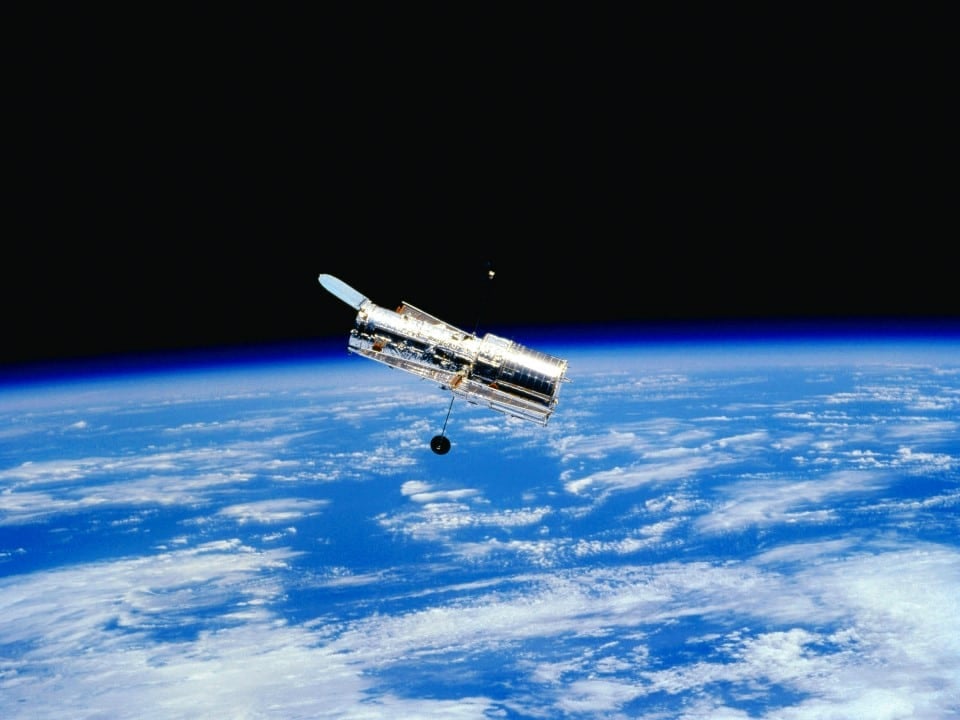
International astronomers used Telescópio Espacial Hubble to observe the region. The images revealed a complete absence of stellar population, even in deep searches capable of detecting faint objects.
- The diameter of the neutral hydrogen core reaches approximately 4,900 light years.
- The mass of gas is equivalent to about a million solar masses.
- The estimated dark matter halo reaches five billion solar masses.
This configuration maintains a delicate balance, preventing both collapse to star formation and gas dispersion.
Characteristics of the Cloud-9
A Cloud-9It differs from other hydrogen clouds close to Via Láctea by its compact and almost spherical shape. Observações in radio indicate stable concentration of gas, confined by the gravity of dark matter. Essa stability explains why the structure has survived since the beginning of the universe without initiating star formation processes.
Researchers highlight that the cloud belongs to the class of Nuvens from HI Limitadas to Reionização (RELHIC). Essas structures represent dark matter halos that have accumulated gas, but not enough gas to overcome the thermal and gravitational barriers necessary for star birth. The confirmation eliminates previous doubts about the possible presence of faint dwarf galaxies.
Detection process
The initial identification of theCloud-9occurred three years ago, during a radio survey with the FAST telescope, on China. Subsequent Observações with Green Bank Telescope and Very Large Array, in the Estados Unidos, confirmed the presence of neutral hydrogen. Apenas the deep images of Hubble, obtained with the Advanced Camera for Surveys, made it possible to confirm with certainty the absence of stars.
High-resolution data reveals subtle distortions in the gas. Essas distortions suggest possible physical interaction with neighboring galaxy Messier 94. The nameCloud-9It derives from being the ninth gas cloud cataloged in this specific region.
Implications for dark matter
A Cloud-9offers rare insight into invisible components of the universe. Dark matter, which neither emits nor absorbs light, dominates the structure’s mass, allowing direct studies of its gravitational properties without interference from stellar radiation.
Experts point out that the object validates cosmological models about primordial dark halos. Esses halos captured gas in the first billion years of the universe, but failed to trigger star formation due to density or temperature limitations.
Observations with Hubble
Telescópio Espacial Hubble performed multiple deep observation orbits in the region ofCloud-9. The composite images combine optical data with radio contours, highlighting the cloud in diffuse magenta with no internal bright spots.
The sensitivity of the instrument ruled out the presence of old or weak stars. Essa capability differentiates the Hubble from ground-based telescopes, which face atmospheric limitations. The results reinforce the observatory’s continued role in fundamental discoveries, even after more than three decades of operation.
Detailed physical properties
A Cloud-9maintains precise thermal and gravitational balance. The mass of dark matter estimated at five billion solar masses prevents dispersion of the gas, while the limited amount of neutral hydrogen prevents total collapse.
- Nearly spherical and compact shape distinguishes the cloud from common irregular structures.
- Concentration of cold, non-ionized gas aligns with predictions for relics of the early universe.
- Absence of ionization suggests isolation from external sources of radiation.
These characteristics position theCloud-9as a natural laboratory to test theories about the limits of galaxy formation.
Future research perspectives
The rarity ofCloud-9suggests the existence of similar structures hidden in traditional surveys focused on luminous objects. Futuros surveys with advanced instruments may reveal more RELHICs in the local universe.
Astronomers plan additional observations to map distortions in the gas. Essas distortions indicate interactions with neighboring galaxies. The discovery opens ways to better understand the role of dark matter in cosmic evolution.




