
Hubble Telescope confirms companion star Siwarha in Betelgeuse’s orbit

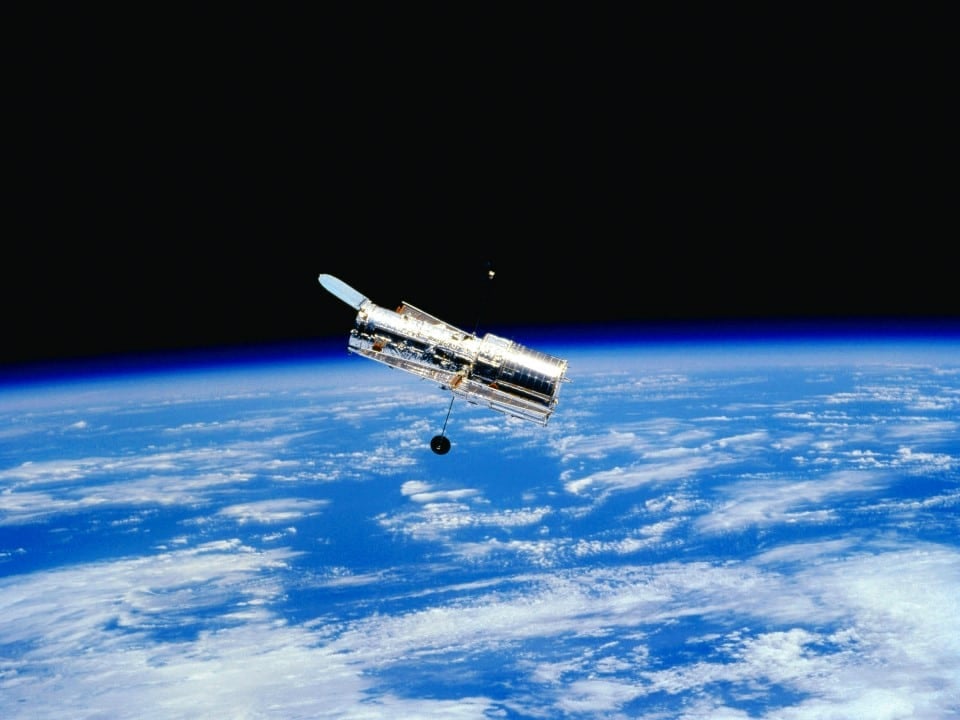
The Hubble space telescope has allowed astronomers to confirm a discovery that alters understanding of the red supergiant Betelgeuse. Localizada in the constellation of Órion, the star is not alone in space, harboring a smaller companion called Siwarha. Este celestial body orbits so close to the giant that it physically passes through the outer layers of its rarefied atmosphere.
The interaction between the two stars explains behavior that has intrigued the scientific community for more than a century. The brightness of Betelgeuse shows intense and rhythmic variations that were previously attributed only to internal processes or stardust clouds. With the new data, it was proven that the passage of Siwarha is the predominant factor for these periodic light oscillations.
The gas trail detected by the telescope
Centro of Astrofísica of Harvard-Smithsonian researchers monitored the star continuously for eight years to reach this definitive conclusion. Durante observations, Hubble detected a trail of densely turbulent gas that appears whenever the companion crosses the front of the supergiant. Esse phenomenon works as indisputable physical proof of the presence of the secondary object, even if it is difficult to visualize directly.
The effect caused by Siwarha on the atmosphere of Betelgeuse can be compared to the movement of a boat on a calm lake. The ripples generated on the surface reveal the passage of the vessel, regardless of the clear visibility of the hull at certain times. On a cosmic scale, these waves manifest as consistent changes in the light spectrum captured by terrestrial and space-based technological instruments.
- Luminous changes appear clearly in the spectrum associated with ionized iron.
- The speed and direction of gases in the outer atmosphere undergo cyclical disturbances.
- The trail of gas left by the smaller star expands laterally at the speed of sound.
- The companion’s gravity concentrates the stellar wind into a cone of compressed gas.

Orbital cycles and the periodicity of glow
Confirmation of the data indicates that the orbital cycle of Siwarha around Betelgeuse lasts approximately 2,100 days. Esse interval coincides exactly with the so-called long secondary period of brightness variation that astronomers have observed for generations. The regularity of the encounter between the two stars makes it possible to accurately predict when the next atmospheric changes will occur in the binary system.
Currently, the small companion star is hidden behind the red supergiant’s colossal disk, preventing direct view of Terra. However, mathematical models and calculated trajectories indicate that it should reappear for more detailed observations in August 2027. Cientistas is awaiting this time window to refine mass and temperature measurements of Betelgeuse’s neighbor.
The importance of the discovery for stellar evolution
Betelgeuse is considered a natural laboratory due to its enormous size, being able to house around 400 million Sóis in its volume. Being just 650 light-years away, it offers a unique opportunity to study in detail the death of massive stars. The presence of a companion drastically changes how the star loses mass before its final explosion.
Understanding this binary system helps predict the type of supernova that Betelgeuse will become in the distant future. The transfer of matter and the agitation of the outer atmosphere directly influence the collapse of the stellar core. Estudar Siwarha is therefore a way to understand the final moments of stars that shape the chemical composition of galaxies.
Identification of the companion star Siwarha
The name chosen for the companion, Siwarha, has a deep symbolic meaning within astronomical and cultural tradition. In Arabic, the term means “The Bracelete”, complementing the etymology of Betelgeuse, which is often associated with the “hand” of the giant Órion. Essa choice reflects the proximity and gravitational union between the two objects that are now officially recognized as a pair.
Despite being small compared to the supergiant, Siwarha has enough mass to cause real physical impacts on its environment. Ela not only orbits the giant, but acts as a modifying agent for the entire external structure of the main star. Essa complex dynamics invalidate older theories that focused exclusively on isolated magnetic activity to explain the unstable glow.
Continuous monitoring and space technology
The accuracy of the data obtained by Hubble was fundamental in separating the Siwarha signals from other common stellar noise. The atmosphere of Betelgeuse is extremely turbulent and vast, making it difficult to identify external patterns in short-term studies. Somente monitoring for almost a decade made it possible to isolate the gravitational effect of the companion star on the ionized iron.
This technological advancement demonstrates how veteran space tools remain essential to modern science and solving historical puzzles. The integration of new theoretical models with long-term empirical observations made it possible to end a decades-long debate. Astrônomos from around the world are now using this data to recalibrate what is known about other red supergiants in Via Láctea.
Next steps for astronomical research
The international scientific community is already planning new missions and the use of more powerful telescopes to observe the reappearance of Siwarha. The objective will be to capture images that allow us to clearly distinguish the companion’s light from the supergiant’s blinding brightness. Essa task will require advanced filtering and image processing techniques to block the dominant radiation from Betelgeuse.
In addition to Hubble, state-of-the-art ground-based observatories are expected to participate in the collective monitoring effort in the coming years. Collecting multispectral data will be vital to understanding whether there are other, as yet undetected, smaller companions in the system. The journey to understand Betelgeuse has entered a new phase, where the multitude of celestial bodies is the main focus.
Nature of the atmosphere of Betelgeuse
The outer atmosphere of a red supergiant is drastically different from the atmosphere of smaller stars like our Sol. Ela is extremely extended and has a very low density, resembling a vacuum with scattered clouds of gas and dust. It is precisely this characteristic that allows a smaller star to pass through the layers without being immediately destroyed by heat or pressure.
- The collision between stars occurs less violently than in compact star systems.
- The turbulence generated helps distribute heavy elements into deep space.
- The energy released during the crossing contributes to the heating of the external gas layers.
- Stellar winds are accelerated by the orbital passage of the companion Siwarha.
Resolution of historical hypotheses of science
For a long time, it was discussed whether variations in Betelgeuse were caused by giant convection cells, which are like bubbles of heat rising to the surface. Embora these processes occur, the discovery proves that they do not act alone in regulating the long-term light cycle. The star Siwarha imposes a mechanical and gravitational rhythm that overrides the giant’s internal thermal processes.
Another theory suggested that large clouds of dust expelled by the star itself intermittently blocked the light. Although dust played an important role, especially in the “great dimming” event seen years ago, it did not explain the periodicity of 2,100 days. The missing piece of the puzzle was precisely the secondary celestial body that has now been properly catalogued.
Betelgeuse remains one of the most watched objects in the firmament due to its inevitable fate of exploding. Quando happens, the star will be visible during the day at Terra for several weeks, providing a unique spectacle. Saber that a companion like Siwarha exists helps scientists refine the cosmic clocks that try to predict when this cataclysmic event will finally occur.



