
NASA’s OSIRIS-APEX probe captures images of Earth on its journey to find the asteroid Apophis

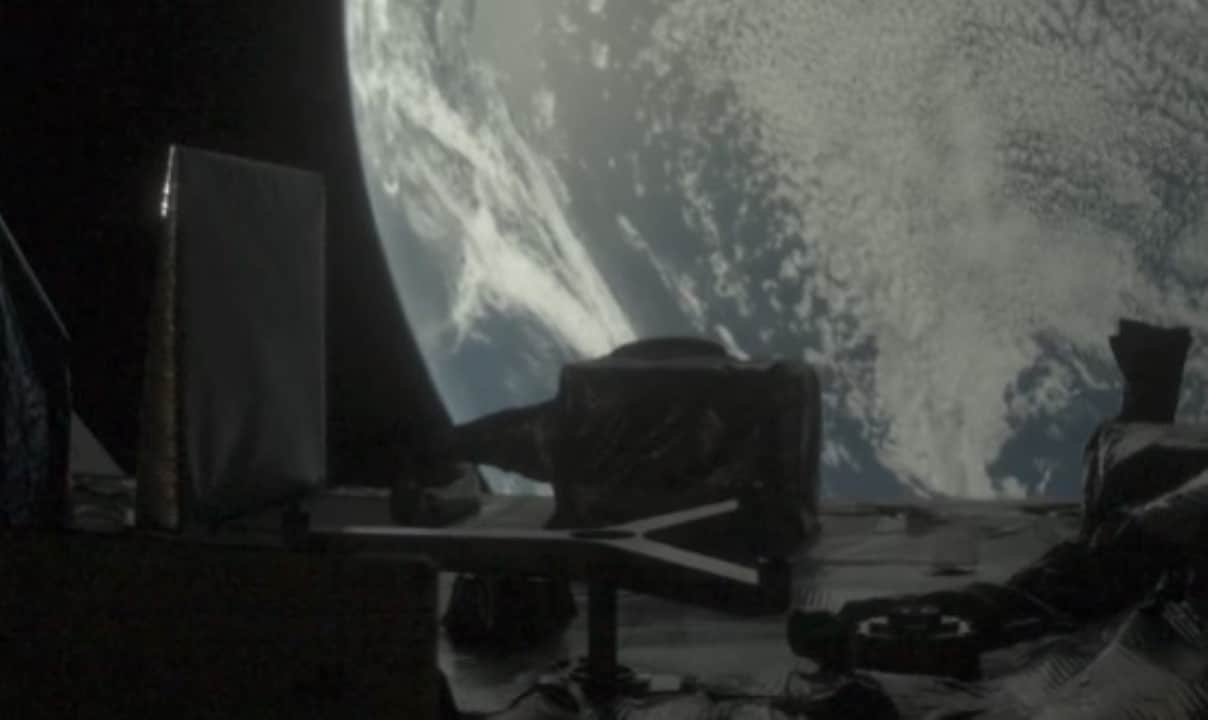
The North American space agency, NASA, confirmed the success of the gravitational assistance maneuver carried out by the OSIRIS-APEX probe, which flew over Terra on January 22, 2025 as part of its new extended mission. Durante approach, which occurred at an altitude of approximately 6,400 kilometers, the spacecraft took advantage of our planet’s gravitational field to adjust its trajectory towards its next target, asteroid 99942 Apophis. Para to validate the health of its instruments after years in space, mission operators activated the onboard cameras, which recorded a series of stunning images of Terra and Lua. Esses records not only serve as a visual marker of the journey, but also confirm that the navigation and imaging systems are fully functioning for the scientific challenges to come.
The passage through Terra was carried out at a speed of over 40 thousand kilometers per hour, a complex and fundamental procedure to save fuel and ensure that the probe reaches its destination on the scheduled date. The photos released show the planet partially illuminated, highlighting continents and oceans from a unique perspective, with Lua appearing prominently in the same field of view.
This maneuver is the first in a series of three ground flybys planned to place OSIRIS-APEX on the exact course to intercept Apophis. The mission represents a direct continuation of the legacy of OSIRIS-REx, which successfully completed its primary task by returning samples from the asteroid Bennu in 2023, offering unprecedented data on the formation of the solar system.
Hope you didn’t blink!
On Sept. 23,@NASA‘s OSIRIS-APEX spacecraft made a quick flyby, passing 2,136 miles above Earth. Along the way, OSIRIS-APEX turned to look home.https://t.co/wexOWQZ8h0 pic.twitter.com/vs3s1LrIxt
— NASA Solar System (@NASASolarSystem)November 25, 2025
The strategic importance of asteroid Apophis
Asteroid 99942 Apophis is an object of deep interest to the scientific community and planetary defense agencies around the world. Descoberto in 2004, it quickly gained notoriety due to an initial, albeit small, probability of collision with Terra. Subsequent Observações have ruled out this possibility for the near future, but its extremely close passage to our planet on April 13, 2029 remains a rare astronomical event and an unprecedented scientific opportunity. Nessa date, the rocky body measuring approximately 370 meters in diameter will pass just 32 thousand kilometers from the surface, an altitude lower than that of geostationary satellites. OSIRIS-APEX is scheduled to arrive at the asteroid just days after this closest approach, allowing scientists to observe firsthand any physical changes that Terra’s gravity may have caused, such as changes in its rotation, shape or the occurrence of landslides on its surface. Detailed study of these interactions will provide crucial data for refining trajectory prediction models and understanding how tidal forces affect celestial bodies.
Objectives of the new phase of the mission
With the original mission complete, the spacecraft was renamed OSIRIS-APEX (OSIRIS-Apophis Explorer) and refocused on an entirely new set of scientific objectives. The main goal is to carry out a prolonged and detailed study of Apophis, an S-type asteroid, composed mainly of silicates and metals, a different class from the Bennu asteroid, which is type C and rich in carbon.
This direct comparison between two distinct types of asteroids will allow researchers to deepen their knowledge of the diversity of materials that make up these objects. The probe will spend 18 months in orbit around Apophis, carrying out a complete mapping of its surface.
Instruments on board will analyze the asteroid’s mineral and chemical composition, as well as measure its temperature and thermal properties. One of the focuses will be to investigate the internal structure of Apophis, determining its porosity and the cohesion of its material.
This information is vital for developing impact mitigation strategies, as the effectiveness of a diversion technique, such as that tested by the DART mission, directly depends on the physical properties of the target.
Schedule and space maneuvers
OSIRIS-APEX’s journey to Apophis is an orbital marathon that requires precision and meticulous planning on the part of NASA engineers. After the successful January 2025 flyby, the spacecraft entered a new orbit around Sol, which will bring it back to the vicinity of Terra for additional gravitational assists.
The next trajectory adjustment maneuver using Earth’s gravity is scheduled to take place in September 2026, followed by a third and final one in 2028. Cada one of these encounters will serve to refine the probe’s route, aligning it perfectly for the interception of to collect as much data as possible before, during and after the asteroid’s approach to Terra.
Scientific instruments on board the probe
OSIRIS-APEX retains almost the entire suite of scientific instruments that made it so successful on its previous mission to asteroid Bennu. The ability to reuse a spacecraft already in operation represents a significant saving of resources and time, allowing a rapid response to a new scientific opportunity.
Among the active equipment are the MapCam camera, responsible for high-resolution images, the OVIRS spectrometer, which analyzes the chemical composition of the surface, and the OLA laser altimeter, which creates detailed three-dimensional topographic maps. The only notable change was the removal of the TAGSAM sample collection arm, which has already fulfilled its function.
Checks during land overflight
The encounter with Terra in January 2025 was more than just a course adjustment maneuver; it functioned as a complete calibration and stress test for the probe’s systems. Mission engineers took the opportunity to activate and test several components that were in hibernation.
Hundreds of images were captured in rapid sequence by navigation cameras (NavCam) and MapCam, confirming the accuracy of the pointing system and the thermal stability of the sensors.
These tests are crucial to ensure the spacecraft can execute the complex observation sequences planned for when it reaches Apophis, ensuring high-quality data collection.
Expected results of the investigation
Analysis of Apophis by OSIRIS-APEX will provide answers to fundamental questions about the nature of S-type asteroids, which are common in the inner region of the solar system. Scientists hope to determine whether the close passage to Terra could trigger seismic activity on the asteroid, altering its surface.
The data collected will help validate and improve planetary defense techniques, offering a real case study on how a potentially dangerous asteroid reacts to a strong gravitational interaction.
Next steps on the interplanetary journey
With the first gravitational assistance successfully completed, OSIRIS-APEX continues on its calculated trajectory. The mission team will continue to monitor the health of the spacecraft and prepare for the next flyby of Terra in 2026, another key step in its long journey to unlock the secrets of asteroid Apophis.



