
First-of-its-kind Hubble discovery reveals starless cloud with dark matter near galaxy M94


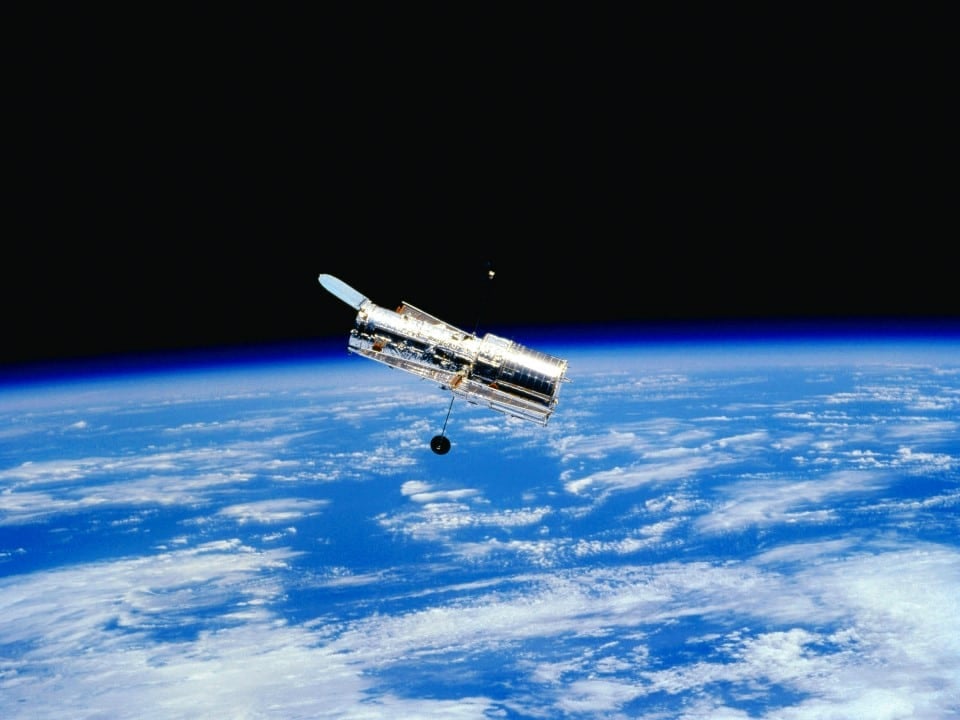
An international team of astronomers, using Telescópio Espacial Hubble, has confirmed the existence of a long-theorized cosmic structure: a cloud of primordial gas completely devoid of stars and dominated by the gravitational pull of dark matter. The object, named Cloud-9, is located approximately 16 million light-years from Terra, in the vicinity of the spiral galaxy Messier 94, and represents the first unambiguous detection of a “fossil” from the early universe, offering an unprecedented window into the early stages of galaxy formation.
The confirmation, detailed in a study published in the scientific journal The Astrophysical Journal Letters, ends a debate about the nature of these objects. Deep observations of Hubble left no room for doubt, revealing a total absence of any stellar population, even of the oldest and faintest stars. Isso differentiates Cloud-9 from ultrafaint dwarf galaxies, which, despite their low luminosity, still contain stars.
This discovery validates cosmological models that predicted the existence of dark matter halos that managed to capture hydrogen gas in the first billion years of the universe, but that, for some reason, failed to initiate the star formation process. Cloud-9 now serves as a natural laboratory to study the properties of dark matter without the luminous and radiative interference of stars, a constant challenge in astrophysics.
An invisible structure takes shape
Cloud-9 is a compact, almost spherical cloud, composed mainly of neutral hydrogen gas. Measurements indicate that the gas nucleus has a diameter of about 4,900 light-years and a mass equivalent to approximately one million times the mass of our Sol. However, what makes this structure truly extraordinary is its invisible component. Estima-se que o halo de matéria escura que a envolve e a mantém coesa possua uma massa de até cinco bilhões de massas solares, dominando completamente a dinâmica gravitacional do sistema.
This configuration creates a delicate and stable balance. The immense gravity of dark matter prevents the gas from dispersing throughout intergalactic space, while the density and temperature of the gas itself are not sufficient to overcome energy barriers and collapse to form stars. It is this stability that allowed Cloud-9 to survive practically unchanged since the beginning of the universe, becoming a cosmic relic of inestimable value for science.
The discovery confirmation process
The identification of Cloud-9 was a meticulous process that involved multiple observatories around the world over several years. The first suspicion of its existence arose three years ago, during a survey of the sky carried out by the gigantic radio telescope FAST (Five-hundred-meter Aperture Spherical radio Telescope), located at China. Initial data pointed to an anomalous concentration of neutral hydrogen in a region where there were no corresponding visible galaxies.
Intrigued, the researchers performed follow-up observations with other cutting-edge instruments, such as the Green Bank Telescope and the Very Large Array, both on the Estados Unidos. Esses radio telescopes confirmed the presence and structure of the gas cloud, but the crucial question remained: were there very faint stars hidden there? The definitive answer could only be obtained by Telescópio Espacial Hubble.
Using its powerful Advanced Camera for The result was conclusive and surprising: the darkness was total. The telescope’s sensitivity, operating above the atmospheric distortion of Terra, allowed it to rule out the presence of any stellar population, solidifying Cloud-9’s status as the first confirmed dark cloud in the nearby universe.
Implications for the study of dark matter
The discovery of Cloud-9 is a milestone for cosmology, as it offers a rare and direct insight into one of the universe’s greatest mysteries: dark matter. Esta enigmatic substance, which does not emit, absorb or reflect light, constitutes about 85% of all matter in the cosmos, and its presence can only be inferred by its gravitational effects on visible matter. By finding an object whose mass is overwhelmingly dominated by dark matter and which lacks the luminous “contamination” of stars, scientists gain a pristine study environment. It is possible to analyze how dark matter clumps together and shapes cosmic structures without the complexities introduced by stellar physics, such as solar winds, supernova explosions and intense radiation. The cloud acts as a small-scale gravitational lens, allowing us to more accurately test the predictions of Modelo Padrão from Cosmologia, known as Lambda-CDM, which describes the evolution of the universe since Big Bang.
What are RELHIC clouds?
The researchers classify Cloud-9 as a RELHIC, an acronym for “HI Clouds Limitadas by Reionização”. Essa classe de objetos teóricos representa halos de matéria escura primordiais que, embora tenham conseguido acumular gás hidrogênio neutro (HI), não atingiram a massa ou a densidade crítica necessária para dar início à formação estelar em larga escala. Acredita These “failed galaxies” are said to have been suppressed during a cosmic era known as reionization.
During this period, about a billion years after Cloud-9 would therefore be a survivor of that era, an example of a galactic building block that never fully developed, remaining in a primitive and untouched state for billions of years.
Gravitational balance and the future of the cloud
The stability of Cloud-9 lies in a complex game of forces. The gravity of its massive dark matter halo is the glue that keeps the cloud from dissipating.
At the same time, the amount of hydrogen gas is insufficient for its own gravity to overcome the internal pressure and heat, initiating the collapse that leads to the birth of stars.
Despite its apparent calm, high-resolution data reveals subtle distortions in the gas distribution, particularly at its outer edges.
These perturbations suggest that Cloud-9 is not completely isolated and may be in the process of physical interaction with its giant neighbor, the galaxy Messier 94.
Next steps in the search for failed galaxies
The confirmation of Cloud-9 raises the possibility that there are many other similar structures hidden in the universe. Como do not emit their own light, they are invisible to traditional optical surveys, which look for shiny objects.
Future projects with even more sensitive next-generation radio telescopes will be essential for mapping the sky in search of other isolated hydrogen clouds, potentially revealing an entire population of “dark galaxies” that have so far gone unnoticed.
The importance of international collaboration
This discovery highlights the power of global scientific collaboration. The project brought together researchers and resources from multiple countries, combining data from telescopes on China, Estados Unidos and in space. Essa synergy was key to tracking the object from its initial detection in radio waves to its final confirmation with Hubble’s ultra-high-resolution images, demonstrating how modern astronomy transcends borders to unlock the deepest secrets of the cosmos.




