
Image analysis shows large particles in the anti-tail glow of interstellar 3I/ATLAS

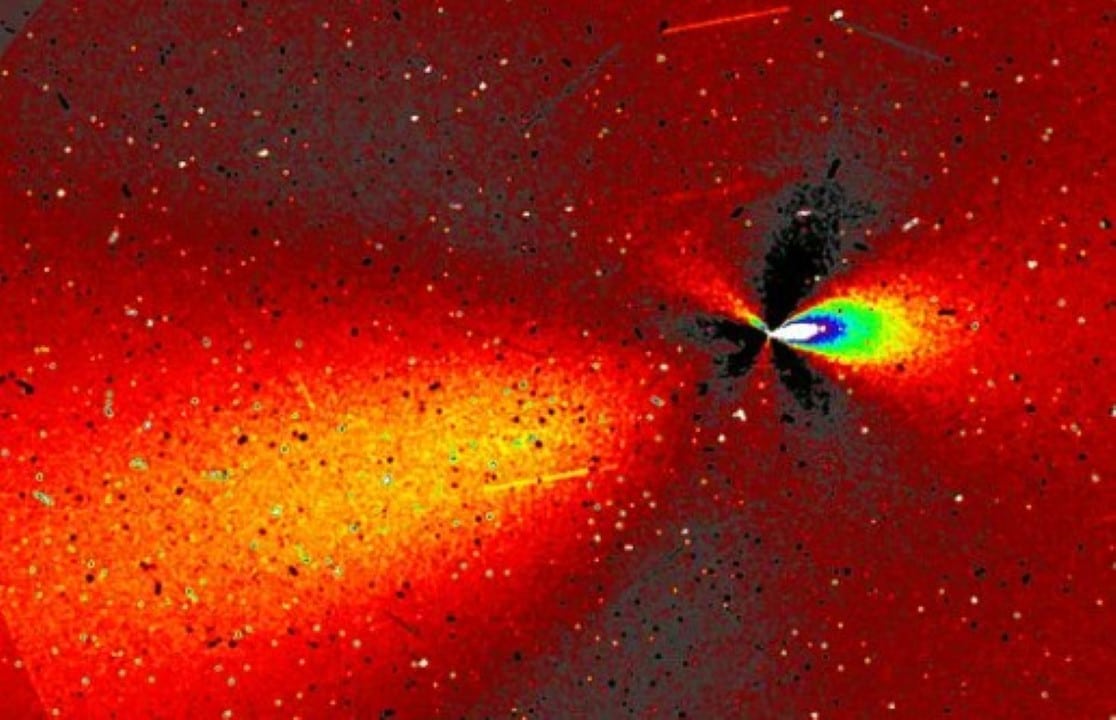
The interstellar comet 3I/ATLAS, the third confirmed object coming from outside Sistema Solar, continues to be the target of detailed observations by astronomers. Imagens captured in December 2025 reveals a narrow, collimated anti-tail jet extending at least 400,000 kilometers toward Sol. Essa structure presents characteristics that differ from typical comets of Sistema Solar.
The analysis indicates that the glow observed in the jet results mainly from the scattering of sunlight by particles larger than ordinary dust. Esses grains need to be significantly larger to sustain the long jet extension against solar radiative slowdown.
The object was observed at a heliocentric distance of approximately 2 astronomical units during the period of the most recent images. Astrônomos processed the data with specific filters to highlight the sunward jet.
Recent observations of the collimated jet
Images processed by independent observers on December 13 and 15, 2025 show the anti-tail jet with high collimation. The structure maintains a constant width over a large length, which suggests directed release of material.
The jet points directly towards Sol, a rare phenomenon but already recorded in comets from Sistema Solar. In the case of 3I/ATLAS, the extension reaches values ten times greater than the width after correction of the projection angle.
Observations with telescopes such as the Hubble and other terrestrial instruments have confirmed the presence of this feature since July 2025. The activity remained visible even after the object’s perihelion.
👽🚨 Inicio of 2026 and the space to talk
— UNCLE OVNI CHILE (@OvniChile1)January 1, 2026
Between November 30th and 30th. y el 27 de dic. 2025, Hubble captured 17 images of the interstellar object 3I/ATLAS.
🔭 Tres symmetrical jets, one pointing towards the Sol (anti-tail).
Extreme natural phenomenon… or a real anomaly?#3IATLAS pic.twitter.com/dpx4tR8CfU
Calculations on radiative deceleration
The force of solar radiation acts as a brake on particles ejected from the nucleus. Para spherical grains with a radius greater than the wavelength of visible light, the deceleration depends inversely on the particle size.
At a distance of 2 AU, the deceleration for particles of typical solid density reaches values that limit the range of small grains. Apenas particles with a radius greater than microns can travel distances of hundreds of thousands of kilometers.
Initial velocities required for submicrometer grains would exceed physical limits of natural comets. Drag by sublimated gas would not be sufficient to accelerate fine dust to such speeds.
Limits on particle size
There is an upper restriction on the radius of the dominant particles in the jet. Very large Grãos have less surface area per unit mass and are less efficient at scattering light.
The mass loss rate estimated at around 500 kg/s near perihelion allows jet density to be calculated. Collimation implies a narrow opening angle, on the order of 8 degrees.
The gas drag time must be shorter than the flow dilution time. Essa condition restricts the maximum radius to values below 100 microns for cores of size compatible with observations.
Comparison with known comets
Sistema Solar comets generally exhibit tails dominated by submicron dust. Esses grains scatter sunlight with high efficiency due to the favorable area-to-mass ratio.
In 3I/ATLAS, the dominance of larger particles makes the object anomalous in relation to observed patterns. The extent of the sunward jet exceeds typical records even after geometric corrections.
- Submicrometer particles dominate brightness in comets like Hale-Bopp;
- Larger grains reduce scattering efficiency but resist radiation better;
- Extreme collimation suggests limited fraction release from the nuclear surface;
- Persistent activity after perihelion differs from many long-period comets.
Derived physical properties
The 3I/ATLAS core has a lower radius limit based on Hubble images. Small Valores would be incompatible with observed mass loss rates.
The estimated core rotation influences material release patterns. Períodos of about 15 hours have been suggested from variations in the jet.
Future spectroscopic measurements could determine exact flow velocity via displacement Doppler. Esses data would refine particle size estimates.
The reddish-red composition of the coma indicates the presence of organic dust. Cometary activity confirms sublimation of volatiles despite interstellar origin.
Interstellar trajectory and context
3I/ATLAS follows a hyperbolic orbit with an excess speed of about 58 km/s. The object entered Sistema Solar from an external direction and passed perihelion in October 2025.
The minimum approach to Terra occurred in December 2025 at 1.8 AU. Desde then, the comet quickly moves away towards interstellar space.
Compared to the previous 1I/’Oumuamua and 2I/Borisov, it presents greater speed and more pronounced cometary activity. The discovery occurred in July 2025 by the ATLAS system.
Material release details
Release occurs preferably on the side facing Sol. Essa asymmetry explains sunward direction of the observed jet.
Mass loss rates increased close to perihelion and maintained high values post-perihelion. The jet stream observed in recent months reflects continued activity.
The flux density decreases with the square of the distance from the nucleus. Narrow cone Modelos reproduce the collimation recorded in images.
Particles between 1 and 100 microns satisfy both resistance to deceleration and acceleration by gaseous drag. Faixa narrower than in typical comets.
Additional observations
Telescopes like Subaru captured images in December 2025 during early morning twilight. The data shows a diffuse coma with a reddish color.
NASA instruments, including transit missions, recorded the object in multiple tracks. Composições ultraviolet light reveals surrounding hydrogen envelope.
The observation campaign involved global coordination of professionals and amateurs. Processamento with gradient filters highlighted fine jet structures.
Characteristics of extreme collimation
The constant width of the jet suggests precise focusing mechanism. Liberação of small fraction of the nuclear surface can explain the pattern.
Temporal variations indicate possible precession or oscillation of the rotation axis. Períodos derivatives are compatible with independent estimates.
The projection-corrected extent reaches extreme values for known objects. The phenomenon challenges standard models of cometary dust dynamics.



