
Interstellar comet 3I/ATLAS approaches Jupiter in 2026: chance of new moons after passage

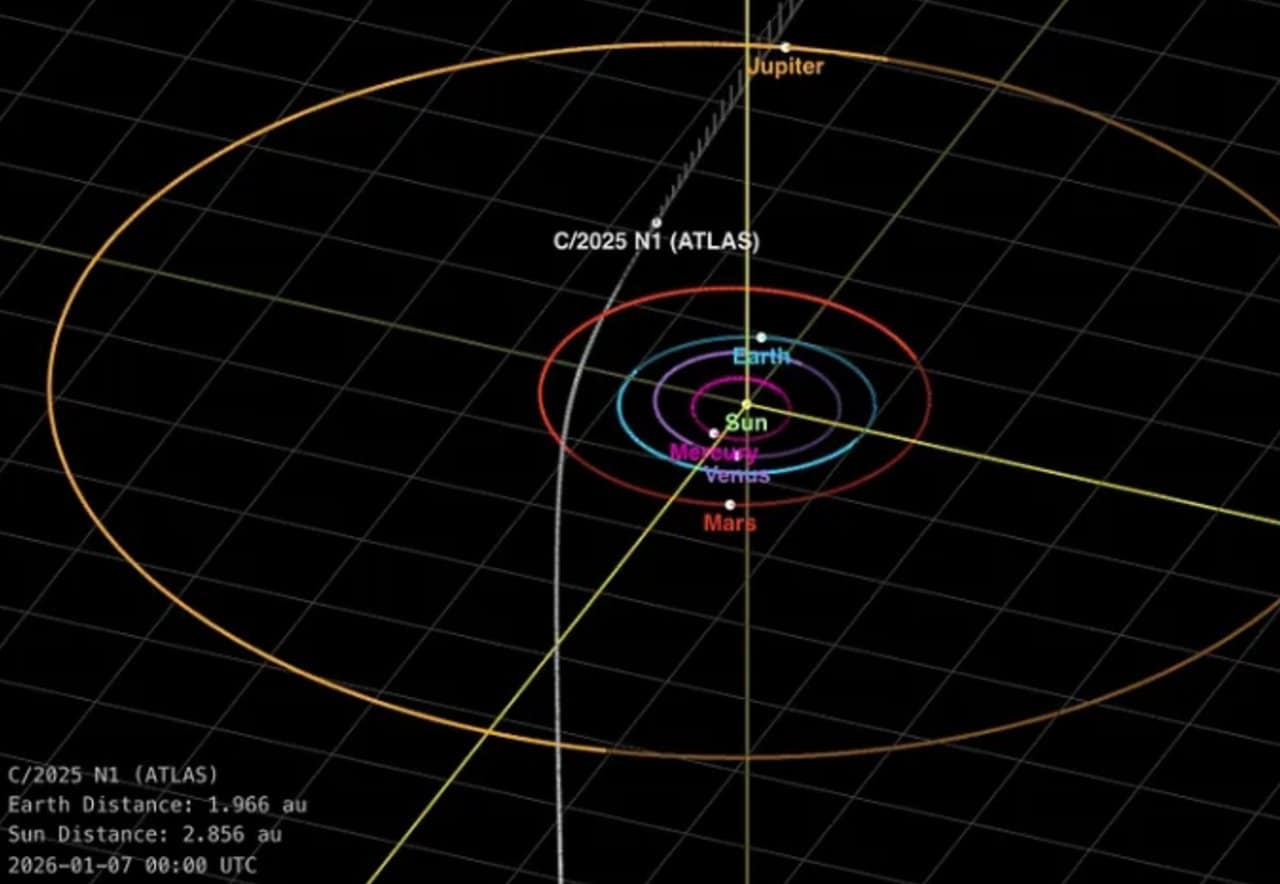
The interstellar object 3I/ATLAS is expected to make a significant approach to Júpiter and its irregular moon, Eupheme, in March 2026.
The trajectory of the comet, which crossed Nuvem from Oort around 8,000 years ago, generates great expectations about the possibility of intense gravitational interaction with the gas giant. Cientistas around the world are studying the implications of this passage, which could reveal unusual celestial phenomena.
The closest approach to Júpiter will occur on March 16, 2026, when 3I/ATLAS will be 53.61 million kilometers from the planet. Essa distance is remarkably close to Hill’s radius of Júpiter, which is 53.5 million kilometers, where its gravity predominates over the influence of Sol.
The proximity of the radius to Hill is a crucial point, as it marks the region where the gravitational influence of Júpiter becomes dominant over the tidal gravity exerted by

The journey of the interstellar comet
After approximately 8,000 years, 3I/ATLAS completes the second half of its journey through the solar system, moving away from Sol and heading towards Júpiter. Sua orbit, according to recent analyses, includes non-gravitational accelerations, indicating complex dynamic behavior in deep space.
This interstellar object represents a fascinating point of study for astronomers. Ele enables analysis of celestial bodies originating from other star systems in our own cosmic backyard, providing valuable data on the composition and evolution of planetary systems beyond our own.
Details about Eupheme
Eupheme is an irregular moon of Júpiter, discovered in 2003 from data collected by the Observatórios of Mauna Kea, in Havaí. Ela is a member of the Ananke group, which includes 15 Jovian satellites that share similar orbits, suggesting a common origin among them.
Based on its brightness and assumed albedo, Eupheme has an average diameter of approximately 2 kilometers. In Greek mythology, her name is associated with the spirit of praise and good omen, being identified as the granddaughter of Zeus, adding a cultural touch to her astronomical designation.
Origin of the moons of Ananke
The Ananke group of Júpiter, to which Eupheme belongs, is considered to be the result of the fragmentation of a progenitor body captured by the planet’s powerful gravity. Este body would have been torn apart by Jovian attraction or by collisions with other objects, giving rise to multiple smaller fragments.
Their orbits, characterized by being retrograde, highly elliptical and inclined in relation to the equatorial plane of Júpiter, corroborate the theory that they are captured objects. Elas did not form in the primordial disk of gas and dust that gave rise to the Júpiter system, offering insights into the dynamics of planetary capture.
Scenario of new lunar formations
The approach of 3I/ATLAS to the radius of Hill of Essa capture requires a precise thrust to offset the high relative speed between the two celestial bodies.
The detection of a 96th moon orbiting Júpiter after March 16, 2026 would be a strong indication of a specific interaction with 3I/ATLAS. Fragmentações natural objects of lower mass do not explain the speeds of 66 kilometers per second necessary for such capture, pointing to an extraordinary event if it occurs.
Complexity of gravitational capture
The escape velocity from the surface of Júpiter reaches 60 kilometers per second. Contudo, gravitational fragmentations of smaller bodies do not produce fragments that exceed the escape velocity of the original object.
At a distance of 53.61 million kilometers from Júpiter, at 3I/ATLAS’ closest approach, the escape velocity is just 2.2 kilometers per second. Este value represents a small fraction of the comet’s relative speed relative to Júpiter.
Thus, for a fragment to be captured and enter a bound orbit, both the direction and magnitude of the thrust would have to be planned with extreme precision. Este is a feat unlikely to occur completely naturally, highlighting the uniqueness of any capture.
Observation and research of the phenomenon
The 3I/ATLAS encounter with Júpiter will be the focus of intense scientific observation, with the mobilization of various resources. The Juno probe, which is already in orbit around the giant planet, will play a crucial role in real-time monitoring of the event, providing proximity data.
Additionally, large ground-based telescopes, including those located near Terra, will be aimed at Júpiter. The objective is to capture details of the passage and any interactions that may occur between the interstellar comet and the Jovian system.
The scientific community and astronomy enthusiasts eagerly await data that could improve understanding of interstellar objects. Expectations are high for March 16, 2026, the closest date.
This unique study opportunity aims to deepen knowledge about the evolution of planetary systems, the formation of moons and large-scale gravitational dynamics, while keeping global attention focused on the gas giant and its cosmic visitor.



