
Passage of comet 3I/ATLAS by Jupiter in 2026 could generate new moons for the gas giant

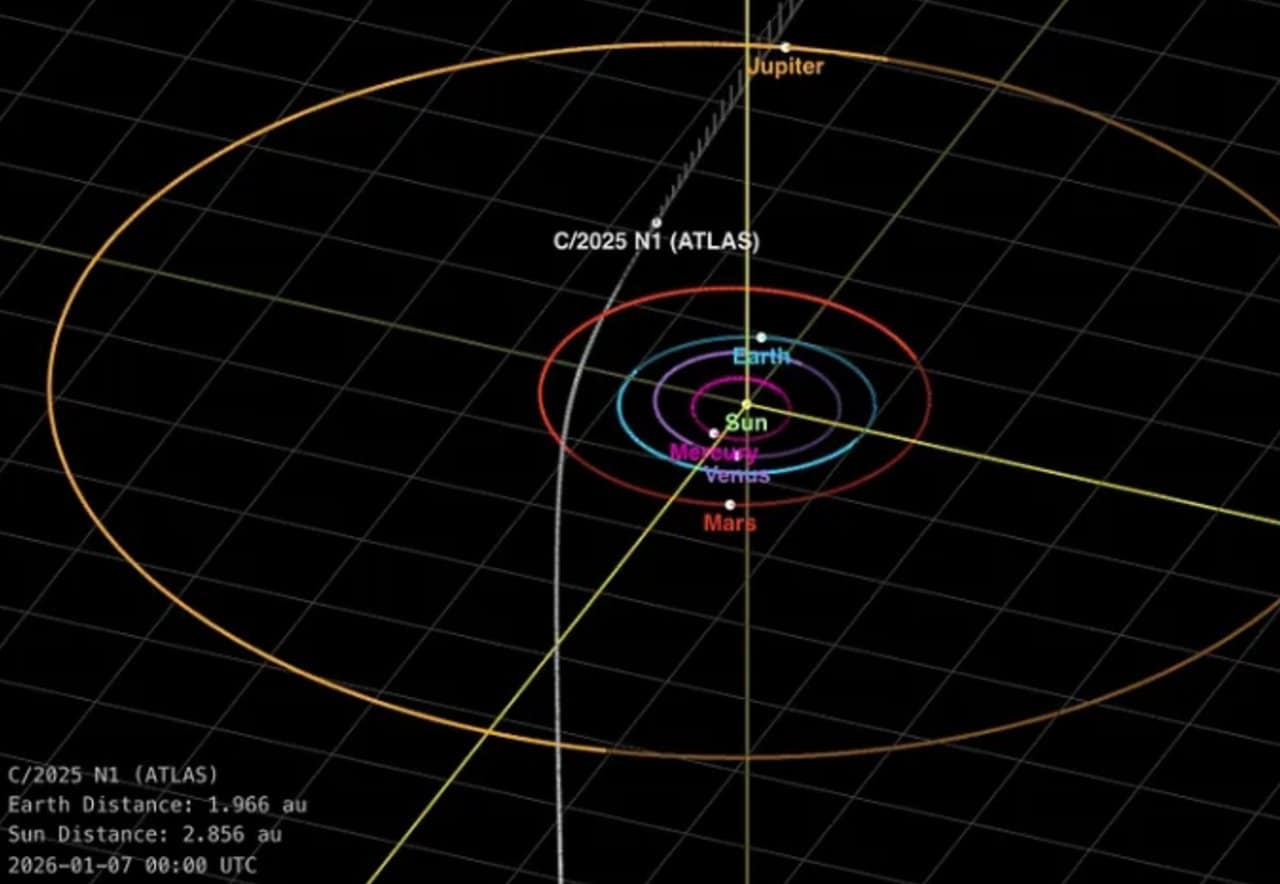
An astronomical event of great relevance is scheduled for March 2026, when the interstellar comet 3I/ATLAS will make its closest approach to the planet Júpiter. The scientific community is closely monitoring the trajectory of the object, which originated outside our solar system, due to the possibility of complex gravitational interactions with the gas giant.
The main expectation revolves around a rare scenario: the chance that fragments of the comet will be captured by the immense gravitational force of Júpiter, potentially transforming into new moons. Tal occurrence would provide unprecedented data on the dynamics of satellite capture and the composition of celestial bodies in other star systems.
The closest date is calculated for March 16, 2026, when 3I/ATLAS will pass at a distance that defies the limits of Jovian gravitational influence, making any outcome an important object of study for astronomers around the world.

The journey of a visitor from another solar system
Comet 3I/ATLAS is no ordinary object in our solar system. Sua designation “I” indicates its interstellar origin, confirming that it traveled through deep space from another star system before being attracted by Sol’s gravity. Analysis of its orbit reveals an extraordinary journey, including a passage through Nuvem of Oort, the vast, frigid frontier of our system, approximately 8,000 years ago. Atualmente, the comet is in the second half of its passage, moving away from Sol and heading towards the Jovian system. Astrônomos observed that its trajectory is not governed by gravity alone; the object exhibits non-gravitational accelerations, a phenomenon generally associated with the sublimation of ice on its surface when heated, which releases gases and dust, acting as small propellants. Este’s dynamic behavior offers valuable clues about its composition, which may be significantly different from that of our system’s native comets, providing a direct sample of material formed around another star.
The critical point of the approximation with Júpiter
The crucial moment of the encounter will occur when 3I/ATLAS reaches a distance of 53.61 million kilometers from Júpiter. The Este number is extremely significant because it comes very close to the radius of the planet’s Esfera, which is approximately 53.5 million kilometers. The Esfera of Hill defines the region of space around a celestial body where its own gravity is the dominant force, overcoming the gravitational pull of a larger body it orbits, in this case, the When crossing this invisible border, any object, or fragments thereof, is susceptible to having its trajectory radically altered or even being captured in a new orbit.
Within this sphere of influence, orbital dynamics become extremely complex. Passing 3I/ATLAS so close to this limit creates a natural laboratory for studying extreme gravitational interactions. If the comet fragments due to tidal stresses or other processes, the ejected debris would have a chance, however small, of being slowed down enough to enter a stable orbit around Júpiter. Este phenomenon is rare and depends on a precise combination of speed, trajectory and time, making observation of the event in 2026 a priority for planetary science.
Eupheme and the Ananke group of moons
The comet’s interaction with Júpiter also draws attention to one of the planet’s irregular moons, Eupheme. Descoberta in 2003 through observations carried out on the Observatórios of Mauna Kea, on the Havaí, Eupheme is a small satellite about 2 kilometers in diameter.
It is part of the Ananke group, a family of at least 15 Jovian satellites that share similar orbital characteristics. Essas moons have retrograde orbits, that is, they move in the opposite direction to the rotation of Júpiter, in addition to being highly elliptical and inclined.
The most accepted theory is that the Ananke group originated from the fragmentation of a single asteroid or progenitor body that was captured by the powerful gravity of Júpiter a long time ago. The existence of this group reinforces the idea that the gas giant is an efficient capturer of objects that pass through its vicinity.
The complex mechanics of capturing a new moon
The possibility of Júpiter acquiring a new moon from 3I/ATLAS is scientifically fascinating, but also a considerable physical challenge. The main obstacle is the very high relative speed between the comet and the planet, estimated at around 66 kilometers per second. Para before a fragment is captured, it needs to lose almost all of its speed.
The escape velocity at the comet’s closest approach is just 2.2 kilometers per second. Isso means that a simple gravitational fragmentation, where pieces gently separate from the main body, would not be sufficient to generate fragments with a speed low enough to be retained by Júpiter.
For capture to occur, a very specific impulse would be needed, both in magnitude and direction. Esse thrust would have to nullify the fragment’s orbital velocity relative to Sol, allowing Júpiter’s gravity to become dominant. Such an event is statistically unlikely to occur naturally.
For this reason, the detection of a 96th moon orbiting Júpiter shortly after March 16, 2026 would be extremely strong evidence that an extraordinary direct interaction with comet 3I/ATLAS occurred, opening a new chapter in the study of satellite system formation.
Instruments and observatories on alert
In order not to miss any details of this rare cosmic encounter, a broad observation campaign is being organized by the international astronomical community. The Juno probe, which has been orbiting Júpiter since 2016, will have a privileged position to monitor the event closely. Seus instruments will be able to detect possible changes in the magnetic and particle environment of Júpiter caused by the comet’s passage.
In parallel, the largest and most powerful ground-based telescopes will be pointed at the Jovian system. Observatórios located in strategic locations such as Chile and
What science hopes to learn from the event
This study opportunity is considered unique for several reasons. Primeiramente, will allow detailed analysis of the composition of an object that formed in a stellar environment different from ours, offering insight into the diversity of materials that make up planetary systems in the galaxy.
Furthermore, observing a potential moon capture in real time would be a first, allowing scientists to test and refine theoretical models about the formation of satellite systems. The data collected could help explain how Júpiter and other gas giants accumulated their vast collections of irregular moons over billions of years.
A milestone for planetary astronomy
The encounter between the interstellar comet 3I/ATLAS and Júpiter in March 2026 is destined to become a landmark in modern astronomy. Independentemente of new moons are formed, the passage will provide a wealth of valuable information that will deepen human knowledge about the dynamics of the solar system and the nature of visitors from other stars.



