
Russian patent revolutionizes aviation: supersonic jet coupled with vacuum for combined flights
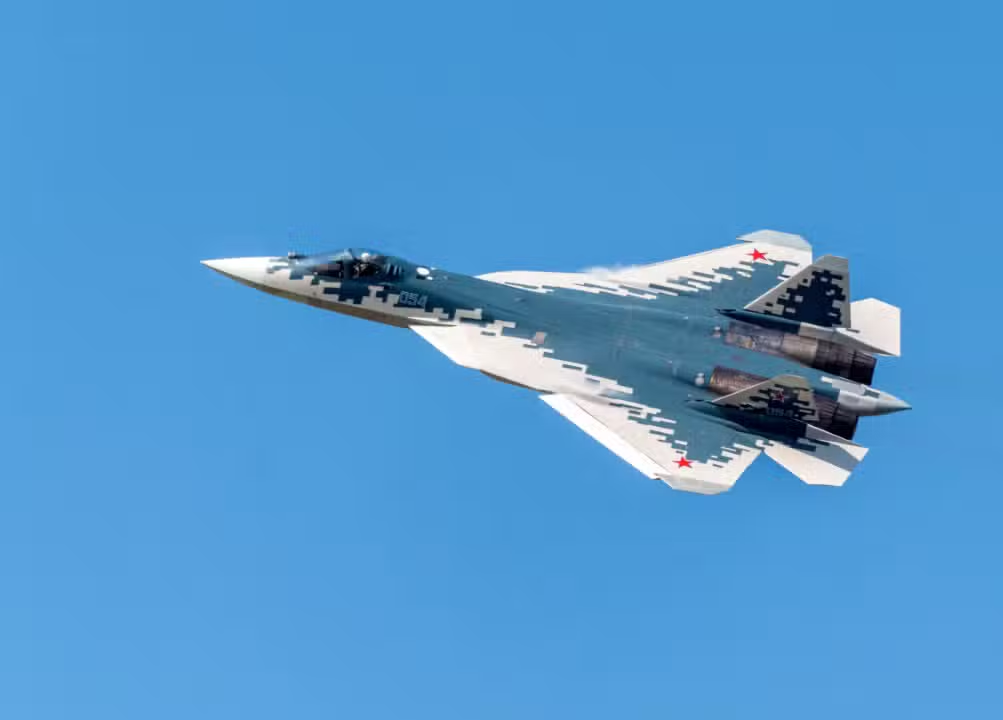
Rússia has filed a patent for an innovative device that promises to transform the way supersonic passenger jets operate. Este system aims to couple a supersonic aircraft to a transport plane, using an unprecedented approach based on the creation of a vacuum.
The project was designed to allow the combined flight of two aircraft at high speed, a scenario that seeks to optimize efficiency and expand the operational capabilities of air transport. Após the joint flight phase, the technology provides for the separation of the supersonic jet in mid-air, allowing each aircraft to follow its course.
This innovation represents a significant step in the field of aerospace engineering, moving away from traditional mechanical fastening methods to a solution that promises lower drag and greater stability, marking a notable advance in the search for more efficient and faster aircraft.
The engineering behind innovation
The patented device was designed as a launch platform, strategically installed on the upper surface of the transport aircraft. Essa configuration allows the supersonic passenger jet to be positioned overhead, ready for the docking and combined flight phase.
The platform integrates a crucial section with a corrugated and perforated surface, specifically designed to come into contact with the lower part of the supersonic jet’s fuselage. Along the closed contour of this contact area, a specialized seal is installed, ensuring the tightness necessary for the system to function effectively.
Vacuum clamping system operation
The holes present in the perforated surface of the platform are interconnected by a complex system of pipes. Estas, in turn, connect to a main vacuum system and a gas supply system, both housed on board the carrier aircraft, ensuring precise control of the process.
To keep the passenger plane firmly attached to the platform during flight, the principle of pressure difference is skillfully employed. A vacuum is created in the chamber between the two aircraft, generating a suction force that holds them together safely and stably.
Just before the supersonic plane is released, the vacuum system is deactivated and a stream of gas is injected underneath the docked aircraft. Esta intelligent maneuver creates an air cushion, eliminating mechanical friction and allowing a smooth and safe separation in mid-air, essential for the integrity of both machines.
Aerodynamic and operational advantages
The Russian patent highlights that the proposed fastening system differs in that it does not require the installation of vacuum chambers in the passenger aircraft itself. Essa feature significantly simplifies the jet’s design, optimizing its weight and structural complexity.
Furthermore, the technology avoids the use of external supports or mechanical locks, elements that traditionally contribute to aerodynamic drag. The absence of these complex structures is crucial to combined flight performance, especially at high speeds.



This innovative approach results in a notable reduction in the aerodynamic drag of the entire assembly, both in coupled flight and in the separation phases. Menor drag translates into greater fuel efficiency and, potentially, an increase in flight range, benefiting the economic viability of supersonic transport.
Aerodynamic stability is also increased when aircraft fly together at high speeds. Vacuum clamping creates a more homogeneous and fluid union, minimizing turbulence and optimizing control during crucial coupling and uncoupling maneuvers.
The future of Russian supersonic aviation
Andrey Kozlov, general director of Instituto Central of Motores of Aviação P. I. Ele anticipates that the first all-Russian supersonic aircraft may not be launched before 2040.
This projection underscores the complexity and vast resources required to develop cutting-edge technologies in supersonic aviation. Mesmo With innovative patents like this, the path from research to commercial implementation is long and fraught with technological and regulatory challenges.
Kozlov also stated that the Rússia has a three-year advantage over the Estados Unidos in the development of engines for supersonic civil aviation. Essa statement reflects a strategic ambition of Moscou to lead or, at least, compete robustly in the global high-speed air arena.
Challenges and the long road to 2040
The development of supersonic aircraft faces a number of formidable obstacles that go beyond simple docking. Engineering requires advances in materials resistant to high temperatures, efficient propulsion systems to overcome the sound barrier without consuming excessive fuel, and aerodynamic designs that minimize noise and environmental impact. The “sonic boom” issue remains a significant challenge, with strict regulations limiting supersonic flights over populated areas, requiring technologies capable of mitigating this effect or operating on specific routes. Além Furthermore, the economic viability of building and operating such aircraft in an increasingly cost- and carbon-footprint-conscious global market represents a test of any nation’s innovation and commercialization capabilities.
Continuous research and development
Patents like the one registered in Rússia are fundamental to driving technological advancement in the aerospace industry, even though their practical application is decades away. Elas serve as markers for the direction of research and development, attracting investment and talent. Esse type of innovation demonstrates Rússia’s continued commitment to advanced solutions, exploring new frontiers of physics and engineering to overcome the current limits of aviation. The search for more effective combined and separation flight methods is a pillar for future generations of high-performance and sustainable aircraft.
Veja Tambem em News (EN)

Research reveals that parents are unaware of how their children use artificial intelligence

Samsung releases new system update with new features for Galaxy Watch 4 users

Digital retail reduces the value of the Galaxy S25 5G smartphone with bank bonuses and device exchange

Amazon’s wireless CarPlay adapter has a 50% discount and high approval ratings from drivers

Zach Cregger’s new Resident Evil ignores games and focuses on an unprecedented story with new characters

Rumor suggests that Nintendo is preparing a special edition of the Switch 2 with a remake of Ocarina of Time

Apple accelerates production of the iPhone 17e and develops new Air model with dual camera system

Epic Games platform releases twelve high-budget games at no permanent cost for PC users

PlayStation 5 Pro price drop accelerates digital retail sales and eliminates global stocks

New Galaxy Watch 9 firmware appears on server and confirms progress in software development

Apple’s commemorative project tests cell phone with 1.1 millimeter edge and curved screen for 2027
