
Anomaly in the anti-tail of comet 3I/ATLAS reveals larger particles and intrigues scientist Avi Loeb


An anomaly detected in the third known interstellar object to visit our Sistema Solar, 3I/ATLAS, is challenging conventional wisdom about comets. Análises led by astrophysicist Avi Loeb, of Universidade of
The phenomenon was observed in more detail after 3I/ATLAS passed its closest point to Sol (perihelion) in October 2025 and its closest approach to Terra in December of the same year, when it was approximately 269 million kilometers away. The persistence and structure of this jet, which extends for at least 400 thousand kilometers, suggest physical processes distinct from those observed in comets such as Halley or Hale-Bopp.
The discovery raises new questions about the composition and origin of objects formed in other stellar systems. The nature of these larger particles could provide valuable clues about the conditions that exist in the protoplanetary disks where 3I/ATLAS originated, offering a unique window into the diversity of planetary building materials elsewhere in the galaxy.
The unusual trajectory of the interstellar visitor
Identified on July 1, 2025 by the ATLAS astronomical survey system (Asteroid Terrestrial-impact Last Alert System) in Chile, 3I/ATLAS was quickly classified as an object of interstellar origin due to its hyperbolic trajectory. Diferente of the elliptical orbits of the celestial bodies linked to our Sol, a hyperbolic trajectory indicates that the object has enough speed to escape the solar gravitational pull, confirming that it is just a passing visitor. Sua’s orbit is also retrograde, meaning it moves in the opposite direction to most planets, and it is closely aligned with the ecliptic plane, which has made it easier to detect and track by ground-based observatories.
After reaching perihelion on October 29, 2025, at a distance of 1.4 astronomical units from Sol (about 209 million kilometers), the object continued its journey out of Sistema Solar. The closest approach to Terra occurred on December 19, 2025, a crucial moment that allowed more detailed observations of its composition and behavior, without presenting any risk of collision. The continuous analysis of its light and the structures of its tail and anti-tail has been fundamental in unraveling the particularities that distinguish it from other comets.
The mystery of the anti-tail pointed at Sol
The most intriguing feature of 3I/ATLAS is, without a doubt, its anti-tail. Enquanto Most comets display a dust tail and an ion tail that point away from the Sol, pushed by solar radiation pressure and solar wind, respectively, an anti-tail is a structure that appears to project toward our star. In many cases, this is just an optical illusion, depending on the position of Terra in relation to the comet’s orbit. However, in the case of 3I/ATLAS, observations confirm that it is a physical, narrow and highly collimated jet. Essa collimation, that is, the fact that the jet is very thin and linear, suggests that the material is being ejected from a specific and restricted area on the surface of the comet’s nucleus, possibly a geyser or an active fissure. With an extension that exceeds the distance between Terra and Lua, this structure persisted for months after perihelion, a remarkable behavior that demands a robust physical explanation for the nature of the particles that compose it.
Analysis of Loeb points to atypical dust grains
The analysis by Avi Loeb and his team focuses on the physics behind this jet’s survivability and range. Segundo the models, small particles, less than a micron in size (one millionth of a meter), would be quickly slowed down by the pressure of solar radiation.
This slowdown would prevent them from forming a structure as long and stable as the one observed in 3I/ATLAS. Solar radiation would act like a wind, pushing the fine dust back and dispersing it quickly, which contradicts the images obtained.
The conclusion, therefore, is that the particles that form the anti-tail must be considerably larger, with radii estimated between 1 and 100 microns. Esses Larger grains have more inertia, which makes them more resistant to solar radiation pressure.
Essa characteristic allows them to maintain the initial speed conferred by the sublimation of gases at the surface of the core, traveling much greater distances before being deflected. This composition differentiates 3I/ATLAS from most of our Sistema Solar comets, where the brightness of the tails is generally dominated by finer dust.
Images reveal details of the structure
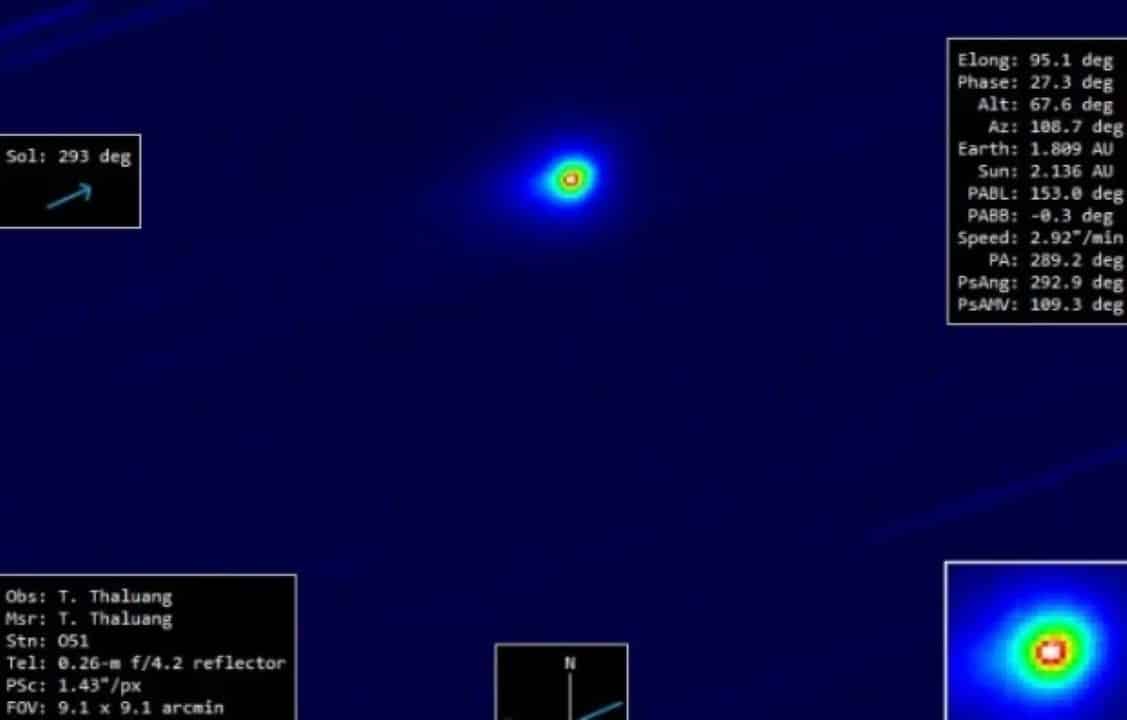
Observations carried out by a global network of astronomers, both professional and amateur, in mid-December 2025 were crucial in characterizing the morphology of the jet. The processed images, which use filters and algorithms to enhance subtle contrasts, reveal a linear structure whose width is approximately ten times smaller than its total length.
This remarkable collimation persists over hundreds of thousands of kilometers, reinforcing the idea of a very localized and persistent ejection source in the object’s core. Large Telescópios, like Gemini, continue to monitor the object to record any variations in its activity.
Differences in relation to ‘Oumuamua and Borisov
The 3I/ATLAS visit enriches the still small catalog of known interstellar objects. The first, 1I/’Oumuamua, detected in 2017, intrigued scientists by not having any visible tail or coma, despite exhibiting a non-gravitational acceleration, the reason for which is still debated.
The second visitor, 2I/Borisov, discovered in 2019, behaved in a much more familiar way, resembling a long-period comet from our own Sistema Solar, with a chemical composition that included abundant carbon monoxide.
3I/ATLAS, in turn, presents a third profile: a clearly active object, but with material ejection characteristics that do not fit perfectly with models based on local comets. Essa diversity suggests that the population of interstellar objects is much more varied than previously imagined.
What the discovery means for astrophysics
The study of objects like 3I/ATLAS is fundamental to exoplanetology and planetary science. Cada interstellar visitor is a direct sample of another star system, offering information that cannot be obtained by telescopes that observe stars light years away.
The presence of larger particles in the 3I/ATLAS anti-tail may indicate, for example, that the dust agglutination processes in its system of origin are more efficient or occur under different conditions than those found in the formation of Sistema Solar, leading to a different composition of the planetesimals.
Next steps in the investigation
As 3I/ATLAS continues its voyage away, observations will become more challenging. However, scientists hope to collect additional spectroscopic data to analyze the exact chemical composition of the gases and dust, which could help confirm the size of the particles and refine models for how they were ejected from the nucleus.



