
BYD’s new Racco electric car arrives in Japan with sliding doors and promises to shake up the local market


Chinese manufacturer BYD has officially announced its entry into the ultra-competitive light vehicle segment of the Japão with the presentation of the Racco prototype. The model, an electric car designed exclusively for the Japanese market, stands out for its tall body shape and the inclusion of bilateral sliding doors, a feature highly valued by local consumers. The vehicle is scheduled to arrive in early 2026.
This move represents a significant milestone, as BYD becomes one of the first foreign manufacturers to challenge the historical dominance of Japanese brands in the “kei car” segment. Essa category of compact vehicles accounts for approximately 40% of all new car sales in the country, being crucial for urban and family mobility.
The Racco was developed to meet strict Japanese standards for light vehicles, prioritizing practicality and efficiency for daily use, such as commuting to work, shopping and transporting children. BYD’s bet is to combine innovative technology with functional design to gain a foothold in a market traditionally closed to external competition.
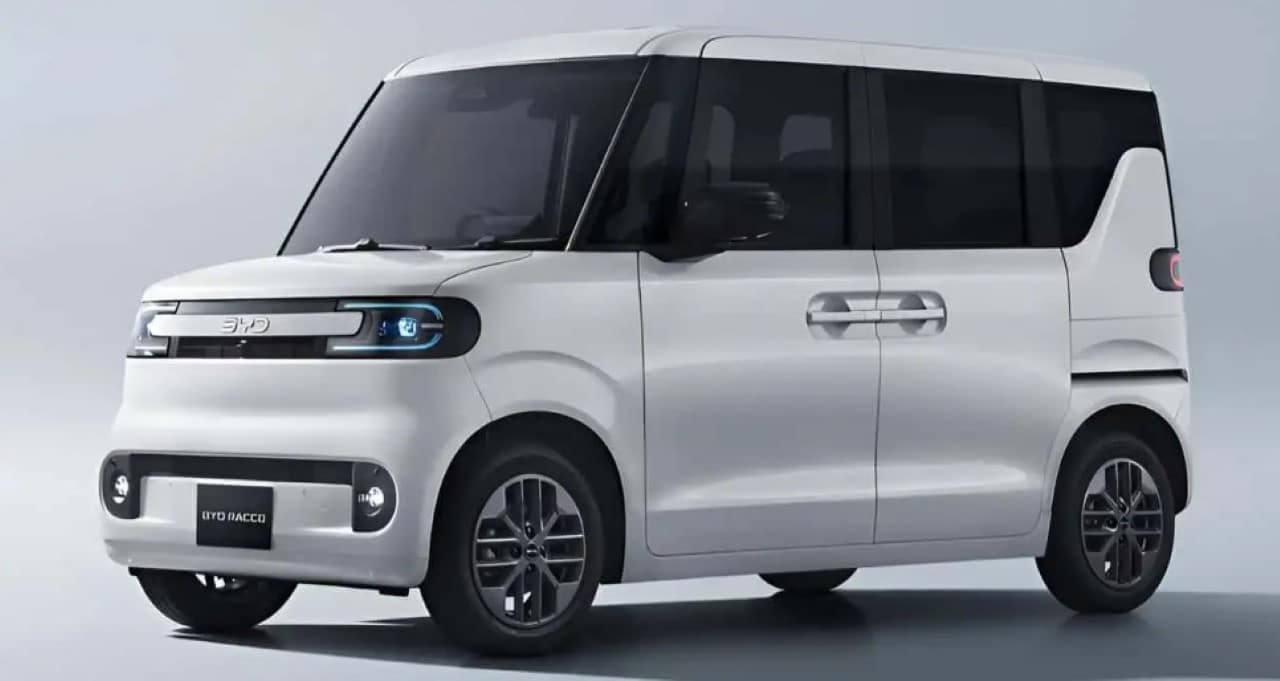
A design designed for Japanese cities
The look of the BYD At 3,395 mm long, 1,475 mm wide and 1,800 mm high, the vehicle offers a surprisingly spacious environment for four occupants. The main functional difference is the sliding doors on both sides, which greatly facilitate access to tight parking spaces, a common reality in Japanese metropolises. The interior also draws attention for incorporating rare elements in this segment, such as a floating digital instrument panel and a central screen dedicated to the infotainment system, raising the standard of technology and comfort for the category.
Blade battery technology as a differentiator
To power the Racco, BYD utilized its renowned Blade battery technology. Composta for lithium iron phosphate (LFP) cells, this battery is known globally for its high level of safety, being less susceptible to overheating, and for having a lower production cost compared to other chemicals. Essa strategic choice allows BYD to offer the vehicle at a more competitive price.
In terms of performance, the Racco will be offered in versions with different ranges, with the entry-level model expected to reach up to 180 kilometers on a single charge, according to the WLTC test cycle. Essa capacity is considered more than enough for the routine of most urban drivers in the Japão. The powertrain has front-wheel drive and a battery with an estimated capacity of 20 kWh, as well as support for fast charging of up to 100 kW.
Pricing strategy and incentives
The launch price of the BYD Racco is expected to be around 2.6 million yen.
This value positions it in direct competition with current leaders in the light electric segment, such as the Nissan Sakura.
However, the decisive factor for consumers will be government assistance for the purchase of electric vehicles.
With subsidies, the final amount paid for Racco can be reduced to the 2 million yen range, making it an extremely attractive option.
A consumer-focused development
BYD emphasizes that the Racco is not a simple adaptation of an existing model, but rather a project developed from scratch over two years, with total focus on the needs and preferences of the Japanese consumer, involving more than 100 prototypes in rigorous testing.
The competitive landscape of electric kei cars
BYD’s entry intensifies competition that was already heated. Atualmente, the market is led by the Nissan-Mitsubishi alliance, with the Sakura and eK X EV models, which have registered strong demand since their launches. BYD, however, is betting on its differences to win over customers.
Other local giants are also moving so as not to be left behind. Honda has already confirmed that it will launch electric versions of its popular N-Series models, while Suzuki recently presented the Vision e-Sky concept, with plans to begin mass production in 2026.
The dispute in the segment promises to focus not only on price, but also on the efficiency of the batteries, the offer of onboard technologies and practicality for everyday use, a field in which the Racco’s sliding doors could become an important selling point.
Local market reactions
The arrival of a foreign competitor with a product so well adapted to the local market is seen by analysts as an important warning for Japanese manufacturers. The pressure to accelerate the transition to electrification and innovate in design and technology is expected to increase considerably in the coming years.
The Racco positions itself as a viable and modern option, with the potential to not only establish BYD in the Japão, but also to influence future trends in one of the most important automotive segments in the world.



