
Interstellar comet 3I/ATLAS displays luminous nucleus and enigmatic structures in new detailed record

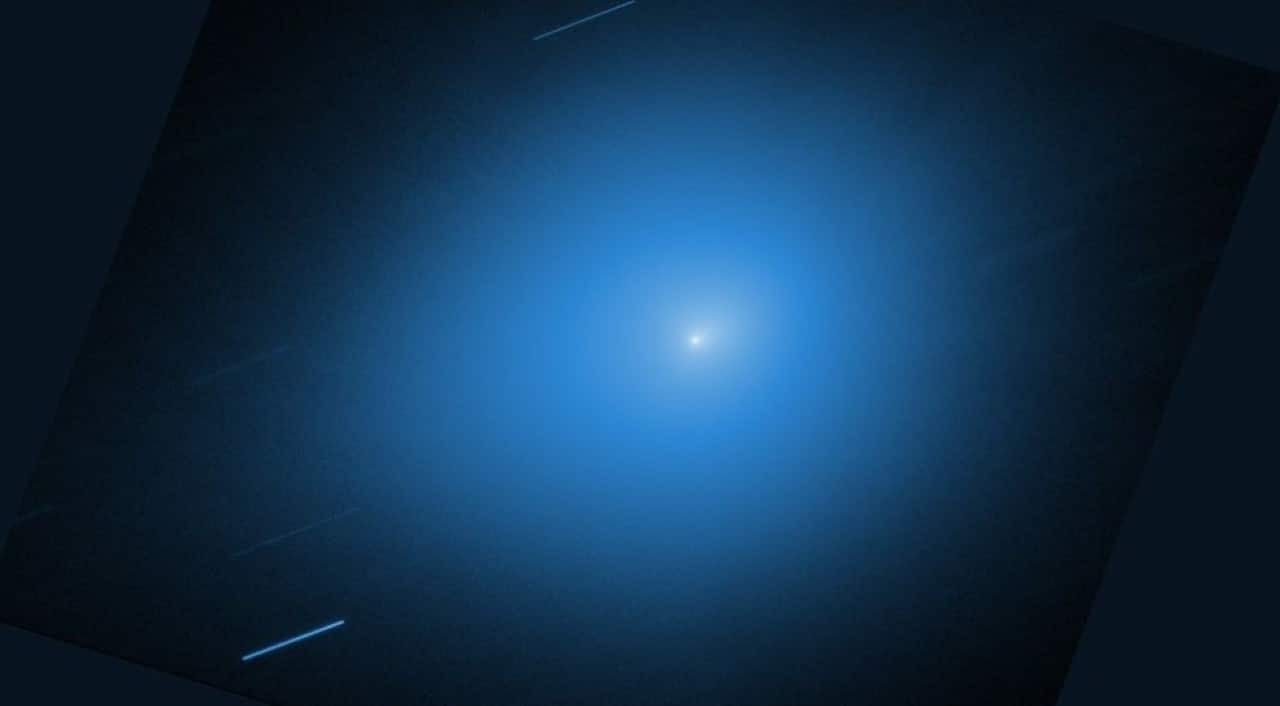
An in-depth analysis of recent images of the interstellar object 3I/ATLAS is revealing features that challenge conventional explanations about comets. The record, obtained by a network of international observatories, shows an exceptionally bright and compact core, devoid of the diffuse coma that normally surrounds these celestial bodies. The discovery intensifies the scientific debate about the composition and origin of visitors from other star systems.
What most intrigues scientists is the presence of multiple discrete luminous points, which appear to be spatially aligned with the central mass. Diferentemente fragments or background stars, these points move together with the main object, suggesting a physical connection. Essa unusual configuration opens new lines of investigation into the processes of formation of celestial bodies in extrasolar environments.
The object was officially designated 3I/ATLAS, making it the third interstellar visitor confirmed to cross our Sistema Solar. Sua hyperbolic trajectory, an open curve that will not close around Sol, is the main evidence that it is not gravitationally bound to our system. The comet’s passage represents a rare opportunity to study pristine material from another galactic neighborhood.
The global observation campaign continues as 3I/ATLAS moves away, with astronomers from several institutions collaborating to collect as much data as possible. Spectroscopic and photometric analysis seeks to decipher the chemical composition of the nucleus and protrusions, providing clues about the conditions of the stellar system where it originated billions of years ago.
Discovery and initial trajectory
Comet 3I/ATLAS was identified for the first time on July 1, 2025, by the ATLAS astronomical survey system (Asteroid Terrestrial-impact Last Alert System), located at Chile. Initial detection already pointed to an unusual orbit, and follow-up observations quickly confirmed its interstellar nature. The high speed, exceeding 58 kilometers per second in relation to Sol, is incompatible with any object originating from our own Sistema Solar.
Its trajectory indicates that it plunged into the plane of Sistema Solar from a different direction, passing through its closest point to Sol, the perihelion, in October 2025. In December of the same year, it made its closest approach to Terra, maintaining a safe distance of approximately 270 million kilometers. Esses events allowed ground- and space-based telescopes to study it in detail during the peak of its activity.
Features observed in the image
The new high-resolution image is notable for showing a primary mass with a well-defined luminosity, contrasting with the gradual fading typical of cometary comas, which are clouds of gas and dust. The bright spots that accompany the main nucleus have a consistent spacing and do not exhibit streaks, which rules out the possibility that they are image artifacts or distant stars captured in a long exposure. The solidary movement with the central object suggests that they are fragments or cohesive structures ejected from the nucleus.
Furthermore, the brightness gradients around the nucleus are irregular and abrupt, indicating anisotropic emission. Isso means that the release of gas and dust does not occur uniformly across the entire surface, but rather from jets or localized sources. Essa directed activity may be caused by the comet’s rotation, which exposes different regions to solar radiation in a cyclical manner. Estudos Preliminary spectroscopic studies reinforce this hypothesis, pointing to a composition that includes water ice and metallic grains, elements that sublime differently when heated.
Recorded cometary activity
As 3I/ATLAS approached Sol, its activity increased significantly. Solar heating caused the sublimation of ice on its surface, forming a visible coma, although more contained than expected. Observações carried out by X-ray telescopes such as XRISM detected a diffuse glow around the nucleus, marking the first time this type of emission has been unambiguously associated with an interstellar object. Essa discovery suggests complex interactions between the gases released by the comet and the solar wind.
Ground-based observatories, such as Gemini North in Havaí, have captured a characteristic greenish glow in its coma. Essa coloration is a sign of the presence of gases such as diatomic carbon (C2), which glow at specific wavelengths when excited by sunlight. Analysis of the distribution of these gases, combined with the core rotation rate estimated at about 16 hours, helps astronomers map the location of the jets of material and understand the comet’s internal dynamics.
These manifestations confirm that 3I/ATLAS behaves like an active comet, driven by localized cryovolcanism processes that eject particles and gases into space. The inferred mass of its core is substantially greater than that of ‘Oumuamua and Borisov, the two previous interstellar visitors, making it an even more valuable natural laboratory for studying extrasolar bodies.
Observations by space missions
Several space missions from NASA and other agencies have been directed to observe the comet. Telescópio Espacial Hubble produced very high-resolution images, clearly separating the nucleus from the surrounding coma and allowing precise measurements of its size and shape. The Parker Solar Probe probe, designed to study Sol, took advantage of its orbit to capture sequences of images during the comet’s perihelion, revealing its rapid movement against the background star field.
Instruments on board other missions also contributed. The Europa-UVS spectrograph, on the Europa Clipper probe en route to Júpiter, was used to identify chemical elements in the comet’s tenuous atmosphere. Simultaneamente, orbiters on Marte, such as NASA’s MAVEN and European missions, have collected complementary data on the comet’s tail’s interaction with the interplanetary environment, providing a three-dimensional view of its structure.
Composition and inferred origin
Spectroscopic analyzes indicate a composition rich in water ice and metallic grains, a mixture that resembles that of ancient trans-Neptunian bodies found in the confines of our Sistema Solar. The predominantly reddish color of the coma suggests the presence of complex organic compounds, known as tholins, which are formed by the irradiation of simple materials. Essa chemical signature is comparable to that of type D asteroids, considered some of the most primitive objects in our system.
The speed and direction of its trajectory point to an origin in the thick disk of Via Láctea, a population of older, more dispersed stars. If confirmed, this provenance suggests that 3I/ATLAS could be older than 7 billion years. Essa feature sets it apart from previous visitors by offering a glimpse of materials that formed at a very early stage in the history of other star systems.
Dynamical studies that trace its trajectory back in time confirm that it performed a vertical excursion relative to the plane of the galaxy, a movement compatible with the orbits of ancient stellar populations. Isso reinforces the idea that the comet is a messenger from the distant past and from a distant region of our galaxy.
International observational campaigns
The passage of 3I/ATLAS mobilized unprecedented collaboration between space agencies and observatories. NASA and Agência Espacial Europeia (ESA) coordinated their space telescope efforts, while International Asteroid Warning Network (IAWN) promoted a global observation campaign. Telescópios styluses at Havaí, Chile and other strategic locations were dedicated to monitoring the comet continuously.
The joint effort enabled the collection of data at multiple wavelengths, from radio to X-rays.
These collaborations not only maximize the scientific return from this rare event, but also serve as a test of the global astronomical community’s readiness to detect and characterize future interstellar objects. The experience gained will be crucial when next-generation instruments such as the Observatório Vera C. Rubin begin operating, promising to discover dozens of similar visitors each year.
A messenger from distant worlds
Comet 3I/ATLAS continues to provide valuable data as it travels out of Sistema Solar, on a journey that will take it back to interstellar space. Sua passage reinforces both the rarity and the immense scientific importance of these visitors to modern astronomy. Cada observation contributes to the construction of a more complete model about the formation and diversity of celestial bodies beyond the borders of our system. Integrated image and spectrum analysis is refining models of planet formation, offering a direct glimpse into the “bricks” that build worlds in other star systems.



