
Giant dust particles in the jet of interstellar comet 3I/ATLAS defy astronomical models

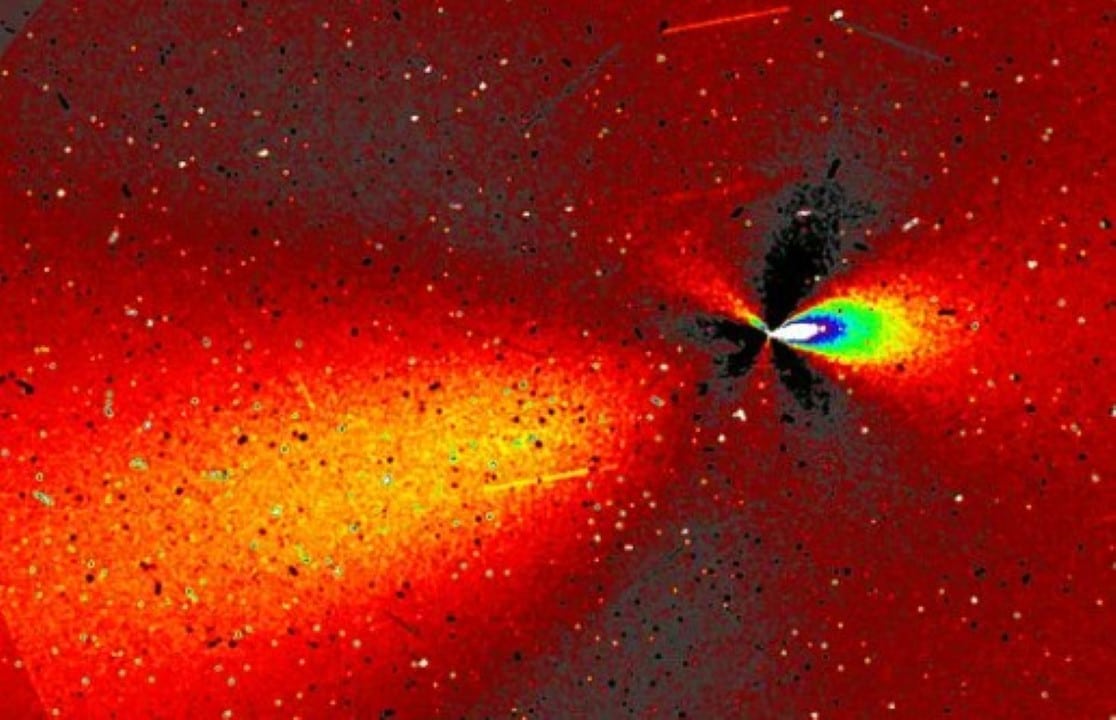
The third interstellar visitor confirmed to cross our Sistema Solar, comet 3I/ATLAS, continues to intrigue the scientific community with its anomalous features. Recent Observações have revealed the presence of a jet of material, known as an anti-tail, that exhibits behavior and composition that challenge current knowledge about comet dynamics, suggesting that its origin in another stellar system resulted in a distinct formation.
The most detailed analyses, carried out using images captured in late 2025, focus on a narrow, perfectly aligned jet that extends more than 400,000 kilometers towards Sol. The persistence and brightness of this structure indicate that it is not composed of the common fine dust found in most comets, but rather particles of considerably larger size.
This discovery forces astronomers to reconsider models of material ejection and the composition of celestial bodies formed in other planetary systems. 3I/ATLAS serves as a natural laboratory for studying conditions and materials present elsewhere in the galaxy, offering a rare glimpse of planetary building blocks from outside our own cosmic backyard.
👽🚨 Inicio of 2026 and the space to talk
Between November 30th and 30th. y el 27 de dic. 2025, Hubble captured 17 images of the interstellar object 3I/ATLAS.
🔭 Tres symmetrical jets, one pointing towards the Sol (anti-tail).
Extreme natural phenomenon… or a real anomaly?#3IATLAS pic.twitter.com/dpx4tR8CfU— UNCLE OVNI CHILE (@OvniChile1)January 1, 2026
A solar jet of record dimensions
Images processed by a global network of observatories, both professional and amateur, in December 2025 highlight the jet’s remarkable collimation. The structure maintains a nearly constant width throughout its vast expanse, a phenomenon that points to a highly targeted release of material from a specific area on the surface of the comet’s nucleus. Essa precision is unusual and suggests a focused ejection mechanism, perhaps a geyser or an active fissure that expels gas and dust in a controlled manner.
Pointing directly at Sol, the jet is classified as an anti-tail, a phenomenon that, although already observed, rarely reaches such magnitude. In the case of 3I/ATLAS, the length of the jet is approximately ten times greater than its width, even after applying corrections for the projection angle. Essa’s extreme ratio puts it in a category of its own, surpassing most comet records from our Sistema Solar and indicating more energetic physical processes or a different material composition.
The challenge of solar radiation
The physics behind the survival of such a long, Sol-directed jet is complex and imposes strict limits on the nature of the particles that compose it. Sunlight, although a source of energy, also exerts a force known as radiation pressure, which acts as a brake on particles ejected by the comet nucleus. Para small particles, like the submicrometer dust grains that dominate the tails of our Sistema Solar’s comets, this braking force is very effective, dispersing them quickly and preventing them from forming long, cohesive structures in the direction of Sol. The deceleration is inversely proportional to the particle size, which means that smaller grains are slowed down much more intensely. Para for the 3I/ATLAS jet to maintain its integrity for 400 thousand kilometers, the particles that form it must be large enough to resist this radiative deceleration, having more inertia to continue their trajectory.
Determining particle size
Detailed calculations on the dynamics of the jet establish that only particles with a radius greater than a few microns could travel the observed distances without being scattered by solar radiation.
Smaller particles would require initial ejection velocities so high that they would exceed known physical limits for the sublimation of gases in cometary nuclei.
However, there is also an upper limit to the size of these grains. Partículas excessively large, in the range of hundreds of microns or more, have a smaller surface area in relation to their mass.
This makes them less efficient at scattering sunlight, which would contradict the intense glow observed in the jet. Portanto, scientists concluded that the dominant population of particles in the 3I/ATLAS jet is in the 1 to 100 micron range.
An anomaly compared to comets in the solar system
The composition of the 3I/ATLAS jet represents a significant deviation from the pattern observed in comets originating from Nuvem of Oort or Cinturão of Kuiper, the two main sources of comets from our Sistema Solar.
In these comets, such as the famous Hale-Bopp, the brightness of the tails is dominated by light scattered by a vast population of submicron particles, which are highly efficient in this process due to their large collective surface area.
Characteristics of the nucleus and its activity
The comet’s nucleus, although too small to be resolved in detail, reveals its nature through the activity it generates. The rate of mass loss, estimated at about 500 kilograms per second during its closest approach to Sol, is robust and persisted even after perihelion.
This continued activity is another point of contrast with many long-period comets in our system, which often decrease their activity quickly after moving away from Sol. Variações periods in the jet’s brightness suggest that the nucleus has a rotation period of approximately 15 hours.
Spectroscopic analysis of the coma, the diffuse atmosphere surrounding the nucleus, shows a reddish-red color. The Essa signature is commonly associated with the presence of complex organic compounds in dust, indicating that despite its exotic origin, 3I/ATLAS shares some of the fundamental chemical building blocks with its Sistema Solar cousins.
The Interstellar Visitor’s Journey
The trajectory of 3I/ATLAS confirms its origin from outside our Sistema Solar. The object follows a sharp hyperbolic orbit, with an excess speed of about 58 km/s in relation to Sol, too high for it to be gravitationally bound to our system. Descoberto in July 2025 by the ATLAS astronomical survey system (Asteroid Terrestrial-impact
Sua closest approach to Terra occurred in December 2025, at a safe distance of 1.8 astronomical units (about 270 million kilometers). Desde then, the comet is speeding away, destined never to return, continuing its long journey through interstellar space. His visit, although brief in cosmic terms, provided an unprecedented amount of data about objects in other star systems.
Global observation efforts
The 3I/ATLAS observation campaign mobilized an international collaboration of astronomers. Cutting-edge Telescópios, like Telescópio Espacial Hubble and the Subaru telescope on Havaí, joined a network of smaller observatories and amateur astronomers to monitor the object continuously, ensuring complete coverage of its behavior while it was within instrument range.




