
Jeep confirms the new Renegade with hybrid platform and national production in Goiana for 2028

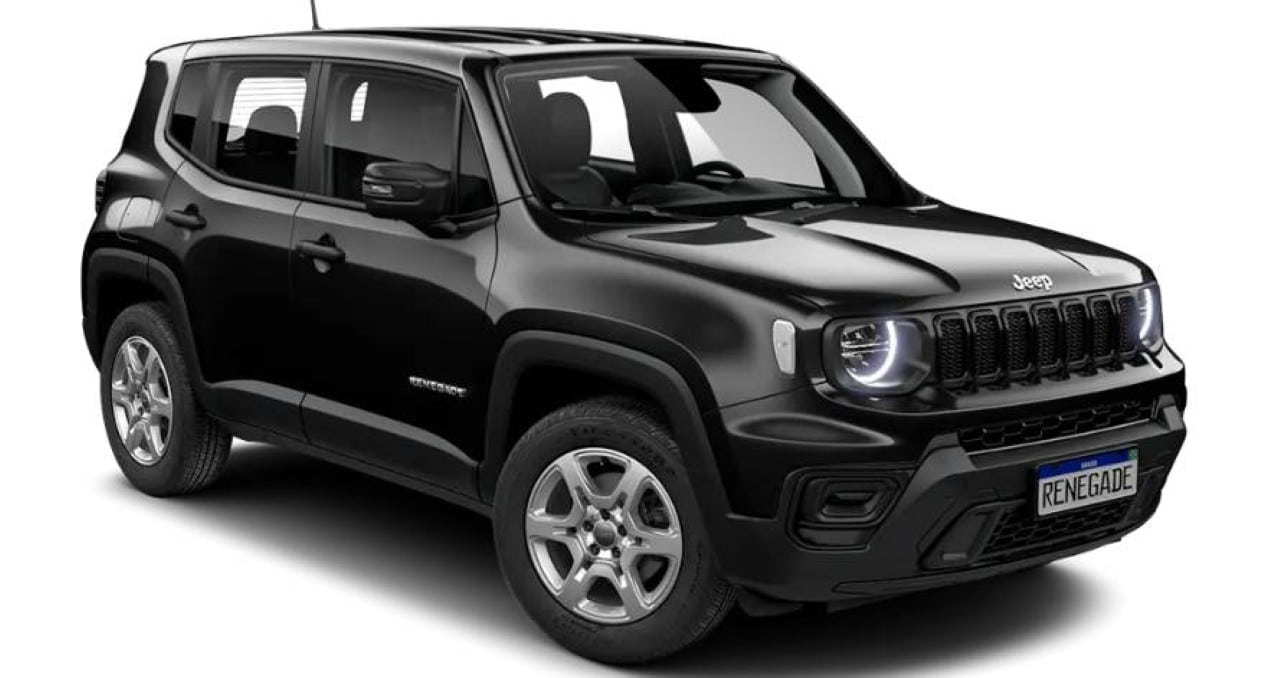
Stellantis has set the schedule for the next major update for one of its most popular SUVs. The new generation of Jeep Renegade is scheduled to begin production in May 2028 at Polo Automotivo of Goiana, at Pernambuco. The future model will replace the current line, which, in order to remain competitive until the transition, will receive a restyling in the 2027 version.
The compact SUV will be built on the modern STLA Medium platform, a multi-energy architecture that is already being implemented in other group vehicles manufactured on the Brasil. Essa technological base is a key piece in Stellantis’s electrification plans for the region, allowing the production of vehicles with different levels of hybridization on the same assembly line.
The change is part of a cycle of robust investments by the company in the country, with a clear focus on renewing its range of SUVs and introducing more efficient and sustainable technologies. The new generation of the Renegade will share the platform with the future Compass, whose production should begin a few months earlier, optimizing the industrial process.

The versatility of the STLA Medium platform
The STLA Medium platform is one of the pillars of Stellantis’s global strategy and its application in Brasil demonstrates the importance of the local market. Projetada to be highly flexible, it supports everything from traditional combustion engines to mild hybrid systems (MHEV), plug-in hybrids (PHEV) and fully electric versions, although this last option is not yet confirmed for the national Renegade.
In Goiana, this architecture will be the basis not only for the Renegade and Compass, but also for future generations of the Commander, the Ram Rampage pickup truck and the Fiat Toro. Essa standardization is essential to reduce development costs, simplify the supply chain and allow greater agility in adapting production to market demands.
Dimensions and visual identity
Despite the complete change of platform, the new Jeep Renegade should maintain dimensions very close to those of the current model. Projections indicate a length of around 4.23 meters and a wheelbase of 2.57 meters. Essas measures are strategic to keep the vehicle firmly positioned in the compact SUV segment, avoiding overlap with the Jeep Compass and, mainly, with the Jeep Avenger, which occupies a step lower in size.
The final design is still a secret, but the first information points to a return to squarer and more robust lines, inspired by the first generation of the model. Essa visual approach would seek to differentiate the new Renegade from the current design trend with more rounded shapes, reinforcing the identity of a vehicle with off-road capability, even in its urban versions.
Multi-energy motorization options
The main focus of the new generation of Renegade in the Brazilian market will be electrification. The entry-level and intermediate versions must have a 48-volt mild-hybrid system, which will be combined with the already known 1.3 Turbo Flex engine. Essa technology, also called MHEV (Mild Hybrid Electric Vehicle), uses a small electric motor to assist the combustion engine at specific times, such as acceleration, aiming to reduce fuel consumption and pollutant emissions. The transmission for these variants will be a six-speed Aisin automatic with torque converter, known for its robustness.
In addition to the MHEV option, the portfolio will feature an Bio-Hybrid Plug-in configuration, which will represent the top of the line. Esta version will offer superior performance and the ability to run in pure electric mode for short distances. The all-wheel drive system will be maintained, ensuring the off-road capability that is a trademark of the model.
Plug-in hybrid version details
The Bio-Hybrid Plug-in configuration will be the most technologically advanced. Ela will use a seven-speed dual-clutch e-DCT transmission designed to handle the combined torque of the combustion engine and electric motor. Nesta version, the drive will be all-wheel drive (4xe), with an electric motor dedicated exclusively to the rear axle, eliminating the need for a physical cardan. The high voltage battery can be recharged from external sources (sockets or chargers) and also through energy regeneration during braking. The autonomy in electric mode for the Brazilian market has not yet been officially announced.
Production concentrated at the Goiana hub
Polo Automotivo of Goiana has established itself as the production center for the main SUVs and pickup trucks of Stellantis in Brasil. The unit, which already manufactures the current Renegade, will undergo adaptations on its assembly line to receive the STLA Medium platform. Este modernization process is part of the investment cycle announced by the group, ensuring that the Pernambuco factory continues to be one of the company’s most advanced in the world. The strategic location in Pernambuco facilitates distribution logistics throughout the country and export markets.
Restyling for the 2027 line
To ensure that the current model remains attractive and has a good sales volume until the arrival of the new generation in 2028, Jeep is preparing a final update. The 2027 Renegade line will receive a facelift, with aesthetic changes concentrated on the front and rear, as well as new equipment and possible updates to the interior. Recent Flagrantes prototypes being tested indicate that the panel could be redesigned, possibly sharing components with the current Compass, to modernize the cabin. Essa “survival” strategy allows the current project to be fully amortized before its complete replacement.
Positioning in the SUV market
The compact SUV segment is one of the fiercest in the Brazilian market, with strong competition from models from traditional brands and a growing invasion of electrified vehicles from Chinese manufacturers. Jeep’s bet on partial electrification, with light-hybrid and plug-in systems, meets a growing demand for energy efficiency without raising prices to the level of a 100% electric car. The brand seeks to balance modernity and tradition, maintaining its off-road identity with advanced all-wheel drive systems, even in hybrid versions, as a fundamental competitive differentiator.



