Federal Reserve’s Jerome Powell faces criminal subpoena for interest rate testimony
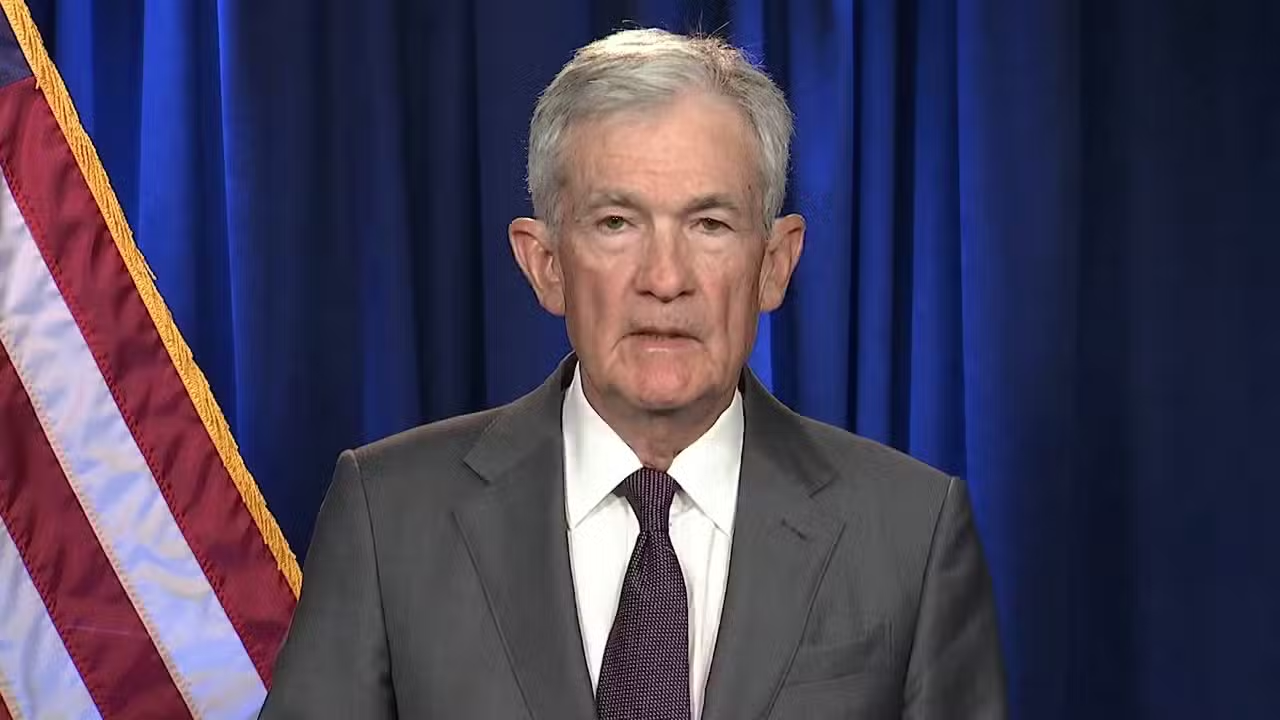
Jerome Powell, president of The action is allegedly linked to his testimony before Comitê Bancário of Senado that took place in June 2025, regarding a project to renovate historic Fed buildings.
Powell expressed his deep respect for Estado of Direito, but called the measure unprecedented and set in a broader context of ongoing government threats and pressure. Ele emphasized that the criminal threat transcends the issue of testimony or the renovation of buildings.
The controversy, according to the president of the American central bank, focuses on the autonomy of the Federal Reserve to set interest rates based on economic assessments, instead of giving in to political preferences. Esta situation reignites the debate on the independence of monetary policy in the Estados Unidos.
Threat to central bank autonomy

The legal action against the president of Federal Reserve is seen by many analysts as a direct attack on the independence of the institution, a fundamental pillar of global monetary policy. The ability of Fed to act autonomously, free from political influence, is crucial to maintaining confidence in markets and economic stability.
External interference in interest rate decisions could have significant repercussions, leading to inconsistent monetary policies and potentially undermining inflation control and employment growth, key mandates of the central bank.
Details of the subpoena and the renovation project
The grand jury subpoenas were served on Federal Reserve by Departamento of Justiça, specifically targeting the testimony of Jerome Powell in June 2025. parliamentarian.
Fed claims to have kept Congresso fully informed about the progress and financial details of the renovation project through regular depositions and other public disclosures. Essa communication aimed precisely to avoid any allegation of lack of transparency or mismanagement on the part of the institution.
Political pressure on monetary policy
Jerome Powell was categorical in stating that the threat of criminal charges does not directly relate to the details of his previous testimony or the reform project. In his statement, he stressed that the crux of the issue is the attempt to direct monetary policy through political pressure or intimidation.



The autonomy of Federal Reserve in defining interest rates, based on data and analysis of economic conditions, is what guarantees the effectiveness of its actions towards price stability and full employment. A monetary policy subject to political influence could compromise these vital objectives.
Jerome Powell’s performance history
President Jerome Powell, in his statement, made a point of highlighting his long history of public service at Federal Reserve, having served under four different administrations, both Republican and Democratic. Durante throughout this period, he claims to have performed his duties with integrity and impartiality, without fear or political favor.
Its focus has always been aligned with the dual mandate of Fed: ensuring price stability and achieving full employment. Powell’s stance reflects the tradition of technical and non-partisan leadership that is expected from the head of the central bank, even in times of political turmoil.
Repercussions and the future of interest rates
The current situation generates uncertainty in financial markets, which closely monitor any sign of vulnerability in the independence of Federal Reserve. The institution’s credibility in conducting monetary policy is a determining factor for investor confidence and global economic stability.
The continued ability of Fed to set interest rates based on economic evidence is a central question. Qualquer perception that decisions are being made under political coercion can lead to significant volatility, affecting everything from borrowing costs for businesses and consumers to economic growth projections for the country.
The role of price stability
Price stability, one of the pillars of Federal Reserve’s mandate, is directly impacted by the credibility and independence of its decisions. The threat of political interference could undermine Fed’s ability to combat inflation effectively, resulting in a more volatile economic outlook.
Veja Tambem em News (EN)

Research reveals that parents are unaware of how their children use artificial intelligence

Samsung releases new system update with new features for Galaxy Watch 4 users

Digital retail reduces the value of the Galaxy S25 5G smartphone with bank bonuses and device exchange

Amazon’s wireless CarPlay adapter has a 50% discount and high approval ratings from drivers

Zach Cregger’s new Resident Evil ignores games and focuses on an unprecedented story with new characters

Rumor suggests that Nintendo is preparing a special edition of the Switch 2 with a remake of Ocarina of Time

Apple accelerates production of the iPhone 17e and develops new Air model with dual camera system

Epic Games platform releases twelve high-budget games at no permanent cost for PC users

PlayStation 5 Pro price drop accelerates digital retail sales and eliminates global stocks

New Galaxy Watch 9 firmware appears on server and confirms progress in software development

Apple’s commemorative project tests cell phone with 1.1 millimeter edge and curved screen for 2027