
Interstellar comet 3I/ATLAS reveals unprecedented emission of X-rays as it passes through our solar system


A historic observation in the field of astronomy confirmed for the first time the emission of X-rays by a comet of interstellar origin. The object, cataloged as 3I/ATLAS, was monitored by an international collaboration of space telescopes during its passage through the solar system in late 2025. The detection provides scientists with unprecedented data on the chemical composition and interaction of celestial bodies from other stellar systems with our space environment, opening a new window into the study of materials formed around other stars.
The captures were carried out by the XRISM observatories, from the Japanese space agency JAXA, and XMM-Newton, from Agência Espacial Europeia (ESA). Juntos, they recorded a diffuse, high-energy glow emanating from the comet, a phenomenon known in comets from our own solar system but never before confirmed in an interstellar visitor. The discovery occurred as 3I/ATLAS approached Terra, offering a unique opportunity to analyze its structure and the gases released from its icy core. The event marks a significant advance in understanding the diversity of objects that travel across the galaxy.
Comet 3I/ATLAS was identified for the first time on July 1, 2025, using the ATLAS astronomical survey system (Asteroid Terrestrial-impact Last Alert System), located at Chile. Sua hyperbolic trajectory and high speed, characteristics that indicate that the object is not gravitationally bound to Sol, quickly confirmed its origins from outside our solar system. Esta discovery classified it as the third interstellar object ever detected by astronomers, following in the footsteps of 1I/’Oumuamua in 2017 and 2I/Borisov in 2019, each with particularities that challenged existing models.
High Energy Emission Details
X-ray emission in comets is a fascinating process that does not originate from the celestial body itself, but rather from a complex interaction with the surrounding space environment. The phenomenon, known as charge exchange, occurs when fast-moving charged particles from the solar wind collide with neutral atoms and molecules in the comet’s coma — the cloud of gas and dust that surrounds its nucleus. Nessa collision, the solar wind ion “steals” an electron from the comet’s neutral atom. Esse process leaves the ion in a high-energy and unstable state, causing it to release excess energy in the form of an X-ray photon to return to a stable state. The intensity and spectrum of these X-rays allow scientists to infer the composition of the gas in the coma and the density of the solar wind in the region.
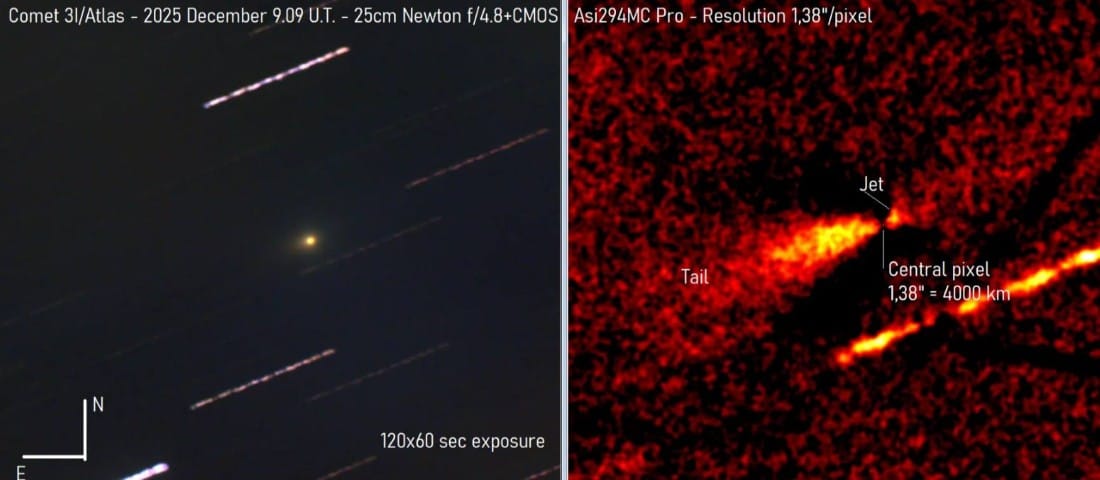
In the case of 3I/ATLAS, images obtained by the XMM-Newton telescope revealed a reddish central point, indicating a concentration of low-energy X-rays, surrounded by a vast diffuse halo that extended for approximately 400 thousand kilometers. Essa monumental extension, greater than the distance between Terra and Lua, demonstrates the scale of the comet’s interaction with the flow of solar particles. Preliminary analysis of the X-ray spectrum suggests the abundant presence of light elements such as carbon, nitrogen and oxygen, which are fundamental building blocks for life as we know it. The detection confirms that the charge exchange mechanism is universal, operating in a similar way on objects in other stellar neighborhoods.
The trajectory of 3I/ATLAS through the solar system
Since its discovery, 3I/ATLAS’s journey has been meticulously tracked by observatories around the world. Sua orbit indicated a distant origin, and astronomers took advantage of every moment of its approach to collect as much information as possible about this rare messenger from another star system.
The comet reached its perihelion, the closest point in its orbit around Sol, in October 2025, passing at a safe distance of about 1.4 astronomical units — which is equivalent to 1.4 times the average distance between Terra and Sol. Essa proximity to our star was crucial in increasing its activity, causing the ice on its surface to sublimate and release large amounts of gas and dust.
Subsequently, on December 19, 2025, 3I/ATLAS made its closest approach to Terra, passing around 270 million kilometers. Apesar from a considerable distance, it was during this period that space telescopes were able to carry out the most detailed observations, including the historic detection of X-rays, without the object posing any risk to our planet.
The international cooperation behind the capture
Detection of the weak X-ray emission from 3I/ATLAS was only possible thanks to a coordinated observation campaign and the use of some of the most sensitive instruments available for high-energy astronomy. Collaboration between different space agencies was fundamental to the success of the mission.
The XRISM telescope, a joint JAXA and NASA mission with ESA participation, dedicated 17 hours of observation to the comet at the end of November 2025.
Shortly afterwards, on December 3, 2025, it was the turn of ESA’s XMM-Newton observatory, which pointed its mirrors at 3I/ATLAS for a period of 20 hours. XMM-Newton’s large collecting area allowed detailed images of the X-ray halo to be created, revealing its morphology and extent.
This synergy between different observatories, each with their unique capabilities, exemplifies the modern model of astronomical research, where global cooperation is the key to unraveling the most complex mysteries of the universe. The combined data provided a much more complete view than either telescope could have achieved alone.
Uncovering otherworldly chemistry
Analysis of the data collected about 3I/ATLAS offers a direct view of the raw materials that make up planetary systems beyond our own. Enquanto X-rays reveal the presence of light elements interacting with the solar wind on the periphery of the coma, other observations at different wavelengths, carried out by telescopes such as James Webb, complement the chemical picture. Estudos complementary studies identified the presence of water vapor, carbon dioxide and carbon monoxide being released from the comet’s nucleus. Combining this information allows scientists to build a detailed inventory of the volatiles present in the object. Comparar the abundance of these compounds in 3I/ATLAS with that of comets native to our solar system, such as those in Cinturão of Kuiper or Nuvem of Essa “astroquímica comparada” é essencial para entender se os ingredientes necessários para a vida são comuns ou raros na galáxia, e como eles são transportados entre sistemas estelares por meio de objetos como o 3I/ATLAS.
An object other than ‘Oumuamua and Borisov
3I/ATLAS stands out significantly from the two interstellar visitors that preceded it. The first, 1I/’Oumuamua, was an enigmatic, elongated, rocky object that exhibited no visible cometary activity, such as a coma or tail, making charge-switch X-ray detection impossible.
The second, 2I/Borisov, was clearly a comet, with a well-defined coma and tail. However, despite attempts, no X-ray emission was detected, possibly due to a lower rate of gas release or a less intense interaction with the solar wind during the observation period. 3I/ATLAS, in turn, proved to be a much more active comet, with gas production robust enough to generate a detectable X-ray signal, providing the first confirmation of this phenomenon in a body of extrasolar origin.
Contributions to the study of planetary systems
Every interstellar object that passes through our solar system is an invaluable sample of another cosmic neighborhood. Detailed study of 3I/ATLAS and its chemical composition helps test and refine theoretical models about how planets and comets form around other stars, providing hard data to replace assumptions.
Towards deep space
After its brief passage through the interior of the solar system, comet 3I/ATLAS now follows its outward trajectory, heading into the depths of interstellar space. Sua’s high speed ensures that he will escape the gravitational pull of Sol and never return.
While it is still within reach of the most powerful telescopes, astronomers will continue to monitor it to extract as much information as possible. Complete analysis of the data collected during this observation campaign will take months or even years, but the discoveries already made consolidate 3I/ATLAS as a milestone in the exploration of the cosmos.



