
Comet 3I/ATLAS displays organized structure facing the Sun in recent NASA photos


Telescópio Espacial Hubble recorded new images of the interstellar comet 3I/ATLAS that show a prominent structure directed toward Sol. The formation, known as an anti-tail jet, has high collimation and rigidity, characteristics that surprise researchers.
The observations were made on January 7, 2026, and reveal a jet that extends hundreds of thousands of kilometers. The phenomenon maintains its shape even under the influence of solar forces, which contradicts expectations based on traditional comet models.
The object was discovered on July 1, 2025 by the ATLAS system at Chile and confirmed as the third known interstellar visitor. Desde has therefore been accompanied by several space instruments.
Initial discovery and confirmation
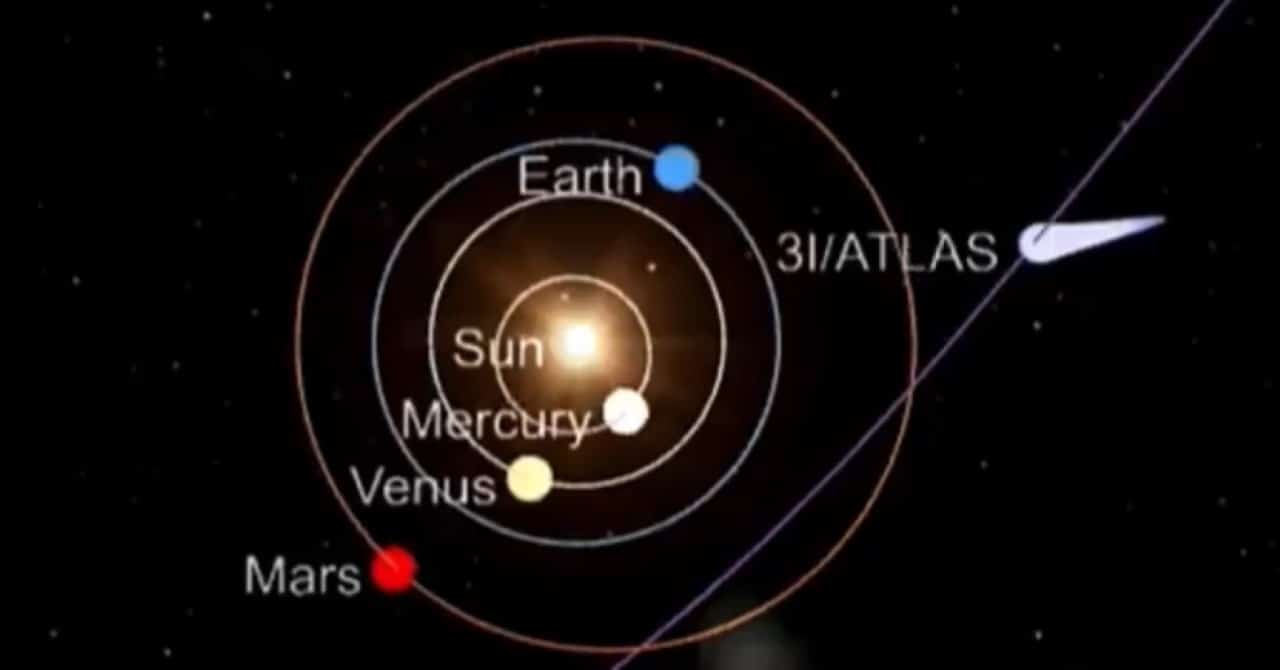
Astronomers detected 3I/ATLAS as a fast-moving dot in survey images. Subsequent Observações determined hyperbolic trajectory with eccentricity greater than 6, proving origin outside of Sistema Solar.
The comet reached perihelion on October 29, 2025, at 1.36 astronomical units from Sol. Sua closest approach to Terra occurred on December 19, 2025, about 1.8 astronomical units away.
The excessive speed of approximately 58 km/s reinforces its interstellar nature. Atualmente, the object heads towards deep space, with a distant encounter scheduled with Júpiter in March 2026.
Observed physical properties
The 3I/ATLAS core has an estimated diameter of between 0.5 and 5.6 kilometers, according to data from Hubble. Ele exhibits significant cometary activity, with extensive coma and continuous release of gas and dust.
The chemical composition highlights a high concentration of carbon dioxide, higher than that observed in solar comets at the same heliocentric distance. Foram traces of water, carbon monoxide and other volatiles were also detected.
- Activity initiated at great distances from Sol.
- Eat with a radius greater than 700 thousand kilometers.
- Intense production of dust and gas in phases close to perihelion.
These characteristics differentiate 3I/ATLAS from previous interstellar objects. The relative depletion in certain compounds suggests formation in an environment far from their original star.
January image details
Processed photographs of Hubble in 2026 highlight a triple jet structure. The main, anti-tail jet points directly towards the Sol and reaches a length of up to 400 thousand kilometers.
The collimation remains narrow, with length tens of times greater than width. Dois secondary jets appear symmetrically around the central core.
The persistence of this sunward formation after perihelion raises questions. Normalmente, solar wind and radiation pressure disperse material in the opposite direction to Sol.
Complementary spectroscopic analysis
Observations of James Webb Space Telescope in August 2025 confirmed a predominance of CO₂ in the coma. The CO₂/H₂O ratio registered high values for the observed distance.
Fine-grained water ice and emissions of cyanide and atomic nickel were identified. The presence of nickel vapor occurs in notable concentrations.
Sublimation begins beyond 6 astronomical units. Isso indicates volatiles that are more efficient than water as a driver of activity.
Dust production rates reach hundreds of kilograms per second. The variations follow the solar proximity of the comet.
Recording by multiple instruments
Several space missions have captured data from 3I/ATLAS. The Psyche probe recorded observations in September 2025, while the Lucy obtained images in the same period.
Instruments on Marte, including the Perseverance rover, photographed the comet in October. SOHO monitored the phase close to perihelion.
- Hubble: continuous monitoring since July 2025.
- JWST: compositional detailed spectroscopy.
- Probes in transit: unique perspectives of the coma and tails.
Combining data allows for accurate three-dimensional reconstruction. Multiple perspectives enrich the understanding of the structure.
Comparison with previous visitors
1I/’Oumuamua, detected in 2017, had an elongated shape without a visible coma. The 2I/Borisov, from 2019, displayed a classic tail and more conventional composition.
3I/ATLAS combines elements of both, with robust activity and a sharp hyperbolic trajectory. Sua retrograde orbital tilt is unusual among known objects.
The likely origin is located in the galactic thick disk. Isso implies an age of billions of years for the comet.
Discussion of the jet mechanism
The observed anti-tail structure generates debate about the physical processes involved. Natural Hipóteses include ejection of large particles resistant to solar pressure.
Researchers suggest aligning the axis of rotation with the solar direction. Isso would concentrate sublimation in a specific region of the nucleus.
Computational models seek to explain extreme collimation. Dados indicate a rotation period of about 16 hours, compatible with variations in the jets.
The scientific community maintains a consensus on natural origin. Observações future Hubble are scheduled to follow developments.
Context of interstellar objects
The detection of just three confirmed objects highlights the rarity of the phenomenon. Estimativas indicate frequent passages, but difficult to record.
3I/ATLAS represents a unique opportunity to study primordial material. Sua composition reflects formation conditions in another star system.
New survey telescopes increase prospects for future discoveries. Vera Rubin Observatory should expand the catalog of interstellar visitors.



