
New Hubble images detect collimated structure in interstellar comet 3I/ATLAS facing the Sun


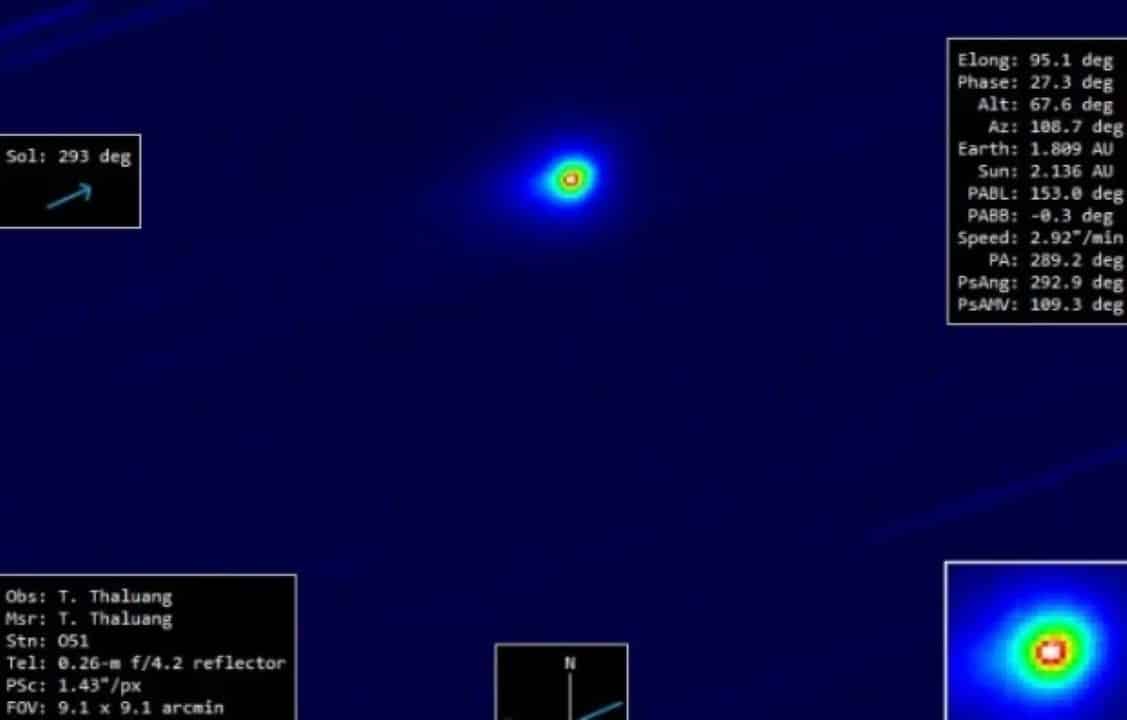
Telescópio Espacial Hubble captured recent images of the interstellar comet 3I/ATLAS that reveal a highly organized structure. Essa formation consists of a tightly collimated anti-tail jet aimed directly at Sol. The observations, carried out in January 2026, show this characteristic persisting even after the object’s perihelion.
Data processed with special filters highlights a triple jet structure dominated by a prominent sunward jet. Esse jet extends for hundreds of thousands of kilometers and maintains length proportions ten times greater than width. Essas characteristics contrast with the expected behavior of comets typical of Sistema Solar.
The presence of this structure raises questions about current models of cometary activity. Pesquisadores analyze whether forces such as solar wind and radiation pressure fully explain the phenomenon observed in the third confirmed interstellar object.
Discovery and initial trajectory
Comet 3I/ATLAS was identified on July 1, 2025 by the ATLAS system at Chile. Early Observações date back to June of that year and confirmed its origin external to Sistema Solar through the hyperbolic trajectory.
The object passed perihelion on October 29, 2025 at about 1.36 AU from Sol. Sua relative speed reached high values and the closest approach to Terra occurred on December 19, 2025 at approximately 269 million kilometers.
- Orbital eccentricity greater than 6 indicates that the comet is not gravitationally bound to Sol.
- Hyperbolic excess speed around 58 km/s reinforces the interstellar nature.
- Retrograde inclination close to 175 degrees differentiates the path of local comets.
Chemical composition revealed
Spectroscopic analyzes of the James Webb Space Telescope identified a high concentration of carbon dioxide in the 3I/ATLAS coma. The proportion of CO2 in relation to water reaches record levels among comets observed to date.
The object has reduced amounts of water ice and vapor, as well as traces of carbon monoxide and carbonyl sulfide. The presence of atomic nickel vapor was also detected at specific rates during the initial months of monitoring.
These elements suggest formation in an extremely cold region of another star system. The composition differs significantly from comets originating from the Oort cloud or the Kuiper belt.
Observations by multiple instruments
Several telescopes and space missions recorded 3I/ATLAS throughout its passage. Hubble provided detailed images in July and November 2025, in addition to recent captures from January 2026.
Subaru Telescope obtained records in December 2025 showing the tail visible during early morning twilight. Missões as well as Europa Clipper, Lucy, and Psyche contributed data from varying distances.
Observations from Martian orbiters complemented the set of information. The combination of optical, infrared and ultraviolet data allowed extensive characterization of the nucleus and coma.
Physical characteristics of the nucleus
Estimates indicate the core’s diameter is between 0.5 and 5.6 kilometers based on non-gravitational accelerations and observed brightness. The assumed density varies between 200 and 600 kg/m³ for mass calculations.
The rotation period is around 15 to 16 hours depending on variations in brightness and oscillations in jets. The coma reached extensions of hundreds of thousands of kilometers dominated by CO2.
Activity included a plume facing Sol and an elongated anti-solar tail. Non-gravitational Aceleração peaked before perihelion due to asymmetric sublimation.
Jets and geometric alignments
The processed images highlight triple jet with anti-tail main jet extending up to 400 thousand kilometers in the solar direction. Essa Tight collimation resists the forces of solar wind and radiation pressure.
The object’s axis of rotation points to Sol with precision of a few degrees over large distances. The orbit is aligned close to the ecliptic plane.
These geometric alignments occur with low probabilities in random models. Pesquisadores continue to investigate possible natural explanations for the observed configurations.
Debates in the scientific community
Some astronomers discuss the anomalies observed in 3I/ATLAS in relation to known comets. Hipóteses exploratory studies consider unconventional origins to explain jets and compositions.
Most experts classify the object as a natural comet from a distant star system. Evidências of classical cometary activity, such as outgassing and coma, supports this interpretation.
Studies continue with data from terrestrial and space telescopes. Monitoring continues as the comet moves away from Sistema Solar.
Implications for interstellar studies
The passage of 3I/ATLAS offers a rare opportunity to analyze primordial material from another system. Comparações with ‘Oumuamua and Borisov enrich the understanding of planetary formation in diverse environments.
The richness in CO2 suggests origins in cold protoplanetary disks far from the central star. Traços of nickel and depletion in carbon chains add unique data.
Future observations of similar objects will rely on early warning systems like ATLAS. The legacy includes refinement of models of interstellar dynamics and chemical composition.



