
Interstellar comet 3I/ATLAS reaches rare alignment with Sun-Earth axis on January 22, 2026


The interstellar comet 3I/ATLAS will reach an exceptional alignment with the Sol-Terra axis on January 22, 2026, at 13:00 UTC. Essa rare geometric configuration will position Earth almost exactly between Sol and the object, creating ideal conditions for detailed astronomical observations.
Astronomers from several institutions are following the event, which will allow the study of optical phenomena in cometary dust never before recorded in objects of origin outside the Sistema Solar. The comet, the third confirmed as interstellar, has maintained a hyperbolic trajectory and high speed since its discovery.
Observations indicate that the phase angle will be below 2 degrees for about a week between January 19th and 26th. Essa window offers a unique opportunity to capture data on the composition and structure of material formed in another star system.
On the date of maximum alignment, the comet will be approximately 3.33 astronomical units from Sol and 2.35 astronomical units from Terra. Sua estimated visual magnitude is around 16.7, requiring medium to large telescopes for accurate recordings.
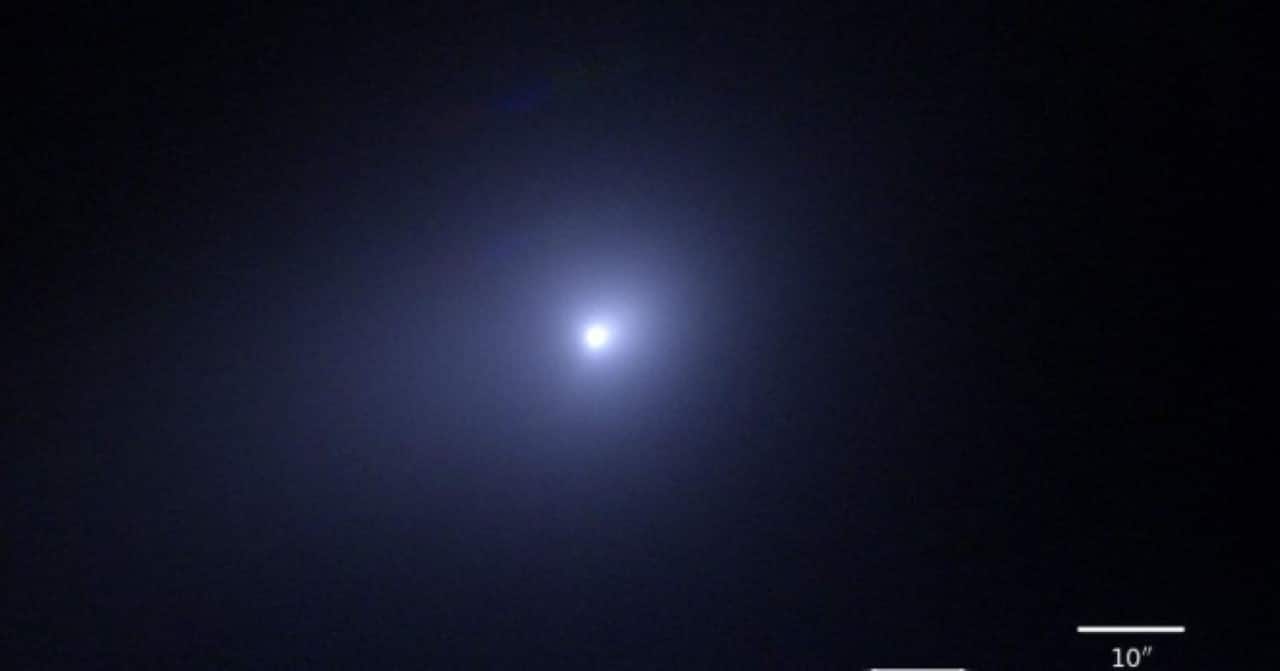
Discovery and trajectory of 3I/ATLAS
The ATLAS system identified the comet on July 1, 2025, at Chile, during a routine scan for potentially dangerous asteroids. Later Análises confirmed its interstellar origin by orbital eccentricity of about 6.139 and speed relative to Sol of 57.7 km/s.
The object reached perihelion on October 29, 2025, at 1.36 astronomical units from Sol. Desde then follows the exit trajectory of Sistema Solar, with a close passage to Júpiter scheduled for March 16, 2026, at 0.358 astronomical units.
Orbital data show retrograde inclination close to 175 degrees, a distinct characteristic of local comets. Observações with space telescopes recorded visible coma and gaseous emissions, differentiating it from the first interstellar object, ‘Oumuamua, which did not show similar activity.
Optical phenomenon of opposition surge
The alignment will activate the so-called opposition flare, an increase in brightness observed when the phase angle approaches zero. Esse effect results from two main mechanisms: occultation of shadows between dust particles and coherent backscattering of sunlight.
In Sistema Solar comets, the phenomenon has already been measured in limited cases, such as 67P/Churyumov-Gerasimenko. Para interstellar objects, however, there was never a similar opportunity, as the second confirmed comet, 2I/Borisov, maintained phase angles above 16 degrees.
- Shadow-hiding occurs at angles greater than 2 degrees and eliminates shadows cast by particles.
- Coherent backscatter dominates below 2 degrees and produces constructive interference from reflected light.
- Amplitude of the flare depends on the albedo and structure of the dust grains.
- Angular width varies depending on the packing of the particles.
Expected observational conditions
Telescopes with an aperture greater than 1 meter will be required for accurate photometry at the expected magnitude. Observações multi-bands, in at least three filters, will help to distinguish the optical mechanisms involved.
Linear polarimetry close to the minimum angle will provide additional information about the grain structure. Coordenação between observatories at different longitudes will ensure continuous temporal coverage and minimize interruptions due to weather conditions.
The one-week window allows us to separate variations in brightness caused by the comet’s burst of intrinsic oscillations. Relative Precisão less than 0.03 magnitudes per data point is recommended for robust results.
Dust composition and characteristics
Spectroscopic analyzes indicate a high proportion of carbon dioxide in relation to water ice in the 3I/ATLAS coma. Presença of nickel-rich gas and signatures of carbonaceous material suggest formation in an ancient planetary system, more than seven billion years old.
Dust may have a low albedo, typical of carbonaceous compounds, or higher if it includes fragments of processed ice. The burst of opposition will help determine whether the grains are compact or fractal aggregates, revealing environmental conditions of origin.
Recent images of Telescópio Espacial Hubble show a collimated structure in the anti-tail, directed towards Sol. Essa feature persists after perihelion and indicates jet dynamics distinct from common solar comets.
Larger-than-expected particles were detected in jets facing Sol. Essa feature challenges standard models of sublimation and suggests unique surface processes in the cometary nucleus.
Scientific importance of the event
The alignment represents the first chance to characterize interstellar dust in the closely opposed regime. Dados collected could clarify differences between pristine material from external molecular clouds and processed dust in protoplanetary disks.
Comparisons with local comets will highlight compositional variations between stellar systems. Informações on albedo and grain packing will contribute to models of planetary formation in distant environments.
Additional observations made
Telescopes such as James Webb and Hubble have already captured data from the comet in earlier phases of its trajectory. Registros include emissions of cyanogen, carbon monoxide and traces of atomic nickel, compatible with natural cometary composition.
Searches for artificial signals, conducted with radio telescopes, did not detect anomalous emissions. Resultados reinforce the object’s classification as an interstellar comet of natural origin.
Observations by ESA’s Juice probe took place in November 2025. Transmissão of the data is scheduled for February 2026 due to thermal restrictions during passage through the inner Sistema Solar.
Future trajectory of the comet
After rendezvous with Júpiter in March 2026, 3I/ATLAS will continue accelerating away from Sistema Solar. Projeções indicate that it will reach the inner cloud region of Oort around 2189.
In 2027, the comet will be 16 astronomical units from Sol, with an estimated magnitude of 24. A year later, the distance will grow to 28 astronomical units and an even weaker brightness.
The 2026 alignment may not be repeated for decades, making the current event especially valuable. Observações coordinates will maximize the scientific return from this single pass.
Preparation of the astronomical community
Institutions on several continents plan observational campaigns dedicated to the January period. Redes of professional and amateur telescopes will contribute to broad temporal sampling.
Protocols include high-precision photometry and polarimetric monitoring. Rapid Compartilhamento of data will facilitate preliminary analyzes during the observation window itself.
The event reinforces the need for permanent infrastructure to study interstellar objects. Aumento expected rate of discoveries, with new telescopes, demands coordinated global strategies.
- International coordination optimizes 24-hour coverage.
- Space telescopes complement ground-based observations.
- Public data accelerates independent analysis.
- Standardized protocols guarantee comparability of results.
The 3I/ATLAS alignment offers a rare window to advance knowledge about matter outside Sistema Solar. Observações systematics during the critical week will produce lasting scientific legacy on interstellar composition.



