
Rare planetary alignment will allow us to unlock the secrets of the interstellar comet 3I/Atlas

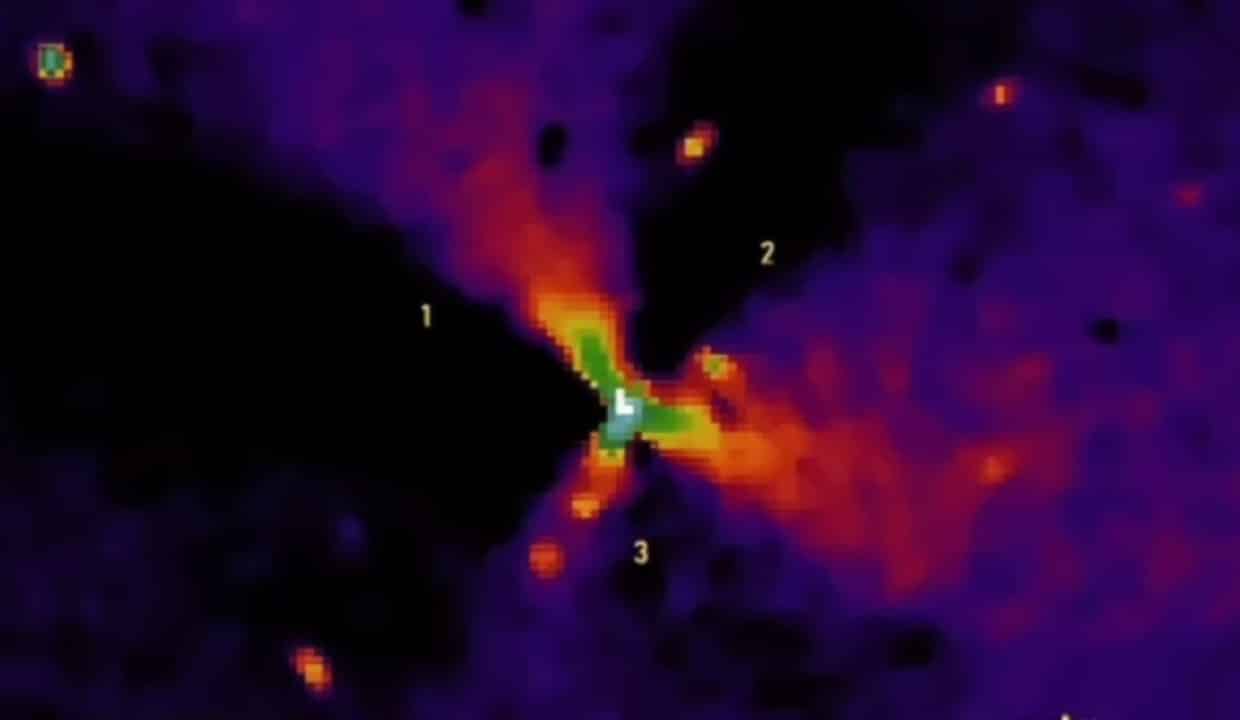
The global astronomical community is counting down to a celestial event of rare magnitude. Nos In the coming days, comet 3I/Atlas, a visitor from another star system, will position itself uniquely in relation to Terra and Sol, offering an unprecedented opportunity to uncover their deepest secrets. Este phenomenon will allow scientists to analyze its composition in detail never before possible.
Detected in mid-2025, 3I/Atlas is the third interstellar object ever recorded, and its trajectory through our solar system has been followed with great interest. The main expectation is that the data collected will help answer fundamental questions about the formation of planets and comets in other regions of the galaxy, providing a direct glimpse into materials that did not originate in our cosmic neighborhood.
The mobilization of telescopes around the globe is intense, as the ideal observation window will be short and will not be repeated. The study of this celestial body represents a milestone for astronomy, potentially confirming or reformulating theories about interstellar matter and the diversity of planetary systems in Via Láctea.
A unique cosmic opportunity
Studying interstellar objects like 3I/Atlas is like receiving a message in a bottle from an unknown cosmic beach. Diferente of comets and asteroids that belong to our Sistema Solar, these travelers bring with them the chemical composition and physical properties of their original environment, which can be drastically different from ours. Analysis of its dust and gas works like a remote probe, revealing conditions in distant star systems without the need to send spacecraft on journeys that would last millennia. 3I/Atlas, with its impressive speed and anomalous characteristics, stands out from its predecessors, ‘Oumuamua and 2I/Borisov, promising a much richer and more detailed volume of data. Its passage is therefore a natural laboratory for testing our theories about how the building blocks of life and planets are distributed across the galaxy.
January’s perfect lineup
The high point of the observation campaign is scheduled for January 22, 2026. On this date, an extremely precise astronomical alignment will occur, in which Terra will be positioned almost perfectly between Sol and the comet. Essa configuration will result in a phase angle — the Sol-comet-Earth angle — of just 0.69 degrees. Para terms of comparison, is an exceptionally low value, rarely reached by comets in their orbits.
This ideal positioning will not be limited to a single day. Astronomers will have a privileged observation window that will last approximately one week, between January 19th and 26th. Durante this period, it will be possible to observe a phenomenon known as the Seeliger effect, which causes a sudden and significant increase in the brightness of the dust surrounding the comet, providing crucial data on the properties of the particles that make it up.
Understanding the rare Seeliger effect
The Seeliger effect, also known as the opposition peak, is an optical phenomenon that occurs when an observer sees a celestial body with the Sol directly behind it. Nessa configuration, the object’s surface, made up of irregular particles, reflects sunlight back to the observer much more efficiently, causing a peak in brightness.
The rarity of this event for comets is due to the need for extremely small phase angles, something that most cometary orbits do not allow. The previous interstellar comet, 2I/Borisov, for example, was never observed at an angle of less than 16 degrees, which made detailed study through this effect impossible.
Therefore, analysis of the 3I/Atlas light curve during the opposition peak will act as a powerful diagnostic tool. The intensity and rapidity of the increase in brightness will provide direct clues about the texture, porosity and microstructure of the dust ejected by the comet.
The physics behind intense glow
Two main physical mechanisms explain the dramatic increase in brightness during the Seeliger effect. The first is known as shadow hiding. Quando we see the comet head on, with Sol behind us, the shadows cast by each grain of dust are hidden behind the grains themselves, from our point of view.
This makes the comet’s visible area appear fully illuminated, without the dark areas that would normally exist between the particles. As the phase angle approaches zero, shadow hiding becomes maximum, resulting in a strong increase in the overall observed brightness.
The second mechanism is coherent backscatter. Este is a more complex phenomenon, which occurs at the level of light waves. Quando sunlight strikes the comet’s surface, the waves can travel along multiple paths between the particles before being reflected back in the Terra direction.
At phase angles close to zero, these multiple light paths can overlap and interfere constructively, that is, their crests and valleys align, amplifying the intensity of the reflected light. Analyzing this effect allows scientists to infer the size and spacing of dust particles with great precision.
Ice or organic matter in the core
One of the biggest questions about 3I/Atlas is its composition. The Seeliger effect will provide an accurate estimate of the comet’s albedo, which is a measure of its ability to reflect sunlight. The albedo value is a key indicator for determining what the comet is made of.
If the measurements point to a low albedo, around 0.03, it will mean that the comet is extremely dark, similar to coal. Isso would suggest a composition rich in organic compounds and carbon. On the other hand, a higher albedo, between 0.1 and 0.3, would indicate an ice-rich surface, reinforcing previous observations that suggested this possibility.
A race against celestial time
The urgency to carry out these observations is maximum. Atualmente, comet 3I/Atlas is about 3.33 astronomical units from Sol, a distance that still allows its detection by medium and large telescopes, with a brightness of magnitude 16.7. However, its high speed is quickly taking it away from us.
Projections indicate that in January 2027, its brightness will drop to magnitude 24. At that point, it will be so faint that only the largest observatories in the world, such as Very Large Telescope in Chile or space telescopes, will be able to detect it, making detailed studies extremely difficult. The January 2026 window is therefore the last major opportunity to investigate this interstellar visitor.
The debate about its anomalies
The comet has also attracted attention for its unusual features, such as an “anti-tail” and light polarization properties that have intrigued scientists. Astrophysicist Avi Loeb, from Universidade of Harvard, has publicly argued that the scientific community should make the most of the observation window to collect data that can explain these anomalies, which differ from the behavior of comets typical of our



