
Safe approach to asteroid 2005 UK1, classified as dangerous, occurred at 12 million km


A large celestial body, identified as 2005 UK1, completed its most recent approach to Terra on January 12. The event was monitored by space agencies around the world and occurred without any risk of collision, with the object passing at a safe distance of approximately 12.4 million kilometers from our planet.
This distance is more than 32 times the average separation between Terra and Lua, which ruled out any possibility of gravitational effects or other interference. The closest point was recorded precisely at 10:26 am in coordinated universal time, according to data from Laboratório from Propulsão to Jato from Nasa.
The asteroid, which moves at a relative speed of about 13 kilometers per second, continued its trajectory through Sistema Solar after passing. Intensive monitoring ensured that all orbital parameters were aligned with predictions, reinforcing the effectiveness of space surveillance systems.
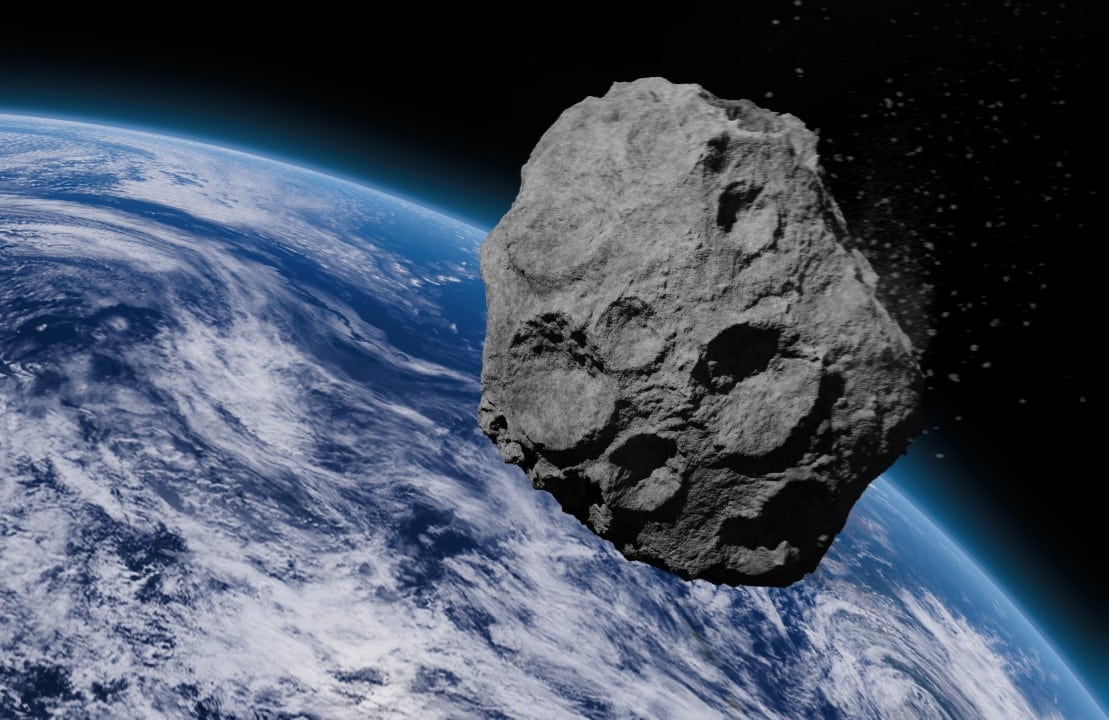
2005 UK1 trajectory details
First identified on October 24, 2005 by the Mount Lemmon Survey team, at Arizona, asteroid 2005 UK1 belongs to the Apollo class. The Essa category includes celestial bodies whose orbits intersect that of the Terra, making them objects of particular interest to the scientific community and planetary defense programs. The discovery was the result of systematic scans of the sky, designed to detect objects close to our planet.
Its elliptical orbit around Sol has a period of approximately 3.97 years. Essa trajectory causes it to make periodic approaches to Terra, such as those recorded in April 2018 and now in January 2026. The inclination and eccentricity of its orbit are crucial factors that determine the minimum distance in each of these passages, which until now have always occurred millions of kilometers away.
Why the asteroid is considered potentially dangerous
The Nasa classifies the 2005 UK1 as an Asteroide Potencialmente Perigoso (PHA), a designation that does not indicate an imminent threat, but rather the need for continued monitoring. Essa classification is based on two technical criteria well defined by the space agency.
The first criterion is size. Para to be classified as PHA, an asteroid must have a diameter greater than 140 meters, a size considered sufficient to cause significant regional devastation in the event of a direct impact with Terra. The 2005 UK1 far exceeds this measure.
The second requirement involves the minimum orbital approach distance. The object’s orbit should allow it to approach within 0.05 astronomical units of Terra, which is equivalent to about 7.5 million kilometers. Embora January passage was at a greater distance, the future trajectory of 2005 UK1 justifies its inclusion in the surveillance catalogue.
Dimensions and the nickname ‘planet killer’
Estimates of the size of 2005 UK1, based on its brightness and the way it reflects sunlight, point to a diameter that varies between 600 meters and 1.4 kilometers. Essa scale places it among the 3% largest asteroids ever recorded in close passes to Terra, which earned it the informal and alarmist nickname “planet killer”.
This term is used to describe objects with the potential to cause consequences on a global scale if they collided with the planet. The energy released by an impact of this magnitude could alter the climate and entire ecosystems, a scenario that motivates international planetary defense efforts.
For comparison purposes, the asteroid is significantly larger than the celestial body responsible for the Tunguska event in 1908. On the Naquela occasion, an object about 50 meters in diameter exploded in the atmosphere and devastated an area of more than 2,000 square kilometers of forest in Sibéria.
It also far surpasses the Chelyabinsk meteor, which in 2013, at just 20 meters, generated a shock wave that injured more than a thousand people in Rússia. Felizmente, geological and astronomical studies indicate that collisions with bodies the size of 2005 UK1 are extremely rare events, occurring every million years.
The constant surveillance of Nasa and other programs
Detecting and tracking objects like 2005 UK1 is possible thanks to a global network of observatories and surveillance programs. Sistemas like Pan-STARRS, in Havaí, and Catalina Sky Survey, in Arizona, are responsible for mapping the night sky and identifying thousands of asteroids and comets annually.
This data is centralized and analyzed by Centro from Estudos from Objetos Próximos to Terra (CNEOS) from Nasa. The CNEOS team uses the information to calculate the future trajectories of these objects with high precision, predicting approaches and assessing any potential risk decades or even centuries in advance.
The scientific importance of approaches like this
Each passage of an asteroid close to Terra represents a valuable scientific opportunity. Esses events allow astronomers to study these celestial bodies in greater detail, using ground- and space-based telescopes to analyze their composition, shape, and rotation speed. Observatórios like Virtual Telescope Project, for example, managed to capture images of 2005 UK1 during its approach, providing data that helps to better understand its nature. Asteroides are considered remnants of the formation of Sistema Solar, about 4.6 billion years ago, and studying them is like looking into a cosmic time capsule. Analysis of its chemical composition, using techniques such as spectroscopy, can reveal information about the conditions at the beginning of our planetary system and even about the presence of mineral resources. Além In addition, accurate monitoring of their orbits is fundamental for the development and testing of planetary defense strategies, such as the successful DART mission of Nasa, which in 2022 demonstrated that it is possible to divert the trajectory of an asteroid through a kinetic impact.
Future passages and the risk of impact
The most recent orbital calculations indicate that the next notable close approach to asteroid 2005 UK1 will occur in December 2029, and again at a completely safe distance to Terra. Long-term projections, which span centuries, do not point to any risk of collision. Continuous monitoring is essential, as small gravitational perturbations, caused by the influence of other planets, can subtly alter an asteroid’s trajectory over time. However, current systems are capable of detecting these variations well in advance, ensuring that any future risk is identified in time for action to be taken.



