
New generation of Toyota RAV4 debuts with exclusively hybrid powertrain and Prius-inspired look


Toyota has officially revealed the sixth generation of its most successful SUV globally, the RAV4. The model, which has its initial launch scheduled for the Japanese market, completely abandons combustion engines and is now offered exclusively with hybrid technology. Além of the profound mechanical change, the vehicle adopts a new visual identity, in line with the brand’s most recent launches, and incorporates a significantly more advanced technological package.
The manufacturer’s strategy is clear: reinforce the RAV4’s position as a sales leader in the compact SUV segment, focusing on energy efficiency, connectivity and a bolder design. The updates range from the body structure to the onboard software, which now allows remote updates (over-the-air), keeping the vehicle always up to date without the need for visits to the dealership.
New generation units have already been spotted testing at Brasil since the middle of the previous year, indicating that their arrival on the national market is a priority. The expectation is that the launch in the country will take place during the first half of 2026, possibly with hybrid flex technology, already used in other models of the brand in the country, such as the Corolla and the Corolla Cross.
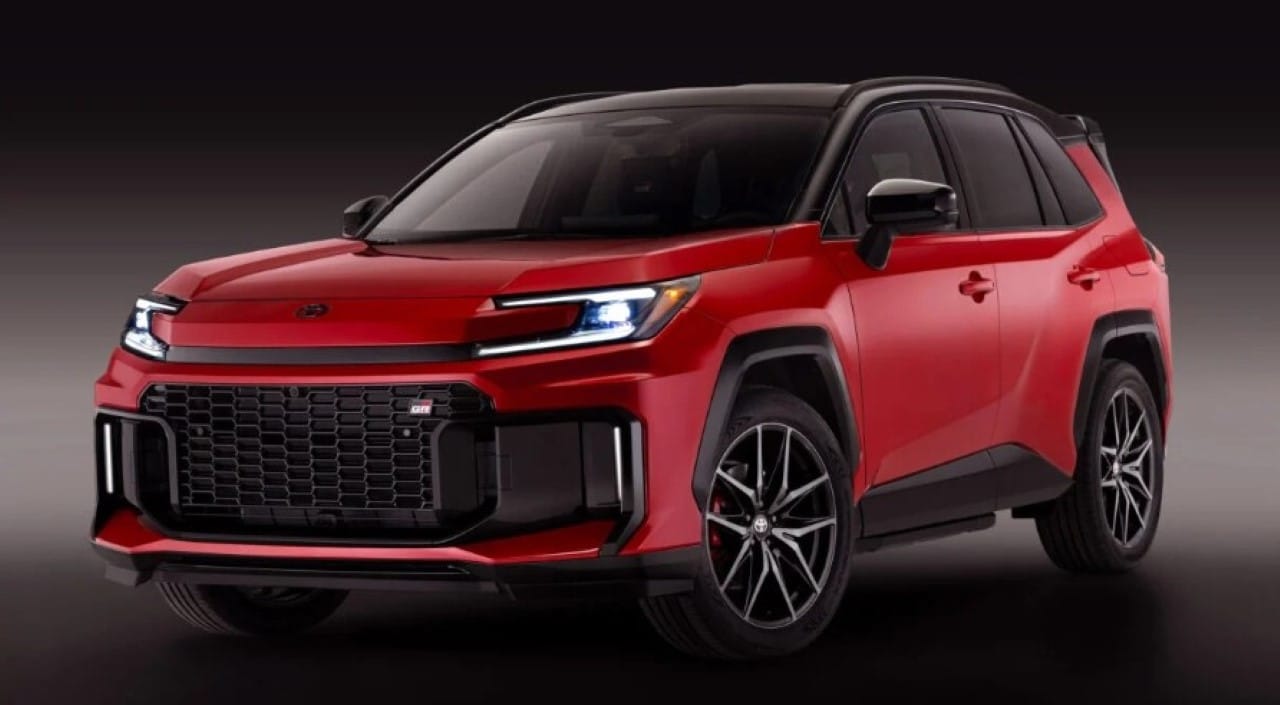
The initial prices for the Japão were established between 4.5 million and 4.9 million yen for the top versions, Adventure and Z.
The new ‘hammer head’ design
The main aesthetic change of the new RAV4 is at the front, which adopts the visual language known as “hammerhead”. Caracterizada with tapered LED headlights and a grille integrated into the bumper, this configuration replaces the more robust and angular style of the previous generation with more fluid and contemporary lines, seen in models such as the Prius and the Crown. Apesar of the modernization, the Toyota maintained characteristic elements of an SUV, such as the high ground clearance and the capacity for large diameter tires, preserving the vehicle’s imposing stance. The sides gained softer creases and pronounced fenders, while the rear features lights interconnected by a luminous horizontal bar, a visual signature increasingly common in the brand’s vehicles. Essas changes are not just aesthetic; They also contribute to improved aerodynamics, which helps reduce fuel consumption.
Improved interior and onboard technology
The RAV4 cabin has been completely redesigned to offer a more technological and comfortable experience. The big highlight is the new multimedia center, whose screen can reach 14 inches, depending on the version. The operating system has been updated and now allows remote updates, ensuring that functions and applications are always on the latest version.
Despite digitalization, the Toyota chose to maintain physical controls for essential functions, such as air conditioning and audio volume, a decision that prioritizes ergonomics and safety while driving. The materials used in the finishing were improved, with a greater presence of soft-touch surfaces and synthetic leather covering options.
The interior space was slightly increased, benefiting the comfort of passengers in the rear seat and the trunk capacity. The instrument panel is now fully digital and configurable, integrating information from navigation and driver assistance systems. Recursos as an induction cell phone charger and multiple USB-C ports become standard items.
Exclusively hybrid engine
The sixth generation of the RAV4 retires the purely combustion engines and adopts the Toyota parallel hybrid system as the only option. The set combines a 2.5 gasoline engine with electric drives to deliver a combined power of up to 226 horsepower in the standard configuration. Essa update results in more agile acceleration, with the 0 to 100 km/h time reduced by approximately half a second compared to the previous model. The drive can be front or all-wheel drive, of the E-Four type, which uses a dedicated electric motor to move the rear wheels, distributing torque intelligently to ensure greater stability and capacity on low-grip terrain.
In selected markets, the SUV will also feature a plug-in hybrid (PHEV) version. Equipada with a larger capacity battery, this variant offers an electric range of more than 100 kilometers, allowing daily urban journeys to be carried out without pollutant emissions. Recharging can be done using common sockets or at fast charging stations. Confirmation of this version for the Brasil is still uncertain, but the tendency is for the initial focus to be on the conventional hybrid system with flex technology.
Enhanced security with Toyota Safety Sense
The Toyota Safety Sense security suite has been updated to its latest generation, bringing more advanced and accurate features. The automatic emergency braking system, for example, now features pedestrian detection even in nighttime conditions, increasing safety in urban environments.
Adaptive cruise control (ACC) has been improved to work at low speeds, being especially useful in traffic jams, as it can stop and resume acceleration autonomously. The lane keeping assistant also received improvements, correcting the vehicle’s trajectory more smoothly and accurately.
To make maneuvering in tight spaces easier, the new RAV4 is equipped with a 360-degree camera system and ultrasonic sensors. Blind spot monitoring alerts the driver to the presence of vehicles in areas that are difficult to see, increasing safety when changing lanes.
The body structure now uses a higher percentage of high-strength steel, which improves impact absorption in the event of collisions. Occupant protection is complemented by curtain airbags, side airbags and a central airbag, ensuring the model achieves the highest ratings in international safety tests.
Versions and market positioning
In the Japão, the initial launch includes two main versions: Adventure and Z. The first has a more robust and off-road visual appeal, while the second focuses on a more sophisticated and urban finish. Ambas share the same hybrid package and advanced technology package.
On the Estados Unidos, the range of options is wider, including finishes such as the Woodland, which comes with raised suspension and mixed-use tires. The Limited version is positioned as the top of the line, with all available equipment. Essa diversity of versions shows the RAV4’s ability to meet different consumer profiles.
Expectations for the Brazilian market
The arrival of the new RAV4 at Brasil in the first half of 2026 should intensify competition in the medium SUV segment. The model will compete directly with rivals such as the Honda CR-V, Volkswagen Tiguan and a growing range of electrified models from Chinese brands. Toyota’s main bet to stand out in the national market will be the offering of flex hybrid technology, which optimizes the vehicle’s efficiency with the use of ethanol.
The trajectory of a pioneering SUV
Originally launched in 1994, the Toyota RAV4 was one of the forerunners of the compact SUV segment. Over five generations, the model has evolved from a niche vehicle to one of the best-selling cars in the world. The fifth generation, introduced with the modular TNGA platform, was a milestone in popularizing hybrid options.
Now, the sixth generation goes a step further by completely eliminating combustion engines, aligning the RAV4 with Toyota’s global electrification and carbon neutrality strategy. Essa transition reflects a trend that should be followed by other models of the brand in the coming years, consolidating hybridization as the new standard in the automotive industry.



