
Agência Espacial Norte-Americana (NASA) is advancing preparations for the Artemis 2 mission, which will mark the return of astronauts to lunar orbit after more than five decades. The operation, which will use the powerful Space Launch System rocket (SLS) and the Orion capsule, has its launch window scheduled for the beginning of February, representing a fundamental milestone in the program that aims to establish a sustainable human presence on Lua.
The crew, made up of four experienced astronauts, will carry out a flight lasting approximately ten days that will follow a lunar flyby trajectory, similar to that followed by the unmanned mission Artemis 1 in 2022. The main objective is to test the life support systems of the Orion spacecraft and validate flight capabilities with a team on board, ensuring safety for future missions that will include a landing on the lunar surface.
The activities at Kennedy Space Center, at Flórida, are in the final phase, with the integration of the SLS-Orion set and system verification tests. The mission is seen as a decisive step towards consolidating the Estados Unidos’s leadership in deep space exploration and strengthening international collaboration, paving the way for even greater challenges, such as an eventual manned mission to Marte.

An experienced crew for a historic flight
The team selected for Artemis 2 is a mix of veterans and an international representative, reflecting the collaborative nature of the program. The mission is commanded by Reid Wiseman, an astronaut from Nasa with extensive experience in space flights, including a long stay on the Estação Espacial Internacional (ISS). Sua leadership will be crucial to coordinating all phases of the flight, from launch to return to Terra. At his side, as pilot, will be Victor Glover, also from Nasa, who was the first black astronaut to complete a long-term mission on the ISS. Glover will be responsible for maneuvering the Orion capsule during the most critical moments of the journey, testing the spacecraft’s manual controls in the deep space environment.
Two mission specialists complete the team. Christina Koch, of Nasa, holds the record for the longest continuous spaceflight ever performed by a woman and will bring her expertise in science and systems operations. The international presence is guaranteed by Jeremy Hansen, from Agência Espacial Canadense (CSA), which will make its first flight into space. Sua participation highlights the importance of global partnerships to the success of the Artemis program. Juntos, the four astronauts will not only test technology, but also inspire a new generation of explorers, paving the way for humanity’s return to Lua.
The main objectives of the lunar journey
The Artemis 2 mission was designed with a series of rigorous technical goals to validate the Orion spacecraft in a real crewed environment. The main focus is the complete verification of environmental control and life support systems. Engenheiros in mission control on Houston will closely monitor the performance of equipment responsible for supplying oxygen, controlling internal temperature and removing carbon dioxide exhaled by astronauts.
Another fundamental point of the mission is to test the maneuverability and navigation capabilities of the Orion under human command. The astronauts will perform a series of trajectory adjustments and piloting tests to evaluate the capsule’s response. Essas maneuvers are essential to ensure that future crews can control the spacecraft accurately during the approach and docking phases with other structures in lunar orbit, such as the Gateway station.
Collecting data about the deep space environment is also a priority. The Orion is equipped with sensors to measure cosmic radiation levels outside the Terra’s protective magnetic field. The information obtained will be vital to develop better protection strategies for astronauts on long-duration missions, both on Lua and on future trips to Marte.
Finally, the mission will serve as a full operational validation of the integration between the SLS rocket and the Orion capsule. The launcher’s performance during ascent, stage separation and translunar injection will be analyzed to confirm the reliability of the system for more complex flights, such as that of Artemis 3, which plans the first manned lunar landing of the 21st century.
Mission trajectory and duration details
The Artemis 2 flight plan was carefully designed to maximize safety and data collection. Após the launch of Kennedy Space Center, the Orion capsule will perform a high orbit around Terra so the crew can check all the spacecraft’s systems. Após this initial check, the upper stage of the SLS rocket will perform an engine burn to propel the Orion on the translunar trajectory.
The journey to Lua will take approximately four days. The trajectory does not foresee entry into lunar orbit, but rather a hybrid free return route. The capsule will fly over the hidden side of Lua, using the natural satellite’s gravity to propel itself back to Terra. Durante this flyby, the crew will reach a maximum distance of around 400 thousand kilometers from our planet, further than any human being has ever traveled.
The return journey will also last about four days, culminating in a high-speed re-entry into the Earth’s atmosphere. The Orion’s heat shield will be tested in extreme conditions, withstanding temperatures of almost 2,800 degrees Celsius. The ten-day mission will end with a parachute-assisted landing (splashdown) at Oceano Pacífico, where US Marinha rescue teams will be positioned to recover the capsule and crew.
Final preparations at Kennedy Space Center
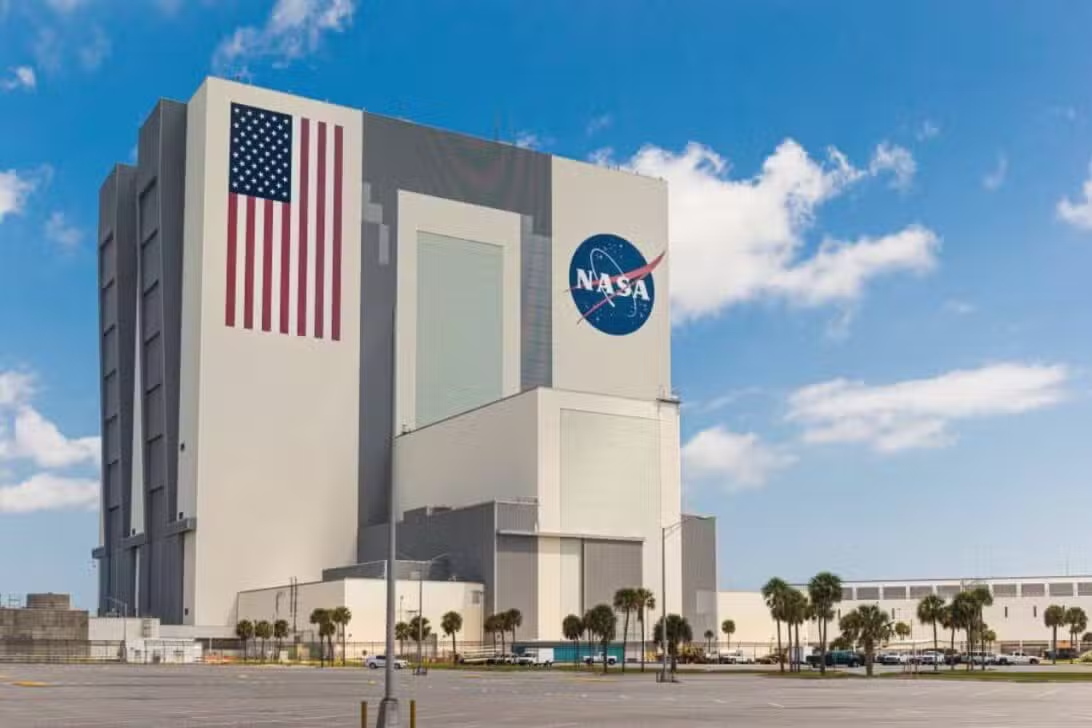
The preparations at Kennedy Space Center, at Flórida, represent the culmination of years of work by thousands of engineers, technicians and scientists. The final phase of operations focuses on the iconic launch platform 39B, the same one that served the Apollo program and the space shuttles. Nas next few weeks, the gigantic SLS rocket, with the Orion capsule attached to its top, will be transported from Edifício of Montagem of Veículos (VAB) to the platform. Este transport, carried out by a tracked vehicle, is a notable event that signals the proximity of the launch. Once on the platform, teams will carry out a series of crucial checks, including filling the tanks with liquid hydrogen and oxygen and electrical and data connection tests. Diversas countdown simulations, known as “wet dress rehearsals”, will be conducted to ensure that all systems and teams are perfectly synchronized. The tests include checking the emergency abort systems, calibrating all scientific instruments and carrying out detailed inspections of the Orion’s heat shield, a vital component for the crew’s safety during re-entry into the Earth’s atmosphere. Paralelamente, the crew completes their final training sessions in high-fidelity simulators, reviewing each step of the flight plan and emergency procedures.
Technology on board the Orion capsule
The Orion capsule is one of the most advanced spacecraft ever built, designed specifically for deep space missions. The Seu crew compartment offers a habitable volume greater than that of the Apollo program capsules, allowing four astronauts to live and work comfortably for up to 21 days. The life support systems are state-of-the-art, capable of recycling part of the air and water, optimizing the use of resources on long missions.
The spacecraft’s power is provided by four “X”-shaped solar panels, which are part of Módulo of Serviço Europeu (ESM), a contribution from Agência Espacial Europeia (ESA). The ESM also houses the Orion’s main propulsion system, responsible for course correction maneuvers and insertion into the return trajectory to Terra, in addition to storing oxygen, nitrogen and water for the crew.
The role of international partnerships
The Artemis program is fundamentally a global collaborative effort, and the Artemis 2 mission exemplifies this approach. The participation of Jeremy Hansen, of Agência Espacial Canadense, is one of the main symbols of this partnership. Canadá is a long-time partner of Nasa in space exploration, responsible for the development of Canadarm3, an advanced robotic arm that will be installed on the future Gateway lunar space station.
In addition to the Canadá, the Agência Espacial Europeia (ESA) plays an indispensable role in providing the Módulo of Serviço Europeu to the Orion capsule. Essa contribution is vital to the propulsion and life support of the spacecraft. Agência of Exploração Aeroespacial of Japão (JAXA) also collaborates with the program, contributing technologies for the Gateway station and future lunar rovers. Essas international alliances not only distribute the costs of the program, but also unite the scientific and technological expertise of different nations towards a common objective.
Um passo crucial para o futuro da exploração
Artemis 2 is much more than a simple test flight; it represents the bridge between the success of the robotic mission Artemis 1 and the ambitious goal of Artemis 3 to land humans again on Lua, including the first woman and the first person of color. The data and operational experience gained during this ten-day journey will be key to refining procedures and mitigating risks for future surface missions. The success of this mission will validate the exploration architecture of Nasa and solidify the timeline for establishing a sustainable human presence on our natural satellite, an essential step towards the future exploration of Marte.