
Avi Loeb detects new anomaly in the gas plume of interstellar comet 3I/ATLAS


Astronomer Avi Loeb, from Universidade Harvard, released an analysis of images captured by the SPHEREx space telescope that reveal an anomaly in the gas plume around the interstellar comet 3I/ATLAS after its passage through perihelion. The observations, carried out between December 8 and 15, 2025, show a 20-fold increase in water emission compared to previous data from August of the same year. Essa difference suggests significant changes in the object’s activity after its closest approach to Sol.
Comet 3I/ATLAS, the third interstellar object confirmed in Sistema Solar, was discovered in July 2025 by the ATLAS system. Sua hyperbolic trajectory indicates origin outside our system, similar to the previous ‘Oumuamua and Borisov. The new images highlight unusual features in the release of volatile materials.
The gas plumes appear almost spherical, while the dust forms an elongated structure in the opposite direction to the Sol. Essa’s configuration differs from patterns observed in comets from Sistema Solar.
Discovery and trajectory of 3I/ATLAS
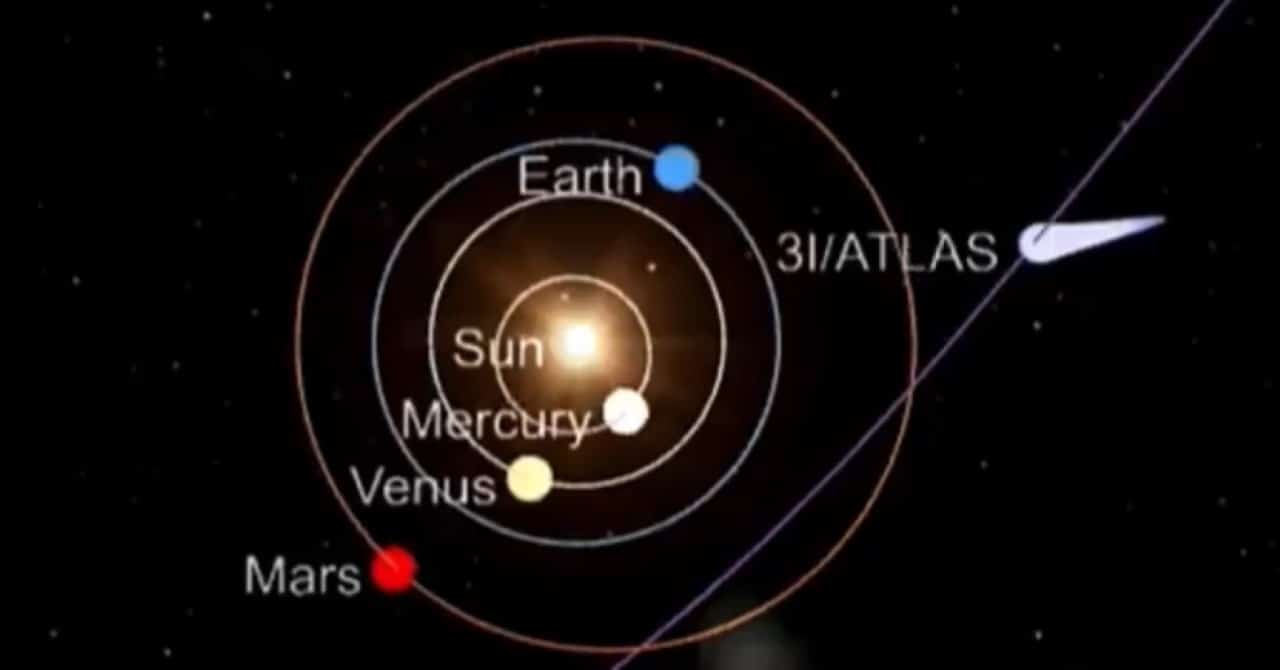
Comet 3I/ATLAS was initially identified on July 1, 2025 by the ATLAS telescope on Chile. Later Observações confirmed its hyperbolic orbit, with excessive speed that prevents gravitational capture by Sol. The object passed perihelion between October 29 and 30, 2025, about 1.4 astronomical units from Sol.
During its approach, the comet exhibited intense activity, releasing gases and dust. Preliminary Dados indicated a composition rich in carbon monoxide and carbon dioxide, common in objects distant from Sistema Solar. The minimum distance to Terra was approximately 1.8 astronomical units, without risk of collision.
SPHEREx mission and recent captures
The SPHEREx mission, launched by NASA in 2025, performs near-infrared sky mapping. The telescope captures images in ranges of 0.75 to 5.0 microns, ideal for detecting cometary gas emissions. Cada image covers areas of hundreds of thousands of kilometers, comparable to the Terra-Moon distance.
In post-perihelion observations in December 2025, the instrument recorded six nearly round gaseous plumes. Espécies identified include:
- Cyanide (CN) at 0.93 microns;
- Water (H2O) at 2.7–2.8 microns;
- Organic compounds (C-H) at 3.2–3.6 microns;
- Carbon dioxide (CO2) at 4.2–4.3 microns;
- Carbon monoxide (CO) at 4.7–4.8 microns.
These detections allow detailed analysis of the comet’s volatile composition.
Details of the anomaly in the gas plume
Analysis of Loeb highlights the substantial increase in the rate of mass loss after perihelion. Water emission registered a 20-fold increase in relation to pre-perihelion data. Taxas estimates reach 180 kg/s for water and carbon dioxide, with a significant contribution from carbon monoxide.
The dust plume is pear-shaped, with anti-tail elongation directed towards Sol. Já the gas plumes maintain spherical symmetry, suggesting distinct sources in the core. The absence of sub-micron particles prevents tail pattern formation by solar radiation pressure.
The post-perihelion reflectance spectrum shows transition from ice-domain to low-albedo dust-domain. Grãos organic-silices dominate the continuum, with no clear absorption of water ice.
Composition and release rates
Spectrophotometric studies indicate that cyanide and organics derive mainly from dust. Já water, carbon dioxide, and carbon monoxide come from symmetric regions in the nucleus. Essa separation implies different sublimation mechanisms.
The carbon dioxide plume extends hundreds of thousands of kilometers. The lack of fine particles suggests the presence of larger icy fragments, possibly with diameters greater than 10 meters. Esses fragments would preserve primordial material not thermally processed.
The amount of dust needed to explain the observed glow requires extensive surface area. Isso reinforces the hypothesis of significant fragmentation during perihelion.
Comparison with known comets
Unlike solar comets, 3I/ATLAS does not exhibit a tail dominated by radiation pressure. Seu post-perihelion spectrum presents light scattering with a bluish tone in the dust. Objetos like comet Borisov, second interstellar, showed compositions closer to solar ones.
‘Oumuamua, first interstellar, exhibited non-gravitational acceleration with no visible coma. Já 3I/ATLAS presents an extensive plume, but with unique asymmetries. Essas differences highlight variability among interstellar visitors.
Additional observations are needed to clarify origins of these characteristics. Dados of multiple instruments contribute to understanding extrasolar objects.
Additional observations and debates
Images of Hubble in January 2026 recorded peculiar geometry in the comet’s jets. Algumas structures maintain stable alignment, defying expectations of rotation. Outras detections include elevated ratios of nickel to iron in gaseous vapors.
Scientists seek natural explanations for these observations. Modelos of fragmentation and primordial composition of distant regions of the galaxy gain support. Discussões academics emphasize the need for more spectroscopic data.
The astronomical community follows the object as it moves away from Sistema Solar. Telescópios terrestrial and space-based activities continue monitoring to record final variations in activity.
Context of interstellar objects
The detection of interstellar objects has increased with advances in surveys such as ATLAS. ‘Oumuamua, discovered in 2017, had an elongated shape and anomalous acceleration. Borisov, in 2019, exhibited a comet-like coma and tail.
3I/ATLAS represents the third confirmed case, with an intermediate mass and size. Sua passage offers rare opportunity to study materials from other stellar systems. Composições volatiles reveal formation conditions in distant environments.
Future research with missions like SPHEREx expands the catalog of interstellar visitors. Estatísticas indicate frequent passage of such objects through the internal Sistema Solar.



