
Avi Loeb points out anomalies in 3I/ATLAS that suggest possible extraterrestrial artificial origin

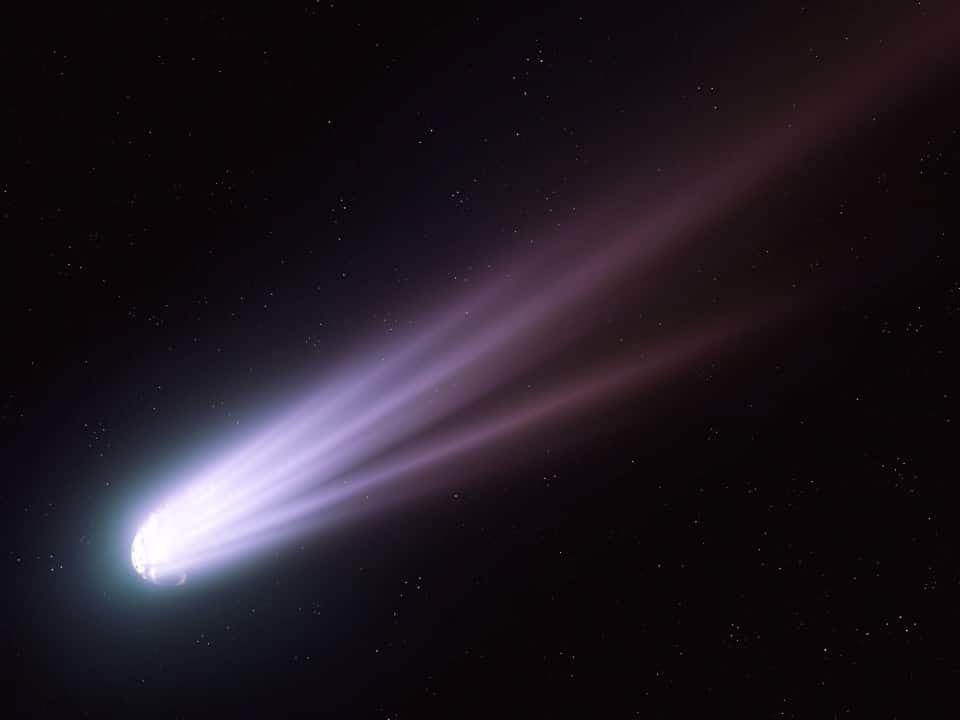
The interstellar object 3I/ATLAS, the third confirmed visitor from outside Sistema Solar, continues to be monitored by telescopes around the world in January 2026.
Images taken by Telescópio Espacial Hubble on January 14, 2026 revealed an unusual structure around the nucleus, with three mini-equidistant jets separated by 120 degrees, as well as a prominent anti-tail aimed at Sol. Essas observations, processed with special filters, highlight features that differ from known comets.
Astrophysicist Avi Loeb, from Universidade Harvard, interprets these configurations as potential signs of technological origin, although the majority scientific community classifies the object as a natural comet of interstellar origin.
Recent observations of Hubble
Telescópio Espacial Hubble recorded new images of 3I/ATLAS in January 2026, showing details of the structure around the nucleus. Após application of the Larson-Sekanina filter, which removes the circular symmetrical glow, three mini-jets appear separated by exactly 120 degrees, configuring a rare geometric pattern.
This symmetry, combined with the Sol-directed anti-tail, extends hundreds of thousands of kilometers. The data indicates that the jets remain collimated, that is, concentrated in narrow beams, even under pressure from the solar wind. Especialistas processed the images to highlight these features, which do not follow the expected pattern of random ejection of material.
Furthermore, the object maintains activity even at greater distances from Sol, producing gas and dust that forms a visible coma. Observações complementary instruments from other instruments confirm the presence of organic molecules and water, typical of comets.

Highlighted geometric anomalies
Avi Loeb has compiled a series of geometric coincidences that make 3I/ATLAS statistically unlikely as a random natural object. The retrograde trajectory aligns less than 5 degrees with the planets’ orbital plane, with an estimated probability of 0.2%.
The object arrived at a time that allowed passages close to Marte and Júpiter, without being visible from Terra at perihelion. The predicted distance for the encounter with Júpiter, on March 16, 2026, coincides almost exactly with the radius of the planet’s Hill.
Other alignments include the initial direction of rotation nearly parallel to Sol and the presence of collimated jets both before and after perihelion. Essas characteristics, according to analysis, would require unlikely thermal insulation in a natural body for months.
- Alignment of the trajectory with the ecliptic plane: probability less than 1%.
- Coincidence with a radius of Hill and Júpiter: difference of just 100 thousand kilometers.
- 120 degree symmetry in the three mini-jets observed in January 2026.
- Persistent anti-tail toward Sol after perihelion.
Composition and physical properties
Spectroscopic analyzes reveal atypical composition in the gas released by 3I/ATLAS. The plume contains a high proportion of nickel in relation to iron, similar to industrial alloys, and a nickel-cyanide ratio much higher than that of thousands of known comets.
Data from the SPHEREx observatory indicated icy fragments before perihelion, but after the close passage of Sol they detected organic molecules such as methanol, formaldehyde and methane, with a 20-fold increase in water production. Essas molecules would need to be buried under a thick layer to survive cosmic rays.
The nucleus has a mass greater than that of other known interstellar objects, with a high speed that suggests it is directed towards the internal Sistema Solar. The extreme negative polarization recorded is also unprecedented in comets.
Official position of the scientific community
NASA classifies 3I/ATLAS as a natural interstellar comet, with a solid core of ice and dust forming a typical coma and tail. Observações from multiple instruments, including JWST and missions on Marte, confirm acceleration due to outgassing, behavior expected in comets.
Searches for radio signals did not detect technosignatures, reinforcing the natural origin. The hyperbolic trajectory and chemical composition align with formation models in another star system.
Experts highlight that observed anomalies may be due to external origin, where different conditions produce unprecedented characteristics. The object does not pose a risk to Terra and continues outside of Sistema Solar.
Lineup scheduled for January
On January 22, 2026, 3I/ATLAS will align with the Sol-Terra axis at just 0.69 degrees, a rare configuration that will allow observations in opposition. At Nesse moment, the anti-tail will point directly towards Earth, facilitating studies of the structure.
The predicted magnitude is around 16.7, requiring professional telescopes for clear detection. The phenomenon will last about a week, with a phase angle of less than 2 degrees.
This geometry favors detailed images of the sunward jet and can clarify the nature of symmetric mini-jets. Observatórios terrestrial and space forces plan intensive campaigns during the period.
Future trajectory of the object
After the January alignment, 3I/ATLAS will continue moving away from Sol towards Júpiter. The gravitational encounter in March 2026 will slightly alter the trajectory, accelerating the exit of Sistema Solar.
The object is estimated to reach the inner Oort cloud around 2189 and the outer edge in a few thousand years. Missões like Juno, in orbit around Júpiter, may record additional data during the pass.
The comet will not return, following an interstellar journey that began billions of years ago. Futuros surveys, like the one in Observatório Rubin, will detect dozens of similar objects in the coming decades.



