
Comet 3I/ATLAS reaches opposition and wins final live before leaving the Solar System forever

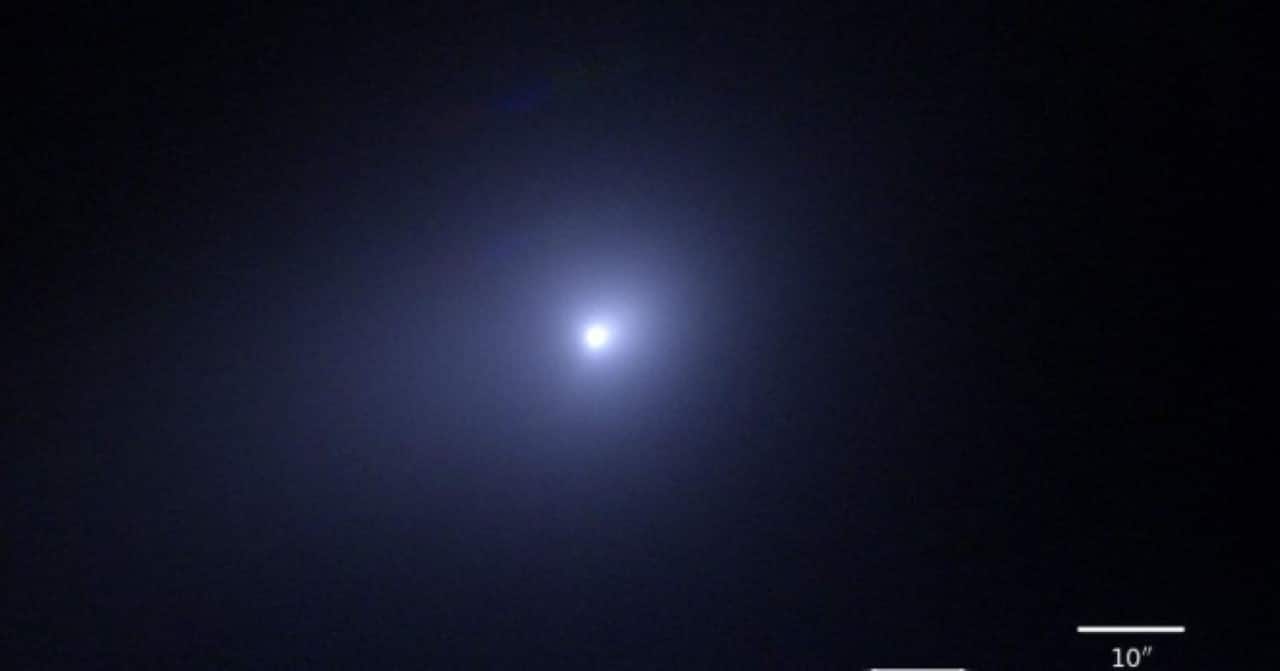
Astronomers at Virtual Telescope Project announced the final live broadcast of the interstellar comet 3I/ATLAS this week. The event is scheduled for January 22, 2026, the date on which the object reaches opposition, a position opposite to Sol in the sky seen from Terra. Essa configuration provides ideal conditions for observing distant celestial bodies.
Comet 3I/ATLAS, discovered on July 1, 2025 by the ATLAS system, is the third interstellar object confirmed to pass through Sistema Solar. Sua hyperbolic trajectory indicates origin outside our system, making it a temporary visitor who will never return.
The live broadcast starts at 23:00 UTC and allows the public to follow images in real time without the need for their own equipment.
Discovery and trajectory of the object
Comet 3I/ATLAS was initially identified as a fast-moving object. Later Análises confirmed its interstellar nature due to its hyperbolic orbit and high speed.
The object passed perihelion in October 2025, about 1.4 astronomical units from Sol. Desde then gradually moves away, with reduced brightness as it gains distance.
Opposition Conditions Explained
Opposition occurs when the Terra is positioned between the Sol and the comet, aligning the three bodies. Essa geometry maximizes object illumination and minimizes apparent distance.
On January 22, 2026, the phase angle reaches a minimum value, favoring details on the surface and tail. Astrônomos consider this time to be the best for telescopic recordings throughout the month.
Virtual Telescope Project Transmission
The Italian project Virtual Telescope has been carrying out online observations since the comet’s discovery. The final session uses robotic telescopes to capture images in real time.
The broadcast starts at 23:00 UTC and is available on the project’s YouTube channel. Participantes can follow live comments from experts during the observation.
The event was rescheduled due to earlier weather conditions. Agora, coincides exactly with the opposition date to maximize image quality.
Observations by large telescopes
Several instruments captured the comet over the months. Telescópio Espacial Hubble recorded detailed images of the coma and tail on multiple dates.
James Webb Space Telescope analyzed the chemical composition, identifying gases typical of comets. Very Large Telescope contributed high-resolution spectroscopy.
- Hubble Telescope: images of the coma in July and November 2025
- James Webb: infrared data on composition
- Europe Clipper: registration during the journey to Júpiter in November
- Mission Juice: complementary observation on the way to the Jovian system
- Earth-based observatories: contributions from Virtual Telescope and others
Location in the sky in January
The comet remains visible throughout January for medium-sized telescopes. Ele moves through the constellation of Câncer, making it easier to locate on clear nights.
Star maps indicate exact position day by day. Observadores amateurs can use coordinates available on specialized websites for precise pointing.
The current brightness requires equipment with a minimum opening of 20 centimeters. Longer Exposições reveal the tail and coma structure more clearly.
Scientific importance of the visitor
Interstellar objects offer unique data on the formation of distant planetary systems. 3I/ATLAS joins 1I/’Oumuamua and 2I/Borisov on the shortlist of confirmed visitors.
Studies have revealed rapid rotation and unusual alignment in some parameters. Pesquisas continue analyzing possible jets and brightness variations.
Astronomers hope new-generation telescopes will boost future detections. Cada passage contributes to understanding the distribution of matter in interstellar space.
The comet’s definitive departure closes a unique window for direct study. Dados collected will be used for comparisons with local objects and trajectory modeling.
Comparison with other interstellars
The first confirmed object, ‘Oumuamua, had an elongated shape and no visible coma. Borisov, second, exhibited a classic comet tail.
3I/ATLAS combines characteristics of both, with clear cometary activity and a proven external origin. Sua slower passage allowed extended observations.
Differences in chemical composition suggest diversity among stellar systems. Análises spectra indicate the presence of organic molecules similar to those found locally.
Prospects for amateur observation
Amateurs with adequate equipment will still be able to record the comet in the coming weeks. Condições of opposition facilitates captures even with reduced brightness.
Astronomy software helps with session planning. Comunidades online shares images and coordinates updated daily.
After January, the object becomes inaccessible to most terrestrial instruments. Live transmission represents a democratic opportunity for monitoring.
Public interest has grown since the discovery, with thousands following previous lives. The final event is expected to attract a significant global audience.



