
Interstellar comet 3I/ATLAS surprises with 20 times greater water emission upon approach to the Sun


A recent analysis of images of the interstellar comet 3I/ATLAS, led by astronomer Avi Loeb of Universidade Harvard, revealed anomalous and unexpected behavior. Dados collected by the SPHEREx space telescope in December 2025 shows that the object’s water emission increased by 20-fold after its closest pass to Sol, a phenomenon that intrigues the scientific community and challenges existing cometary models.
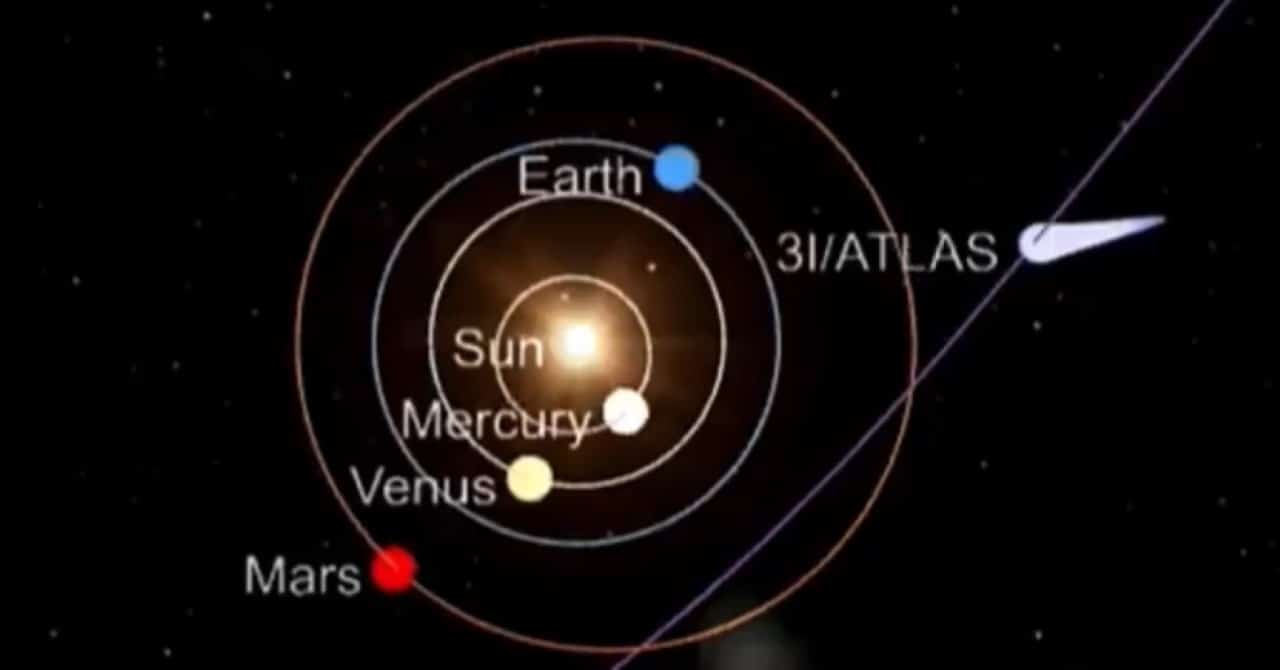
Comet 3I/ATLAS is the third object confirmed to visit our Sistema Solar from interstellar space, following in the footsteps of ‘Oumuamua and Borisov. Sua’s hyperbolic trajectory, which indicates that it is not gravitationally bound to Sol, offers a unique opportunity to study the composition of materials formed around another star.
The new observations, carried out after the comet reached its perihelion, the point of closest approach to Sol, suggest that solar heating caused drastic changes in its activity. The sudden increase in the release of volatile gases, especially water, points to complex internal processes and a composition possibly different from that of our system’s native comets.
What the new observations reveal
Central to the discovery is the dramatic jump in the comet’s rate of mass loss. Measurements taken before perihelion, in August 2025, indicated moderate activity. Contudo, data from December of the same year show a 2000% increase in water vapor emission, reaching an estimated rate of 180 kilograms per second.
In addition to the increase in activity, the morphology of the gas plume also proved to be peculiar. Enquanto the gaseous plumes, including those of water and carbon dioxide, presented an almost perfectly spherical shape, the dust cloud formed an elongated, pear-shaped structure, in the opposite direction to the Sol. Essa dissociation between the behavior of the gas and dust suggests that they are released by different mechanisms or sources on the surface of the comet nucleus.
Trajectory and identification of the extrasolar visitor
Comet 3I/ATLAS was officially identified on July 1, 2025, through the ATLAS astronomical survey system (Asteroid Terrestrial-impact Last Alert System), located at Chile. Observações’s subsequent orbit quickly confirmed its interstellar nature, with an excessive speed that prevents it from being captured by Sol’s gravity.
The object reached its perihelion between October 29 and 30, 2025, passing at a distance of approximately 1.4 astronomical units from Sol, which is equivalent to 1.4 times the distance between Terra and Sol. Foi during this phase of maximum approach that intense solar radiation began to sublimate the ices on its surface, intensifying their activity.
Despite its trajectory through the inner Sistema Solar, 3I/ATLAS did not pose any risk of collision with our planet. Sua closest approach to Terra occurred at a safe distance of about 1.8 astronomical units, allowing astronomers to study it in detail without any danger.
The detailed anomaly in the gas plume
The analysis led by Loeb highlights that the rate of carbon dioxide release matched that of water, at around 180 kg/s, while carbon monoxide also contributed significantly to the gaseous plume. Essa composition is rich in volatiles, common in objects formed in very cold regions of space.
The shape of the dust cloud, with an elongation directed towards Sol, is particularly unusual. The absence of very fine (sub-micron) dust particles prevents solar radiation pressure from forming a classic dust tail, such as that seen on most Sistema Solar comets.
The comet’s reflectance spectrum also changed drastically after perihelion. Antes, was dominated by ice reflection; later, it became dominated by low-albedo (poorly reflective) dust. Isso suggests that the surface layer of ice has been eroded, exposing darker material beneath.
The composition of this dust appears to be dominated by organic-siliceous grains, without a clear signature of mixed water ice. Isso reinforces the idea that ice sublimates from specific regions, while dust is released from other areas of the surface.
The contribution of the SPHEREx telescope
These discoveries were made possible by the SPHEREx mission (Spectro-Photometer for the History of the Universe, Epoch of Reionization, and Ices Explorer), a NASA space telescope launched in 2025. The instrument operates in wavelength ranges from 0.75 to 5.0 microns, enabling the identification of chemical “fingerprints” of various substances.
In the 3I/ATLAS observations, SPHEREx was able to record six distinct, almost round gaseous plumes. Spectral analysis identified the presence of cyanide (CN), water (H2O), organic compounds containing carbon-hydrogen bonds (C-H), carbon dioxide (CO2) and carbon monoxide (CO). The ability to measure the abundance of each of these compounds independently is crucial to unraveling the chemical history of the comet and, by extension, the star system where it formed.
Differences from other comets
The behavior of 3I/ATLAS distinguishes it not only from comets from our Sistema Solar, but also from other interstellar visitors already observed. Diferente of comets like Halley or Hale-Bopp, it did not develop a prominent dust tail shaped by solar radiation pressure, and its dust-scattered light spectrum exhibited a bluish tinge. The second interstellar comet, 2I/Borisov, although also extrasolar, showed a composition and activity much more similar to those of our local comets, being rich in carbon monoxide, but without such pronounced anomalies. Já the first visitor, ‘Oumuamua, remains an enigma, as it accelerated non-gravitationally without displaying any visible coma or gas plume, leading to debates about its nature. The diversity among these three objects shows that planetary systems in our galaxy can produce a vast array of celestial bodies, each with a unique history.
Composition and release mechanisms
Spectrophotometric studies indicate that the cyanide and organic compounds detected in 3I/ATLAS derive mainly from released dust particles. In contrast, water, carbon dioxide and carbon monoxide appear to emanate from distinct, symmetrical sources in the comet’s nucleus. Essa functional separation suggests that the nucleus may not be homogeneous, but rather an agglomeration of materials with different sublimation points, activated at different times by solar radiation.



