
Interstellar object 3I/ATLAS displays symmetrical jets and rare composition, raising debate about its origin

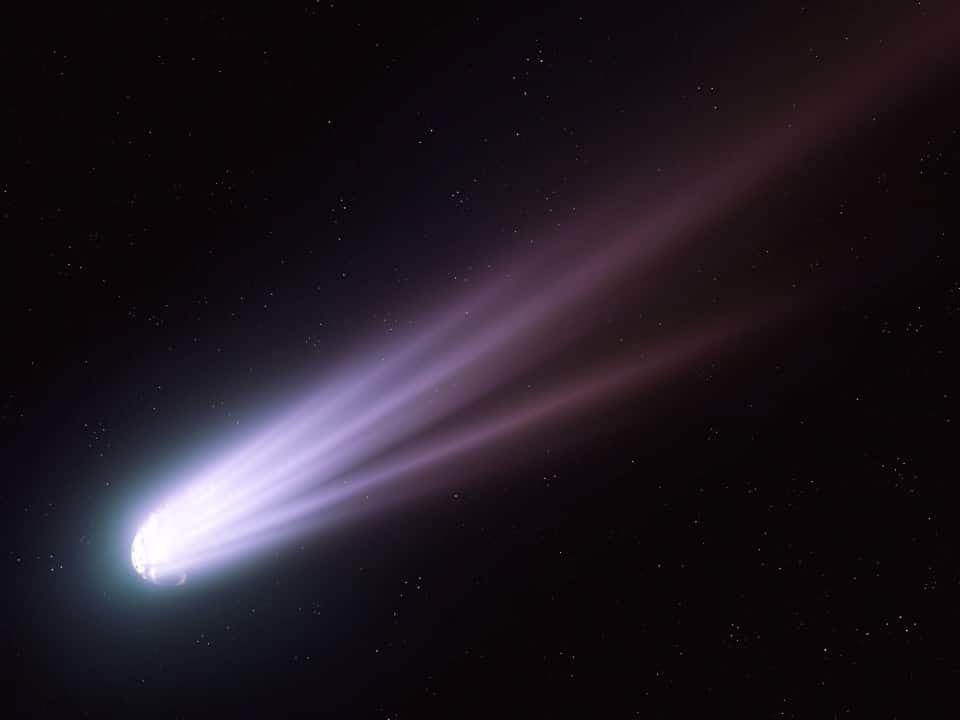
The third interstellar visitor confirmed to cross our Sistema Solar, named 3I/ATLAS, is at the center of intense scientific debate. Descoberto in mid-2025, the object presents a series of anomalies that led astrophysicist Avi Loeb, from Universidade Harvard, to suggest a possible technological origin, while most of the scientific community maintains the classification of a natural comet.
Observations carried out in January 2026 with Telescópio Espacial Hubble revealed unprecedented features. Processed Imagens showed a highly regular geometric structure, with three equidistant jets of matter and a prominent “anti-tail” pointing directly at Sol, an atypical behavior for known comets.
As the object moves away from Sol on its outward trajectory from Sistema Solar, astronomers around the world are preparing for a rare alignment that could provide definitive answers about its nature. The controversy reignites the discussion about the possibility of finding artifacts from extraterrestrial civilizations in our own cosmic backyard.

Details revealed by the Hubble telescope
The latest 3I/ATLAS images, captured by Telescópio Espacial Hubble, have undergone advanced digital processing to highlight subtle features. Utilizando the Larson-Sekanina filter, which subtracts the symmetrical glow of the comet’s coma, scientists were able to isolate a surprising structure. The analysis revealed three distinct “mini-jets” emanating from the nucleus, perfectly separated by 120-degree angles. Essa simetria trigonal é estatisticamente improvável em fenômenos naturais de ejeção de gás e poeira, que geralmente ocorrem de forma aleatória e irregular à medida que o gelo sublima na superfície do núcleo.
In addition to the symmetry of the jets, the presence of a persistent “anti-tail”, which extends hundreds of thousands of kilometers in the direction of Sol, challenges conventional cometary models. Normalmente, the tail of a comet is pushed by radiation and the solar wind, always in the opposite direction to the star. The anti-tail is an optical phenomenon that can occur when Terra crosses the orbital plane of a comet, but the persistence and prominence observed in 3I/ATLAS are considered exceptional, contributing to the list of its peculiarities.
Geometric anomalies that defy the odds
Astrophysicist Avi Loeb argues that the accumulation of coincidences in 3I/ATLAS makes the hypothesis of a random natural object extremely unlikely. The first anomaly pointed out is its trajectory. The comet follows a retrograde path, but its orbital plane is aligned with the ecliptic plane of Sistema Solar by a margin of less than 5 degrees, an event with an estimated probability of just 0.2%.
Another point raised is the moment of its arrival, which allowed relatively close passages of Marte and Júpiter. The closest approach to Júpiter, scheduled for March 16, 2026, will occur at a distance that almost perfectly coincides with the radius of the gas giant’s Esfera of Hill, the region where its gravity dominates over that of Sol.
The orientation of the object’s rotation axis, almost parallel to Sol, and the maintenance of collimated jets for months, both before and after its maximum solar approach (perihelion), are also highlighted. Segundo the analyses, such stability would require thermal insulation that would be difficult to explain in a naturally formed rocky or icy body.
These characteristics, when analyzed together, form a pattern that, to Loeb and his collaborators, suggests intentional design rather than a series of chance events. The astronomical community, however, urges caution, stating that our understanding of objects from other star systems is still very limited.
Unusual chemical composition of the object
Spectroscopic analyzes of the cloud of gas and dust (coma) surrounding the nucleus of 3I/ATLAS revealed a chemical composition that differentiates it from thousands of comets already studied in our Sistema Solar. The plume of material released by the object shows an unusually high ratio of nickel to iron, a signature more common in industrially produced metal alloys than in natural space rocks.
Furthermore, the nickel to cyanide ratio detected is significantly higher than that observed on any known comet. Dados from the SPHEREx space observatory also identified a twenty-fold increase in water production after perihelion, along with the release of complex organic molecules such as methanol and formaldehyde.
For these volatile organic molecules to survive the long journey through interstellar space, exposed to cosmic rays for millions of years, they would need to be protected under a thick, resistant outer layer. The sudden release after passing close to Sol suggests an ejection mechanism or internal structure different from traditional comets.
The view of the majority scientific community
Despite the peculiarities pointed out by Avi Loeb, the official position of NASA and most astronomers is that 3I/ATLAS is an interstellar comet of natural origin. The non-gravitational acceleration observed in its trajectory, that is, a slight deviation caused by forces beyond gravity, is consistent with “outgassing”, the process of ice sublimation that creates jets and drives the nucleus, typical behavior of active comets.
Observations from multiple instruments, including the Telescópio Espacial James Webb (JWST) and probes orbiting Marte, confirm the presence of water and organic molecules common in comets. Buscas by radio signals or other “technosignatures” at frequencies that could indicate artificial technology produced no results, reinforcing the hypothesis of a natural phenomenon, albeit exotic due to its origin in another star system.
Rare alignment predicted for observation
A pivotal moment in unraveling the mysteries of 3I/ATLAS will occur on January 22, 2026. Nesta date, the object will align almost perfectly with the Sol-Terra axis, with an angular separation of just 0.69 degrees. Essa configuration, known as opposition, is extremely rare and will offer a unique opportunity for observation. Durante this event, the object’s anti-tail will be pointed directly at Earth, allowing ground- and space-based telescopes to study its structure and composition in unprecedented detail. The favorable geometry will eliminate shadows and enhance reflected material, which can help determine whether symmetrical jets are a persistent phenomenon or a transient effect. Observatórios around the world are planning intensive observation campaigns during the week of the alignment, hoping to obtain data that could confirm or refute the most controversial hypotheses about the nature of the interstellar visitor.
The Future of the Interstellar Visitor
After the January alignment, the 3I/ATLAS journey will continue. Ele will pass through Júpiter in March 2026, where the planet’s immense gravity will give it an additional boost, accelerating its definitive exit from Sistema Solar. From there, the object will plunge back into the void of interstellar space, on a journey that will take it far from any star for millions of years.
It is estimated that it will take almost two centuries to reach the inner Nuvem of Oort, the theoretical boundary of our system. The comet will not return, but its study will leave a lasting legacy, forcing scientists to reevaluate models of planetary formation and the diversity of objects roaming the galaxy.
The legacy of ‘Oumuamua and 3I/ATLAS
The passage of 3I/ATLAS revives the debate that began in 2017 with the discovery of the first interstellar object, ‘Oumuamua, whose anomalous properties also led Avi Loeb to propose an artificial origin. The arrival of a second visitor with equally strange characteristics strengthens the argument that we need to be open to all possibilities when exploring the cosmos.



