
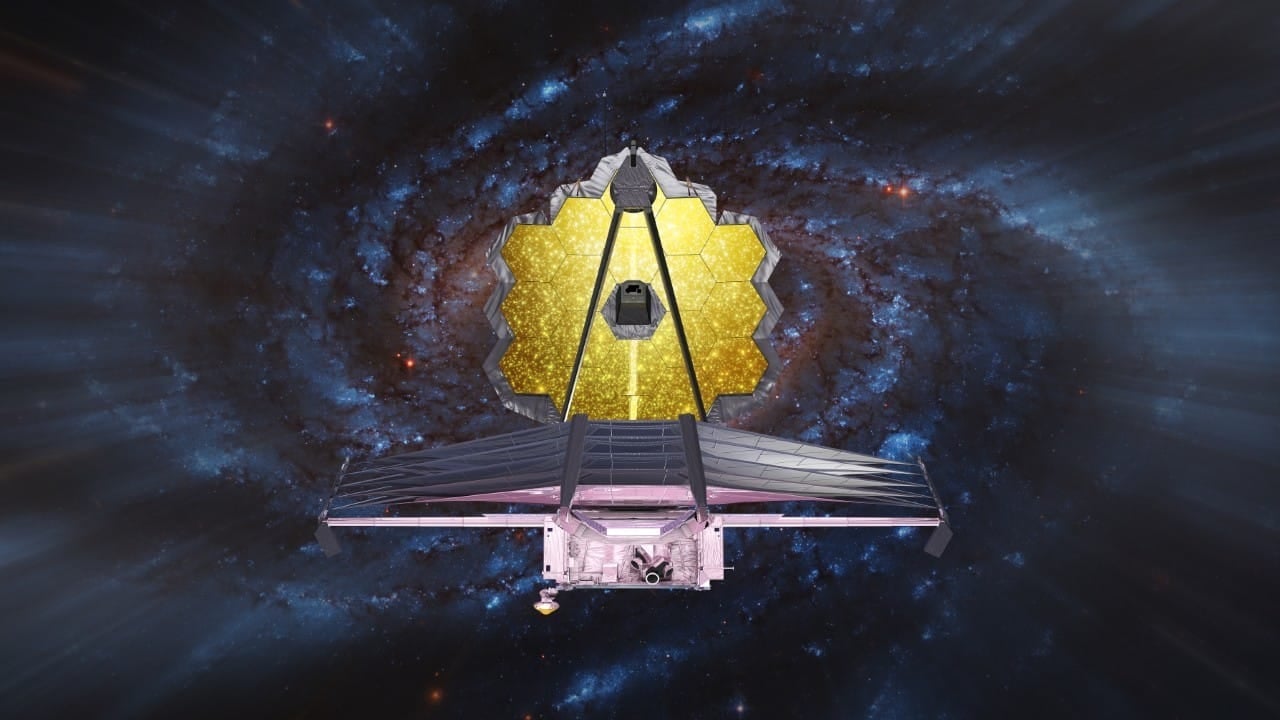
Telescópio Espacial James Webb recorded precise measurements that reinforce the discrepancy known as the Hubble tension in the expansion rate of the universe. Esses data, obtained through independent observations, show incompatible values between the primordial and current universes, which calls into question parts of the standard cosmological model. The constant of Hubble, which measures the rate of separation of galaxies, presents results that do not align even after technical refinements.
This inconsistency persists despite technological advances in recent years. Pesquisas combined with data from Telescópio Hubble and the Planck satellite highlight that local measurements indicate faster expansion than predicted by the cosmic microwave background.
- The local value is around 73 to 74 km/s per megaparsec.
- The primordial value registers about 67 to 68 km/s per megaparsec.
These numbers, confirmed by different methods, fuel debate in the scientific community.
Origin of the constant of Hubble
The constant of Hubble arose from early observations of The Essa relationship laid the foundation for understanding the expansion of the universe after the Big Bang. Over the decades, successive refinements elevated the constant to a central parameter of cosmology.
Currently, the exact value of this constant influences calculations about the age of the universe, estimated at around 13.8 billion years, and about the composition of dark matter and dark energy. Qualquer significant variation alters projections about cosmic destiny, including accelerating expansion.
Expansion measurement methods
Astronomers employ two main approaches to determine the constant of Hubble. The first uses cosmic microwave background radiation, captured by missions such as Planck, which analyzes thermal fluctuations in the young universe. Esse method infers the current rate of expansion from initial conditions.
The second approach is based on the cosmic distance ladder, with Cefeidas variable stars and Ia type supernovae as indicators of distance to nearby galaxies. The redshift of these galaxies reveals their speed away.
- Pulsating Cepheids serve as standard rulers because of the relationship between period and luminosity.
- Ia supernovae are consistently bright, allowing for accurate calculations on larger scales.
James Webb improved this second technique with infrared observations, reducing interference from interstellar dust.
James Webb’s recent contributions
Telescópio James Webb has made detailed observations of Cefeidas and supernovae in distant galaxies in recent years. Esses data aligned with previous Hubble measurements, achieving greater than 3% accuracy in some cases. Independent confirmation excluded systematic errors as the main cause of the discrepancy.
In programs like PEARLS, Webb has identified gravitationally lensed supernovae, offering new references for the constant. Esses objects amplified by galaxy clusters gave local values consistent with 73 km/s per megaparsec.
Divergent values recorded
Local measurements, supported by Hubble and Webb, are concentrated around 73 to 74 km/s per megaparsec. Já those based on the CMB, from the Planck satellite, indicate 67 to 68 km/s per megaparsec. Essa difference of around 8% remains statistically significant.
Recent studies with gravitational lensing and other independent indicators reinforce the higher value for the nearby universe. The insufficient overlap between the data sets suggests that the discrepancy does not arise from observational uncertainties.
Implications for modern cosmology
The Hubble voltage directly affects estimates of the dark energy density, responsible for cosmic acceleration. Higher Valores imply greater influence of this component in the current universe. Além in addition, alter calculations about the total amount of dark matter.
Researchers consider tweaks to the Lambda-CDM model, which integrates cold dark matter and constant dark energy. The persistence of the discrepancy leaves room for hypotheses about temporal variations in dark energy.
Possible scientific explanations
Scientists explore several hypotheses to resolve the tension. One involves physics beyond the Standard Model, such as early forms of dark energy that acted soon after Big Bang. Outra considers undetected interactions between dark matter and radiation.
Observations of supernovae lensed by Webb in future cycles promise to reduce uncertainties to levels below 2%. Terrestrial Projetos, like Atacama Cosmology Telescope, complement these efforts with updated CMB maps.
Observational advances underway
James Webb continues to collect data from distant objects in programs dedicated to the cosmic ladder. Combinações with ground-based telescopes magnify the calibrated Cefeidas sample. Esses efforts aim to map the expansion in different cosmic epochs.
Recent maps of the nearby universe, integrating data from multiple observatories, keep the discrepancy in evidence. The scientific community awaits results from ongoing analyzes to clarify the expansion pattern.
Debates in the astronomical community
Astronomers from institutions such as NASA, ESA and universities around the world actively discuss the Hubble strain in conferences and publications. Confirmation by Webb eliminated doubts about the accuracy of local measurements. The focus now falls on theoretical interpretations of divergence.
Proposals include revisions to the early evolution of the universe or the introduction of new physical fields. Solving this enigma could redefine fundamental parameters of observational cosmology.