
Rare alignment of interstellar comet 3I/ATLAS with Sun-Earth axis occurs on January 22, 2026


The interstellar comet 3I/ATLAS, the third confirmed object coming from outside Sistema Solar, will reach a rare alignment with the Sol-Terra axis on January 22, 2026. Esse event will occur at 13:00 UTC, when the angle between the Sol-3I/ATLAS and Sol-Earth axes will be just 0.69 degrees. The setup will allow precise measurements of the effect known as opposition surge in the dust released by the comet. Astrônomos highlight that this angular proximity is unprecedented among interstellar objects observed so far. The window of opportunity extends for about a week, between January 19th and 26th, with an angle below 2 degrees. Observações during this period can reveal details about the composition and structure of material from other stellar systems. The phenomenon does not pose a risk to Earth, as the comet will be approximately 2.35 AU away. Especialistas recommend the use of large telescopes to capture high-precision data.
The discovery of 3I/ATLAS occurred on July 1, 2025, by the ATLAS system, at Chile. Subsequent Observações confirmed its hyperbolic orbit, with an eccentricity of about 6.139 and a perihelion distance of 1.356 AU.
Its interstellar speed relative to Sol reaches 57.7 km/s, higher than that of 1I/’Oumuamua (26.4 km/s) and 2I/Borisov (32.3 km/s). Esses data reinforces its origin external to Sistema Solar.
Discovery and trajectory of 3I/ATLAS
The ATLAS system initially identified the object as A11pl3Z. Dados follow-up, including prediscovery observations, quickly validated its interstellar nature.
The comet passed perihelion in October 2025, approximately 1.4 AU from Sol. Desde has been moving away, but maintains a trajectory that favors the January alignment.
On January 22, 2026, it will be 3.33 AU from Sol and with an apparent magnitude of 16.7 in band V. Essa distance requires professional equipment for detailed observation.
Rare Alignment Geometry
Alignment occurs when Terra passes almost exactly between Sol and 3I/ATLAS. The phase angle reaches a minimum of 0.69 degrees at 13:00 UTC.
Unlike common comets, this configuration remains for days, with an angle below 2 degrees between January 19th and 26th. Nos following years, the angle remains small, but the comet will become fainter.
In January 2027, for example, the angle will be 1.4 degrees, but the magnitude will reach 24. In 2028, similar values indicate the need for larger telescopes.
This 2026 window represents a unique opportunity for decades.
What is opposition surge
Opposition surge consists of a significant increase in brightness when the phase angle is less than 10 degrees. Dois main mechanisms explain the phenomenon.
- Shadow-hiding: Sombras projected by dust particles are hidden behind themselves, reducing dark areas.
- Coherent backscatter: Luz reflects in reciprocal paths and interferes constructively, creating narrow peak by quantum effect.
The amplitude and width of the surge depend on the albedo and grain structure. Grãos compacts generate narrow surges; fluffy aggregates produce broad surges.
Previous measurements on comets
Only comet 67P/Churyumov-Gerasimenko has well-documented opposition surge measurements. The Rosetta probe recorded a variation of 0.15 magnitude at angles of 1.3 to 5 degrees.
The albedo was estimated at 0.034, indicating very dark material. Outros comets from Sistema Solar lack complete data in this angular range.
The interstellar comet 2I/Borisov has never been observed below 16 degrees phase angle. Portanto, was left out of the opposition surge regime.
Scientific potential of the event
The 3I/ATLAS alignment allows us to answer questions about interstellar dust. The composition may be dominated by carbonaceous material or include ice fragments.
Previous observations indicated extended anti-tail, suggesting possible presence of ice. The structure of the grains reveals whether they are compact or pristine aggregates.
Brightness data and near-opposition polarimetry distinguish physical mechanisms. Essa characterization compares material processed at Sistema Solar with dust from distant molecular clouds.
Recommendations for observations
Astronomers suggest temporal coverage of at least four days before and after January 22. Isso separates phase effects from intrinsic activity variations.
High-precision photometry, less than 0.03 magnitude per point, is essential. Observações on multiple broadband filters provide additional diagnostics.
- Linear polarimetry near the minimum angle constrained grain structure.
- Telescopes above 1 meter are suitable for photometry.
- Coordination between sites notes to avoid gaps due to climate.
Even partial data contributes to understanding angular behavior.
Recent comet observations
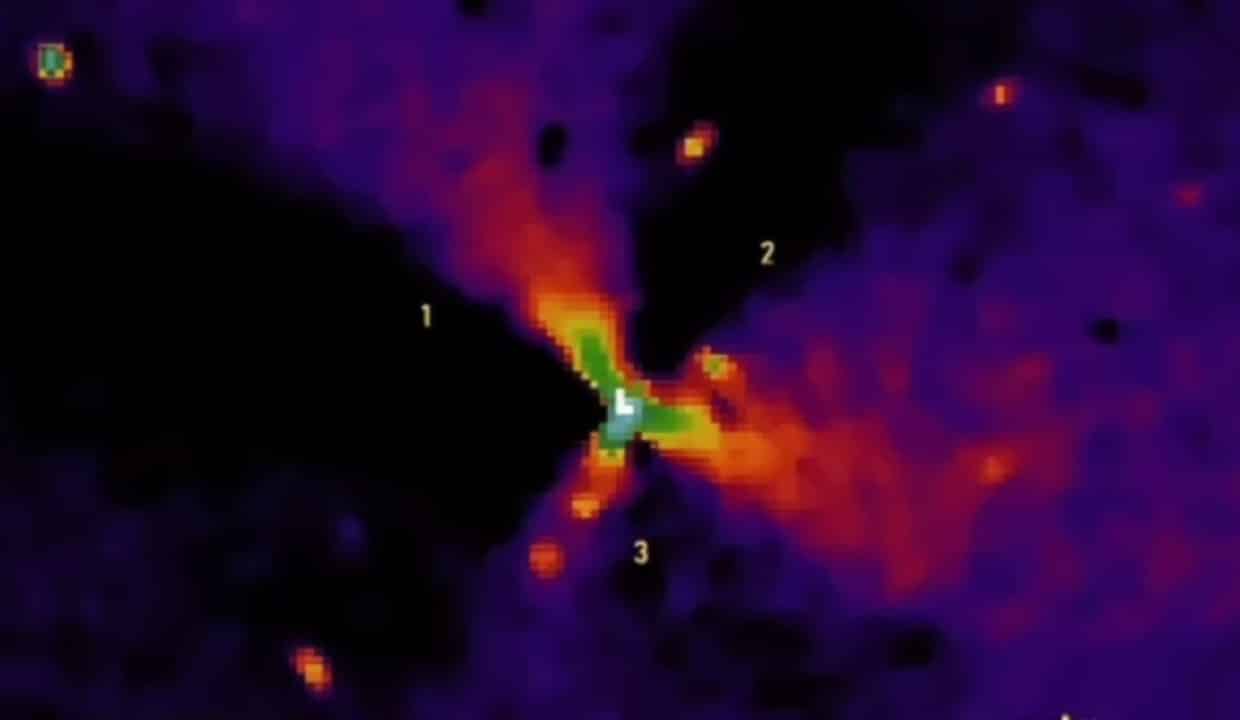
Images of Telescópio Espacial Hubble, captured on January 14, 2026, show jets pointing toward Sol. The anti-tail extends over great distances.
Missions such as Psyche, MAVEN and Europa Clipper recorded the comet at different wavelengths. Essas observations complement terrestrial data.
The estimated core varies between 440 meters and 5.6 km in diameter. The coma and tail indicate continued activity despite the distance.
Current observational window
The current magnitude allows detection by professional telescopes. The imminent alignment mobilizes global astronomical communities.
Live broadcasts and coordinated campaigns are scheduled for the coming days. The event represents a rare chance to study extraterrestrial material under ideal conditions.
After January 2026, the comet will continue moving away into interstellar space. Dados collected now will be a reference for years to come.



