
Interstellar comet 3I/ATLAS exhibits unusual activity with water emission 20 times greater after approaching the Sun


A recent analysis of astronomical data has revealed surprising behavior in the interstellar comet 3I/ATLAS, the third object confirmed to visit our Sistema Solar from another star system. Observações conducted by astronomer Avi Loeb, from
The central point of the discovery is the 20-fold increase in the comet’s water emission rate, when comparing measurements from December 2025 with those from August of the same year. Essa explosion in the release of volatile material suggests that solar heat activated intense processes in the object’s core, significantly altering its appearance and surface composition. The detailed images provide a unique opportunity to study the dynamics of an extrasolar visitor in real time.
3I/ATLAS follows in the footsteps of two other famous interstellar travelers, ‘Oumuamua and Borisov, but has its own characteristics that distinguish it from the previous ones. Enquanto ‘Oumuamua did not have a visible coma and Borisov more closely resembled comets native to our system, 3I/ATLAS displays a plume of gas and dust with a peculiar geometry, challenging existing models of cometary activity.
A burst of post-perihelion activity
The anomaly was detected in a series of observations carried out between December 8 and 15, 2025, weeks after the comet reached perihelion, its point of closest proximity to Sol, between October 29 and 30. Nesse period, intense solar radiation heated the surface of the icy core, causing the sublimation of volatile materials at very high rates.
The estimated rate of mass loss for the water reached around 180 kilograms per second, a volume equivalent to that of carbon dioxide, which was also released in large quantities. Esse burst of activity is a clear indicator of the physical and chemical changes the comet underwent when exposed to an environment much hotter than the one in which it spent most of its existence in interstellar space.
This intensification in activity was not entirely unexpected, but the magnitude of the increase in water emissions exceeded initial projections. Cientistas are now analyzing the data to understand whether the phenomenon was the result of uniform sublimation or the exposure of pockets of fresh ice due to fragmentation or erosion of the comet’s surface crust.
Continuous monitoring of 3I/ATLAS as it moves away from Sol is critical to determining how long this high activity will be sustained. The gas emission decay curve will provide valuable clues about the internal structure of the nucleus and the distribution of its volatile components.
The SPHEREx mission and its crucial observations
Detailed detection of the composition of comet 3I/ATLAS was made possible by NASA’s SPHEREx (Spectro-Photometer for the History of the Universe, Epoch of Reionization, and Ices Explorer) mission, launched in 2025. to identify the chemical signatures of molecules such as water and carbon dioxide. Operando at wavelengths from 0.75 to 5.0 microns, SPHEREx can analyze the composition of cold gases and dust, which are the main components of cometary comas and tails. Nas December observations, the instrument recorded six distinct gaseous plumes, almost perfectly spherical, and identified the presence of several chemical species, including cyanide (CN), organic compounds (C-H), carbon monoxide (CO), in addition to water (H2O) and carbon dioxide (CO2). The Cada image captured by the telescope covers a vast area of the sky, allowing us to view the plume in its entirety, which extends over hundreds of thousands of kilometers, a scale comparable to the distance between Terra and Lua.
Unique characteristics of the gas and dust plume
One of the most intriguing features of 3I/ATLAS is the dissociation between the shape of its gas plumes and that of dust. Enquanto gases, such as water and carbon dioxide, form almost spherical halos around the nucleus, dust creates an elongated, pear-shaped structure that extends in the opposite direction to Sol. Essa configuration suggests that gases and dust are released by mechanisms or from distinct sources on the surface of the cometary nucleus. The spherical symmetry of the gases indicates a more uniform release, possibly from the entire surface illuminated by Sol, while the shape of the dust cloud points to a more directional ejection, perhaps from active jets or specific fissures.
The spectral analysis also revealed another peculiarity: the absence of very fine dust particles, smaller than one micron in size. In Sistema Solar comets, these small particles are the ones that, when pushed by the pressure of solar radiation, form the classic dust tail. The lack of these grains in 3I/ATLAS explains why it did not develop a prominent tail despite its intense activity. The data suggests that the dust is composed of larger, low-albedo (poorly reflective) organic-silice grains, which are not easily influenced by sunlight. Essa composition reinforces the idea that the material that forms the comet is primitive and has undergone little thermal processing.
Origin and trajectory of the extrasolar visitor
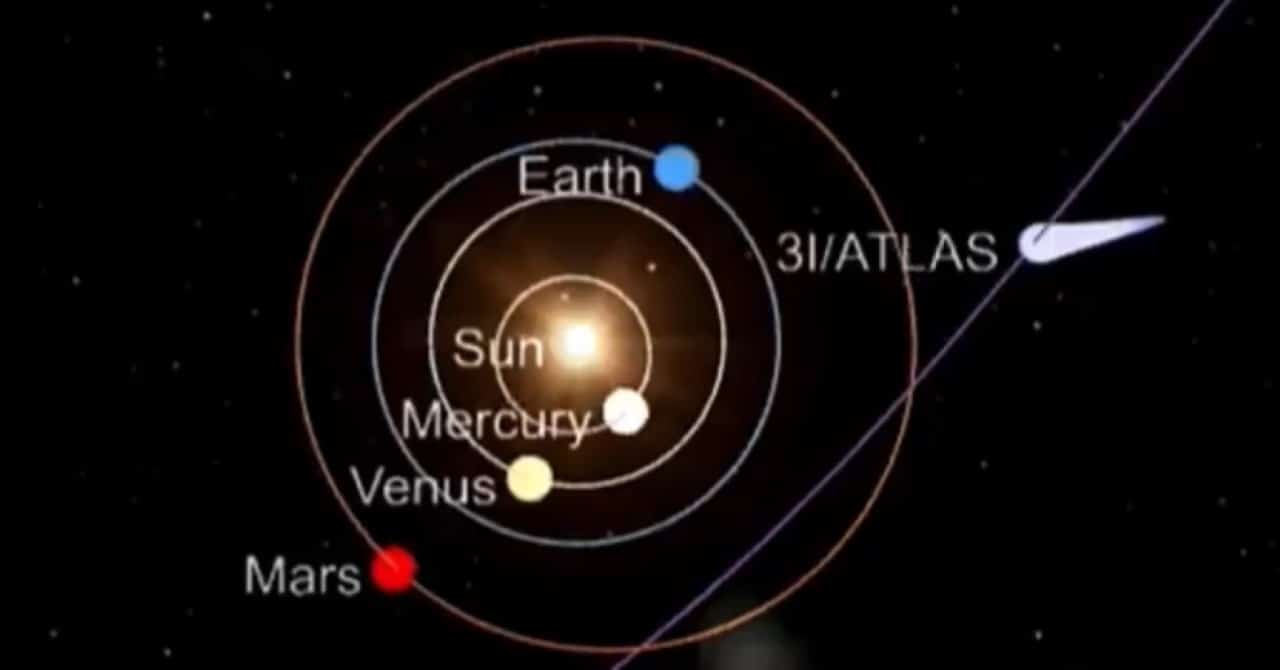
Comet 3I/ATLAS was officially discovered on July 1, 2025, by the ATLAS astronomical survey system (Asteroid Terrestrial-impact Last Alert System), located at Chile. Logo after initial identification, follow-up observations confirmed its hyperbolic trajectory, an open orbit that indicates the object is not gravitationally bound to Sol.
Its excessive speed, much greater than the escape velocity of Sistema Solar, is definitive proof of its interstellar origin. Ele entered our system from a distant direction and will leave it forever, continuing its journey through deep space.
The object made its closest passage to Terra at a safe distance of approximately 1.8 astronomical units (about 270 million kilometers), without presenting any risk of collision. The visit provided astronomers with a rare opportunity to apply modern technologies to analyze raw material from another planetary system.
Chemical composition and material release
Spectrophotometric analysis indicates that the different components of the comet have different origins. The cyanide and organic compounds appear to derive mainly from the fragmentation of dust particles in the coma. In contrast, water, carbon dioxide, and carbon monoxide appear to sublime directly from symmetrical regions on the surface of the nucleus.
This functional separation suggests a heterogeneous composition for the core of 3I/ATLAS, with areas rich in volatile ices and others dominated by rocky and organic material. The vast extent of the carbon dioxide plume reinforces the hypothesis that larger icy fragments, perhaps more than 10 meters in diameter, broke away from the main body during the solar approach, drastically increasing the surface area for sublimation.
Comparisons with ‘Oumuamua and Borisov
When compared to its interstellar predecessors, 3I/ATLAS stands out for its individuality. The first visitor, ‘Oumuamua (2017), was a rocky, elongated object that exhibited non-gravitational acceleration without a visible coma, a mystery that still generates debate.
The second, 2I/Borisov (2019), behaved in a much more familiar way, resembling a long-period comet from our own Sistema Solar, with a composition rich in carbon monoxide. 3I/ATLAS, with its anomalous activity and peculiar plume morphology, positions itself as an intermediary, demonstrating the great diversity of small bodies that roam the galaxy.
The ongoing scientific debate
Additional observations, including images of Telescópio Espacial Hubble in January 2026, have revealed other anomalies, such as jets of material that maintain a surprisingly stable alignment, defying core rotation models. The astronomical community continues to analyze all available data to build a complete portrait of this fascinating messenger from another star system.



