
New generation of plug-in hybrid RAV4 arrives in Brazil to compete with BYD and GWM models


Toyota officially confirmed its plans for the Brazilian market, announcing the arrival of the new generation of RAV4 exclusively in the plug-in hybrid version (PHEV). The launch is scheduled to take place during the second half of 2026, positioning the medium SUV as a more sophisticated and technological option above the Corolla Cross in the Japanese automaker’s product range in the country.
The decision to focus on the PHEV variant represents a strategic change, as the plug-in version of the previous generation was recently discontinued. Atualmente, only the full hybrid model, in the SX Connect configuration, remains available at dealerships. Esta new bet reinforces Toyota’s commitment to electrification to compete in the heated medium SUV segment.
The new model will face stiff competition, especially from Chinese brand vehicles that have gained great popularity in the Brasil. Modelos like the BYD Song Plus and GWM Haval H6, both with plug-in hybrid engines, established a new level of technology and price in the segment, directly challenging traditional automakers.

Details of the new platform and construction
The new generation Toyota RAV4 will continue to be built on the renowned TNGA-K (Toyota New Global Architecture) platform, but will receive significant enhancements to its structure to elevate the driving experience. The brand’s Engenheiros focused on increasing the body’s torsional rigidity and improving acoustic insulation, using new materials and advanced welding techniques. The expected result is a quieter cabin and more precise dynamic behavior, with less noise and vibrations, providing greater comfort for occupants on long journeys and on uneven surfaces. In terms of dimensions, the SUV measures 4.61 meters long, 1.85 meters wide and 1.68 meters high, with a wheelbase of 2.69 meters, ensuring generous internal space. One of the practical highlights is the trunk, which offers an impressive capacity of 749 liters, comfortably meeting the needs of families and those who need to transport large volumes.
A new visual identity for the SUV
The RAV4’s exterior design has been completely renewed, aligning with the latest Toyota visual language, already seen on global models such as the Prius and Camry. The front end displays a more aggressive and modern look, with tapered “C”-shaped headlights that are integrated into a higher hood, giving the vehicle an imposing stance.
At the rear, the changes are also notable. The headlights abandon the previous horizontal format and adopt vertical LED sections, connected by an elegant glossy black plate that runs across the trunk lid, creating a distinct and sophisticated light signature.
The sides of the SUV were sculpted to convey robustness, with square wheel arches and well-defined creases that run along the doors. Essa combination of elements gives the new RAV4 a more muscular and dynamic appearance, clearly differentiating it from the previous generation.
This new design philosophy won’t be limited to the RAV4. The expectation is that future launches of the Toyota in the Brasil, including updates to other models, will gradually incorporate these aesthetic features, unifying the brand’s visual identity in the national market.
Technological and connected interior
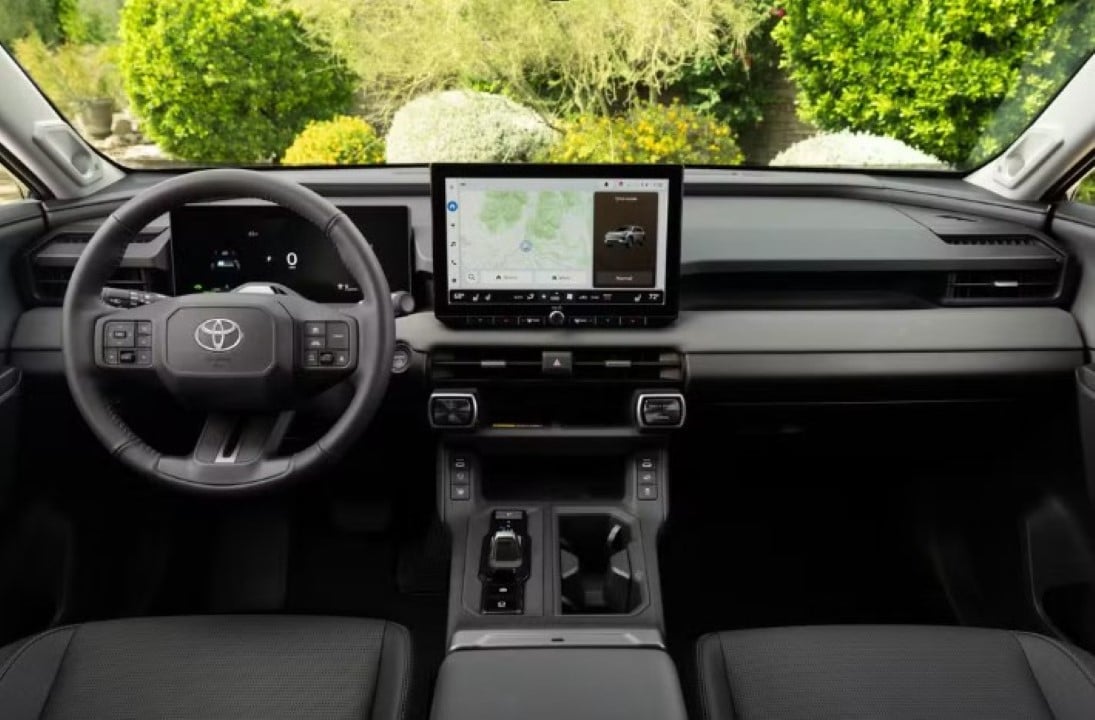
Inside, the RAV4 dashboard has undergone a complete redesign, with a focus on digitalization and user experience. The main highlight is the large screens that dominate the space. The multimedia center can reach 12.9 inches, offering a modern and intuitive interface, while the 12.3-inch digital instrument panel is fully configurable, allowing the driver to view multiple vehicle information, navigation and security systems in a clear and organized way.
The cabin was designed to accommodate five occupants with ample comfort, maintaining the generous internal space that is a trademark of the model. The selection of materials has also been improved, with surfaces that are soft to the touch, high-quality finishes and a design that conveys a sense of sophistication, in line with the premium positioning that the SUV seeks in the market. The Arene electronic architecture, developed by the Woven division of Toyota, is the brain behind the car’s systems. Essa advanced platform not only manages vehicle functions, but also supports over-the-air updates, ensuring software is always up to date without the need for dealership visits, as well as integrating advanced connectivity features.
PHEV package performance and efficiency
The heart of the new RAV4 is its advanced plug-in hybrid system. Ele combines a 2.5-litre, naturally aspirated Atkinson cycle petrol engine with powerful electric motors. Essa configuration allows combined power to range from 268 hp in the front-wheel drive version to an impressive 304 hp in the all-wheel drive (AWD) option.
One of the most important upgrades is the lithium-ion battery, which has had its capacity increased from 18.1 kWh to 22.7 kWh. Essa improvement allows the SUV to reach a range of approximately 100 kilometers in pure electric mode, according to the WLTP test cycle, ideal for covering the majority of daily urban journeys without consuming fuel.
This powertrain is not only efficient but also delivers vigorous performance. Acceleration from 0 to 100 km/h is achieved in just 5.8 seconds in the most powerful version. Recharging has also been optimized, supporting up to 50 kW direct current (DC), which allows the battery to be charged from 10% to 80% in around 30 minutes. In alternating current (AC), the maximum power is 11 kW, completing the full charge in approximately three hours.
Enhanced security with Toyota Safety Sense 4.0
The new generation of the SUV incorporates the latest version of the brand’s active safety package, the Toyota Safety Sense 4.0. Este system has been enhanced with more intelligent and precise driving assistance, including automatic emergency braking, lane keep assist and adaptive cruise control.
Thanks to the use of state-of-the-art sensors and cameras, the ability to detect pedestrians, cyclists and other vehicles has been significantly expanded, working effectively even in low visibility conditions. The safety suite is rounded out by features such as blind spot monitoring and rear cross traffic alert.
Market strategy in Brasil
Toyota’s decision to import only the PHEV variant for the Brasil is in line with the growing demand for electrified models and the need to offer a competitive product against Chinese rivals, such as the BYD Song Plus and the GWM Esses competitors have established a strong position in the premium segment with their plug-in hybrid technologies, and the new RAV4 arrives to compete directly for this market share, betting on the Japanese brand’s reputation for reliability and quality.
Practicality and comfort for daily use
The 2.69 meter wheelbase ensures generous legroom for passengers in the rear seat, making long journeys more comfortable for everyone. Além Furthermore, the height in relation to the ground was designed to allow use on unpaved roads without compromising stability and driving safety.
The suspension calibration has been adjusted to offer an ideal balance between comfort on asphalt and control in curves, absorbing road imperfections well. Appropriate profile tires also help to reduce road noise, especially at high speeds, improving the onboard experience.



