
New plug-in hybrid RAV4 arrives in Brazil with more power to face Chinese rivals


Toyota officially confirmed the arrival of the new generation of RAV4 on the Brazilian market, with launch scheduled for the second half of the year. The medium SUV will be sold exclusively in its plug-in hybrid version (PHEV), reinforcing the brand’s electrification strategy in the country and positioning the model as a superior option to the Corolla Cross.
The decision to focus on the PHEV variant comes after the discontinuation of the previous plug-in version, leaving only the full hybrid (HEV) model available in dealerships currently. With this new bet, the Japanese automaker seeks to compete directly with the advancement of Chinese SUVs that have gained popularity in the segment.
Built on the TNGA-K platform, the new RAV4 has undergone important structural updates. The improvements were focused on increasing body rigidity and improving acoustic insulation, promising a quieter and more comfortable driving experience for occupants in various terrain and speed conditions.

Improved design and dimensions
The exterior look of the SUV has been completely renewed, aligning with the latest global design language of the Toyota, with features that refer to models such as the Prius and the Camry. The front features a striking optical package with “C”-shaped headlights and a higher hood, conveying a feeling of greater grandeur. At the rear, the taillights have been redesigned with vertical LED sections integrated into a glossy black plate that runs along the trunk lid. The sides gained square wheel arches and more defined creases on the doors, reinforcing its robust character. The vehicle measures 4.61 meters long, 1.85 meters wide, 1.68 meters high and has a wheelbase of 2.69 meters, dimensions that guarantee a competitive size. The trunk stands out for its generous capacity of 749 liters, ideal for families and trips.
Technological and connected interior
The interior of the new RAV4 has undergone a complete redesign, with a focus on technology and sophistication. The dashboard is now dominated by large screens, including a multimedia center that can reach 12.9 inches and a 12.3-inch fully digital instrument panel, which offers multiple viewing options for vehicle information and driver assistance systems.
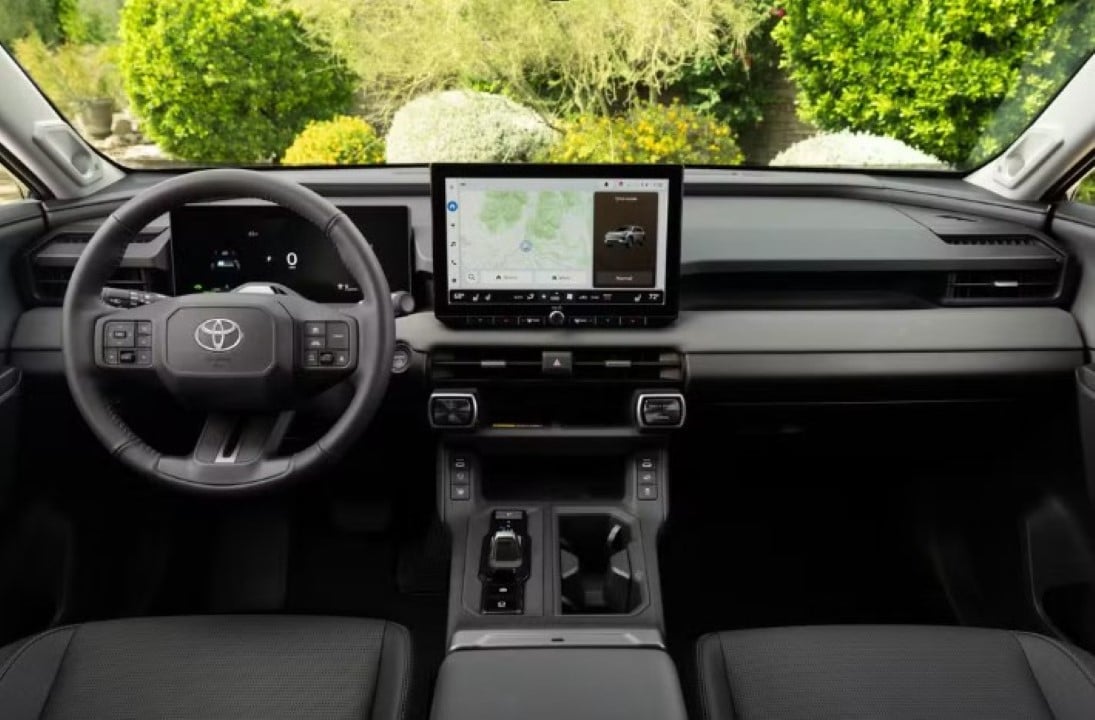
The interior space remains one of its strong points, accommodating five adults comfortably and offering high-quality finishing materials. The Arene electronic architecture, developed by the Woven division of Toyota, manages all of the car’s systems, enabling over-the-air updates and the integration of new connectivity and safety features over time.
Hybrid system performance and autonomy
The RAV4 PHEV’s powertrain combines a 2.5-liter Atkinson cycle gasoline engine with powerful electric motors. Combined power reaches 304 hp in all-wheel drive configuration, ensuring vigorous performance and acceleration from 0 to 100 km/h in just 5.8 seconds.
The lithium-ion battery has had its capacity increased to 22.7 kWh, a significant improvement over the 18.1 kWh of the previous generation. Essa evolution allows a range of approximately 100 kilometers in all-electric mode, according to the WLTP test cycle.
The recharging system has also been improved, supporting up to 50 kW in direct current (DC), which allows the battery to be charged from 10% to 80% in around 30 minutes. In alternating current (AC), the maximum power is 11 kW, allowing a full charge in approximately three hours.
Safety as a priority
The new SUV is equipped with the Toyota Safety Sense 4.0 safety package, the most recent and advanced version of the brand’s assistance systems. The platform includes automatic emergency braking with improved detection of pedestrians, cyclists and motorcyclists.
Additionally, adaptive cruise control and lane keeping assist have been improved for smoother, more precise operation. The suite is complemented by blind spot monitoring and rear cross traffic alert, offering comprehensive safety coverage.
Strategy for the national market
The decision to import only the PHEV version of the RAV4 for the Brasil is part of a calculated strategy to meet a growing demand for electrified vehicles with greater autonomy. The model aims to attract consumers in the premium segment who seek technology, efficiency and performance.
Toyota seeks to position itself competitively against direct competitors that already offer similar technology at aggressive prices. The brand relies on its reputation for reliability and build quality to justify the SUV’s price positioning.
The focus on electrification will also extend to other models in the line, with studies underway to introduce new flex hybrid versions in nationally produced vehicles, such as the Corolla and the Corolla Cross.
This movement indicates an acceleration in the energy transition of Toyota in the country, taking advantage of tax incentives for electrified vehicles and the good acceptance of hybrid technology among Brazilian consumers.
Direct competition in the segment
In the Brazilian market, the new RAV4 PHEV will face strong rivals, mainly models from Chinese brands that have quickly established themselves. Entre the main competitors are the BYD Song Plus and the GWM Outros models such as the Jeep Compass 4xe and the Mitsubishi Outlander PHEV also compete for a share of this market.
Electrification of the Toyota line in the country
The arrival of the plug-in RAV4 is a fundamental step in the electrification plan from the Toyota to the Brasil. The automaker pioneered flex hybrid technology in the Corolla and Corolla Cross, and is now moving to a stage of greater electric autonomy with imported models.
This strategy aims not only to meet new emissions regulations, but also to consolidate the brand’s image as a leader in sustainable technologies, preparing the ground for future launches of all-electric and other hybrid variants in its national portfolio.



