
A trillion cosmic visitors could be in the solar system, reveals analysis of the 3I/ATLAS object

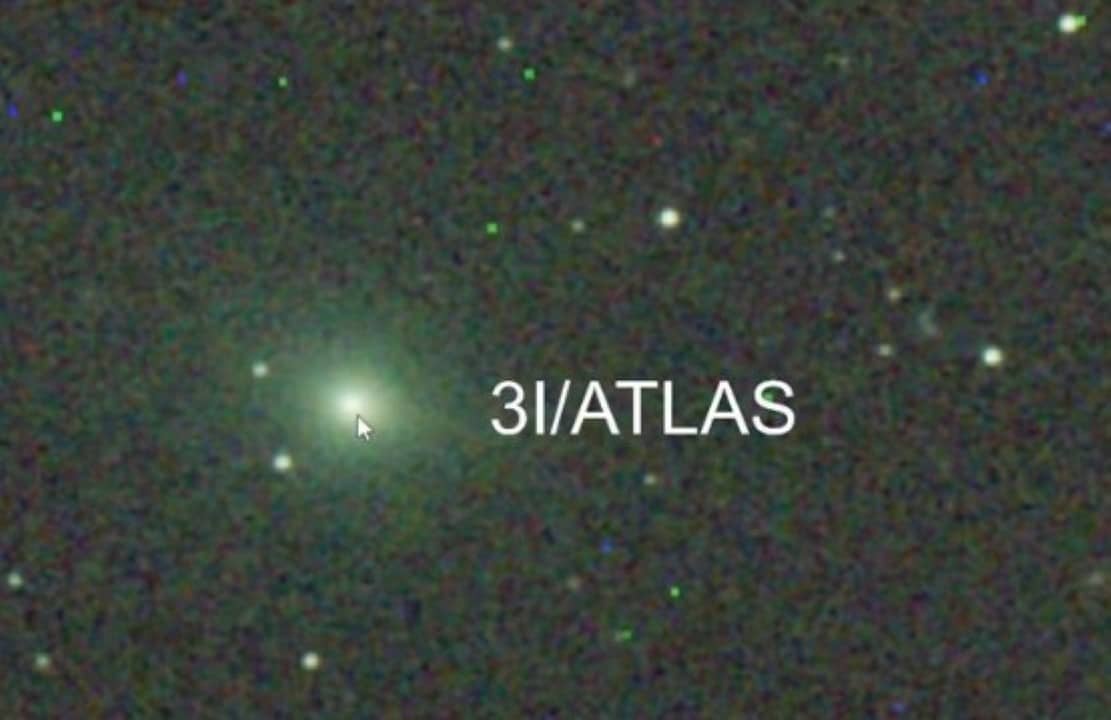
A new analysis of data on the interstellar object 3I/ATLAS, the third confirmed visitor from outside our solar system, suggests a cosmic reality much busier than previously imagined. Pesquisadores of Projeto Galileu and Universidade of Harvard, using images captured by
The confirmation came after detailed processing of observations carried out in December 2025, months after the object was first identified in July of the same year. 3I/ATLAS reached its closest approach to Sol on October 29, 2025, passing to a safe distance of 203 million kilometers, offering an unprecedented opportunity to study materials forged in other star systems.
The discovery reinforces the idea that the solar system is a galactic crossroads, receiving a constant stream of travelers from distant stars. The ability to detect and analyze these objects represents a significant leap in understanding planetary formation and the distribution of chemical elements across Via Láctea, providing valuable clues about the composition of other “suns” and their respective systems.

Population estimates and cosmic origin
The calculations that led to the impressive estimate of one trillion objects are based on the detection frequency and hyperbolic trajectory of 3I/ATLAS. Essa trajectory indicates that the object has enough kinetic energy to escape the gravitational attraction of Sol, confirming its extrasolar origin. Statistical analysis suggests that for every object we can detect, countless others go unnoticed.
This vast population of wandering bodies would extend across the entire solar system, reaching as far as the confines of Nuvem of Oort, a gigantic sphere of icy debris that surrounds our planetary system. Acredita Each star in Via Láctea is expected to eject a colossal number of comets and asteroids during its formation process, and these objects travel through interstellar space for millions or billions of years.
The composition of these visitors is of great scientific interest, being predominantly hydrogen, helium and heavier elements, which are the building blocks of planets and, potentially, life. The mass of a single object measuring one kilometer in diameter, as estimated for many of these bodies, can reach a billion tons, carrying with it a chemical record of its stellar system of origin.
The population density of these objects in Via Láctea is estimated at up to 10²³ bodies with similar characteristics. Esse monumental number implies that visits by interstellar comets and asteroids are a common event on the geological timescale, although the technology to identify them has only become available in recent years, ushering in a new era in astronomy.
Observation and monitoring technology
Detecting and tracking fast-moving objects like 3I/ATLAS requires a sophisticated and coordinated observation infrastructure. The first line of identification is made up of wide-scan telescopes, such as the Observatório Vera C. Rubin, in the Chile. Esse observatory is designed to map the entire visible sky of the Southern Hemisphere every few nights, making it crucial for finding anomalies and fast-moving objects.
However, for complete and uninterrupted coverage, scientists argue for the need for a complementary observatory in the northern hemisphere. Tal installation would eliminate blind spots and ensure that no interstellar visitor would pass by unnoticed, regardless of their approach trajectory. Coordination between global observatories is key to calculating accurate orbits in a short space of time.
Exploration proposals at Lua
To overcome the limitations imposed by the Earth’s atmosphere, which distorts light and degrades the quality of images, the scientific community explores advanced observation concepts. One of the most promising proposals is the installation of a 100-meter-long optical interferometer on the surface of Lua. The absence of atmosphere on the natural satellite would allow for image clarity unattainable on Terra.
This project could be integrated into NASA’s Programa Artemis, which aims to establish a sustainable human presence on Lua. The logistics of lunar missions could be used to transport and assemble the telescope, opening a new frontier in high-resolution astronomy. With such an instrument, it would be possible to obtain detailed images of the surface of objects like 3I/ATLAS, allowing a morphological analysis that could help determine their nature, be it geological or, in a more speculative scenario, artificial.
Details of the trajectory and composition of 3I/ATLAS
3I/ATLAS, like its predecessors Oumuamua and Borisov, has provided valuable data on the diversity of bodies roaming the galaxy. Sua passage through the inner solar system was a rapid but intensely monitored event by telescopes around the world and in space. Analysis of its coma, the cloud of gas and dust surrounding the nucleus, revealed the presence of volatile compounds that sublimed in the heat of Sol.
The object’s trajectory was calculated with high precision, showing that it spent the last 8,000 years traveling through the gravitational influence region of Sol before it was finally detected. Essa’s long journey through the interstellar medium means that its surface may contain information about the different regions of the galaxy it has traversed.
Comparison between the three known interstellar objects already reveals intriguing differences. Enquanto or
Space interception missions
The third layer in the strategy for studying these visitors focuses on the development of rapid response space missions, capable of intercepting and even landing on an interstellar object. Collecting direct samples is considered the holy grail of research, as it would allow detailed laboratory analysis of materials, something impossible to do with telescopes alone.
Such missions represent a monumental technological challenge, requiring advanced propulsion systems to achieve the necessary speed and autonomous navigation systems to maneuver close to a fast-moving and unpredictable body. The objective would be to analyze the isotopic composition and the presence of organic molecules, which could provide clues about the spread of the basic components of life throughout the galaxy.
The photographic record and its implications
The clearest image from 3I/ATLAS, obtained on December 28, 2025, was a milestone in the observation campaign. The recording, the result of a long exposure of 4,800 seconds, clearly revealed a jet of dust and gas known as the “antitail”, which pointed in the direction of Sol. Essa structure is formed by larger particles that are less affected by solar radiation pressure and more closely follow the comet’s orbit. Analysis of this image and other photometric data confirmed the active nature of the object, allowing astronomers to measure its rate of mass loss and the evolution of its brightness. Esses data is crucial for refining mathematical models that describe the interaction of comets with the solar environment and, by extension, help predict the behavior of future interstellar visitors that may be discovered.
A long journey to detection
The 3I/ATLAS journey is a story of cosmic resistance. Antes From its brief appearance in our skies, the object traveled for millennia through deep space. Sua high speed is proof of its gravitational freedom, ensuring that, after passing through our system, it will continue its journey towards other stars, becoming invisible to us again. The observation window, although short, was made the most of by the global scientific community.



