
Analysis by Avi Loeb reveals jets with unusual symmetry in the interstellar object 3I/ATLAS seen by Hubble


The interstellar object 3I/ATLAS, captured in high-resolution images by Telescópio Espacial Hubble, has become the center of a scientific debate following astronomer Avi Loeb’s analysis of Universidade Harvard. The observations, carried out at the end of 2025, revealed a structure of jets with a geometric symmetry that defies conventional explanations for celestial bodies of this nature.
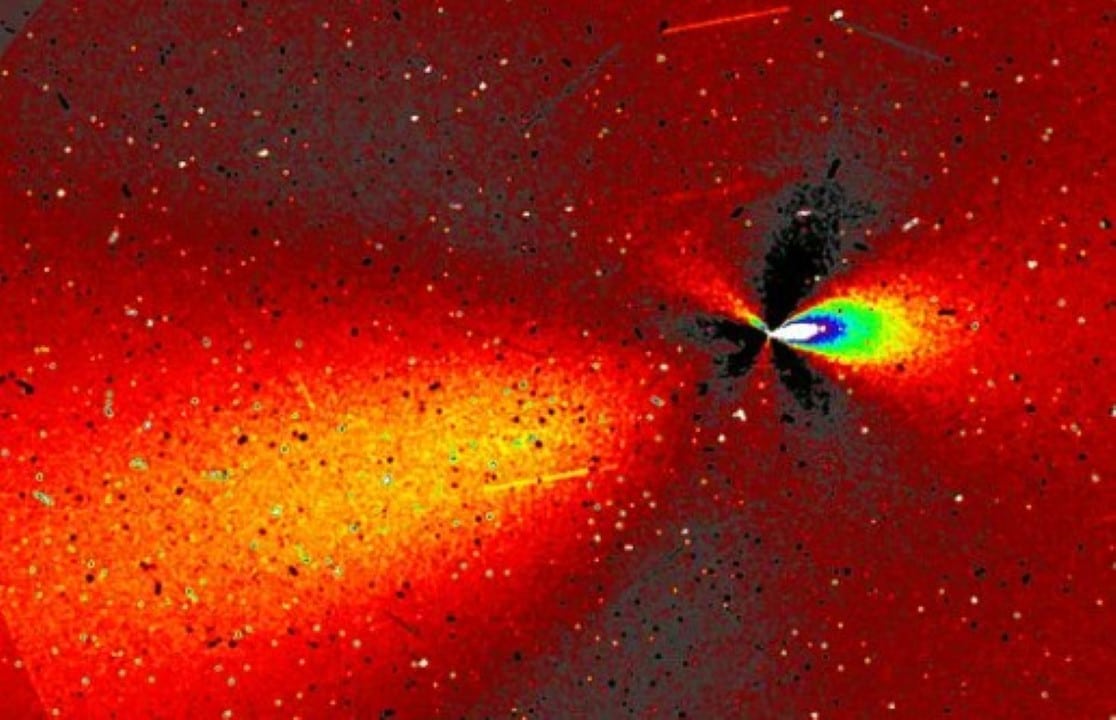
The photographs were taken on three different dates, November 30th, December 12th and 27th, 2025, allowing the evolution of the object’s behavior to be monitored. The processed material highlighted not only a prominent anti-tail pointed toward Sol, but also an internal configuration of jets that raised questions about whether their origin was purely natural.
The analysis of Loeb focuses on the angular arrangement of the internal jets, suggesting that the observed symmetric precision is a rare phenomenon and deserves in-depth investigation. The astronomical community is now evaluating whether the characteristics of 3I/ATLAS can be explained by existing cometary models or whether they indicate an as yet unknown mechanism.
Details of Hubble observations
The 17 images recorded by Hubble provided rich material for study. The raw data was released by NASA, ESA and STScI, allowing independent researchers to analyze the details of the interstellar object as it traveled through our system.
The image processing, carried out by the Italian astronomer Toni Scarmato, used the Larson-Sekanina rotation gradient filter. Essa technique was crucial in highlighting subtle variations in the structure of the jets, at scales extending up to 100,000 kilometers from the core.
The most notable large-scale feature was the anti-tail, a stream of dust and gas directed at Sol. The Essa structure was particularly visible and coherent in observations made in December, dominating the object’s external appearance.
On a smaller scale, up to 24 thousand kilometers from the core, the images revealed the evolution of internal jets. The configuration and intensity of these jets changed significantly between observation dates, indicating an ongoing dynamic process.
Unusual angular symmetry
Analysis of Avi Loeb highlights the internal configuration as being composed of three distinct jets. One of them points in the opposite direction to the Sol, aligning with the anti-tail, while the other two project in lateral directions.
What makes this structure extraordinary is the angular separation between the jets. The two side jets are positioned at angles of approximately +/- 120 degrees to the central jet, dividing the 360-degree space into three almost perfect parts.
Possible natural explanation
The most conventional interpretation for the activity of 3I/ATLAS associates it with the behavior of a comet. Nessa hypothesis, the jets would be the result of the sublimation of pockets of ice located on the surface of a rotating nucleus, which release gas and dust when heated by the Sol.
The main jet, which points towards Sol, would be responsible for the formation of the extensive anti-tail, which remains cohesive for more than 100 thousand kilometers. The activity of the lateral jets, in turn, could be explained by heat conduction through the object’s body, activating other volatile regions.
The maintenance of anti-tail coherence on such a large scale suggests that the core’s rotation axis is almost perfectly aligned with the direction of the Sol. Qualquer significant misalignment, or precession, would disperse the structure quickly.
Questions about alignment
The main issue raised by Avi Loeb lies in the very low probability of such a precise alignment occurring randomly. The chance of an interstellar object’s rotation axis pointing directly toward Sol is estimated at just 0.2%. The persistence of this alignment over great distances, combined with the 120-degree symmetry of the jets, makes the configuration even more enigmatic. Loeb questions whether this geometry can be fully explained by natural gas dynamics or whether it could represent a signature of non-natural origin, a point that generates intense debate. The stability of the system requires an extremely small cone of precession, something that is not commonly observed in comets.
Image processing and development
Toni Scarmato’s work was fundamental in visualizing the complexity of 3I/ATLAS. By applying advanced filters to the raw Hubble data, he was able to separate structures at different scales, revealing details that were not apparent in the original images. The processed images clearly show the anti-tail in the lower left corner, while a digital zoom reveals the surprising symmetry of the three inner jets, a crucial detail for the analysis of Loeb.
Comparison between November and December observations also showed a clear evolution in the jet dynamics. In November, a single jet appeared to dominate the internal structure, but in December, the configuration of three symmetrical jets became evident. Essas changes provide important clues about the physical processes occurring on the object’s surface as it interacts with the solar environment.
Dynamics and rotation of the nucleus
The observed variations in the orientation of the jet axes over time suggest that the core of 3I/ATLAS is rotating. Analysis of these changes allowed astronomers to estimate a rotation period of approximately 16 hours.
This rotation is compatible with the variations seen in smaller jets, which occur on scales of thousands of kilometers. Ice sublimation rates, when combined with the rotation period, can explain the rapid change in the appearance of these structures.
Next steps in the investigation
The 3I/ATLAS object continues to be monitored by ground- and space-based telescopes as it moves away from Sistema Solar, and future spectroscopic data will be essential in determining the chemical composition and exact speed of the jets, helping to clarify their origin.



