
Historic milestone on Mars: NASA probe takes 100,000 photos recording dunes in Syrtis Major


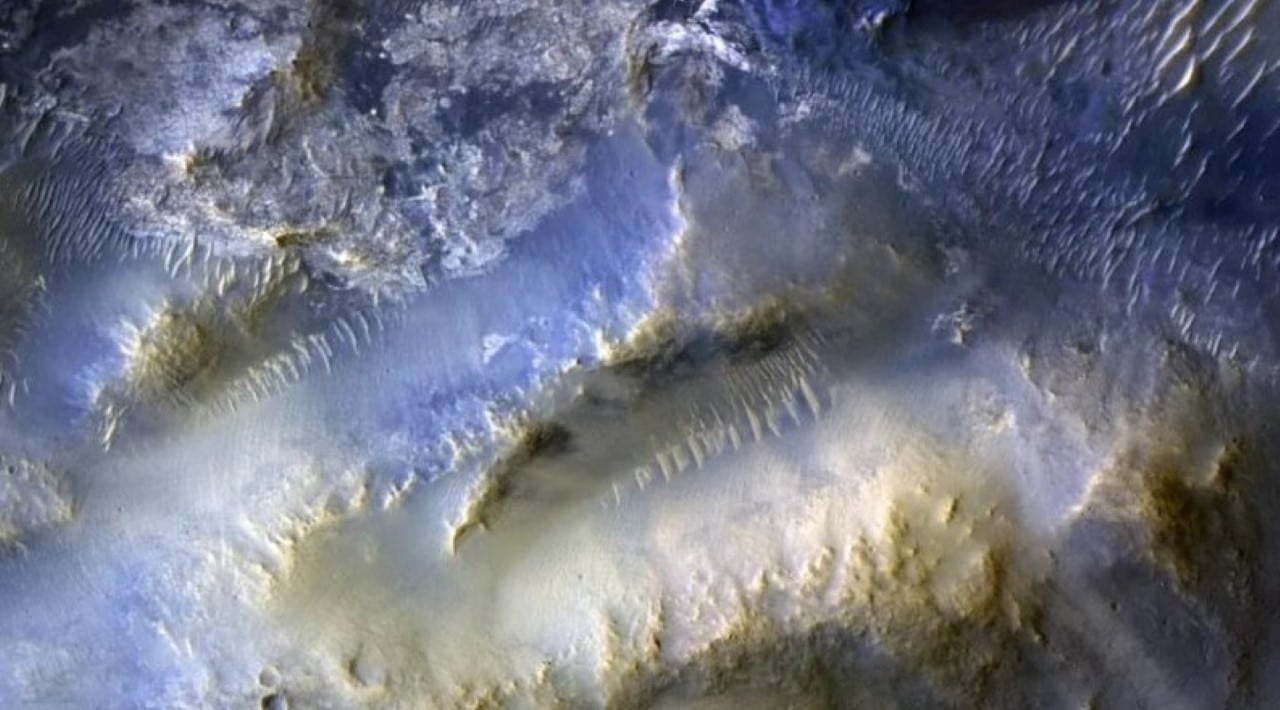
Exploration of Marte has reached an impressive new milestone. NASA’s Mars Reconnaissance Orbiter probe (MRO), one of the longest-lived and most productive satellites in orbit around the Red Planet, captured its 100,000th image using the powerful HiRISE (High Resolution Imaging Science Experiment) camera. The historical record, obtained on October 7, 2025, reveals details of rocky mesas and active dune fields in the iconic Syrtis Major region, a feat that crowns nearly two decades of continuous observation and scientific discoveries.
This milestone is not just a number, but a testament to the durability and relevance of the MRO mission, launched in August 2005 and reaching Martian orbit in March 2006. Desde So, the probe has exceeded all expectations, operating well beyond its designed useful life. Averaging approximately 5,000 high-resolution images captured per year, the mission has fundamentally transformed human understanding of the geology, climate and potential for past life on Marte, transmitting more than 450 terabits of data to Terra.
The commemorative image was not chosen at random. The Syrtis Major region is a vast, dark-colored volcanic plain, easily visible from Terra, and has been the subject of study for centuries. HiRISE’s ability to resolve details down to one meter allows scientists to observe ongoing geological processes, such as the movement of sand across dunes, providing crucial clues about the planet’s wind patterns and atmospheric dynamics. Analysis of these phenomena helps to build a more accurate model of the current Martian environment and its evolution over billions of years.
The meaning of the hundred thousandth image
Reaching the milestone of 100,000 observations by the HiRISE camera is an event of great relevance for the planetary scientific community. Cada image is a complex piece of a puzzle that researchers put together to understand the story of Marte. Mais than static photographs, these observations repeated over the years allow the creation of a slow-motion movie of the Martian surface, revealing a dynamic, geologically active world. The longevity of the MRO mission has allowed it to document seasonal changes, such as the appearance and disappearance of carbon dioxide ice at the poles, the emergence of new impact craters and even avalanches on steep slopes. Esse’s vast visual archive is an invaluable resource, not just for today’s scientists, but for future generations of explorers who will continue to unlock the secrets of the Red Planet. The consistency and quality of data collected by HiRISE has set a standard of excellence for orbital imaging missions, influencing the design and objectives of future space probes aimed at exploring other worlds in our solar system and beyond.
Syrtis Major under the lens of HiRISE
The region of Syrtis Major, the target of the historical image, is one of the most distinct areas of Marte. Localizada approximately 80 kilometers southeast of Cratera Jezero, where the Perseverance rover currently conducts its search for biosignatures, Syrtis Major is a volcanic province formed by dark basalt rocks. Image number 100,000 focuses on an area that exhibits diverse geology, including flat-topped mesas, eroded impact craters, and extensive dark dune fields. Essas dunes are of particular interest to scientists because their movement, shaped by Martian winds, offers a window into the planet’s meteorology. By comparing images of the same area taken at different times, it is possible to measure the speed and direction of sand transport, validating and improving the Marte climate models.
Detailed analysis of these formations helps researchers understand the origin of the sediments that make up the dunes and the processes that transport them across the surface. The dark color suggests a volcanic origin, and its interaction with lighter-colored materials elsewhere in the landscape tells a complex story of erosion and deposition over millennia. The proximity to Cratera Jezero also makes the area strategic, as MRO’s orbital data provides crucial regional context for the discoveries made by Perseverance on the ground, helping to connect the history of an ancient lake and river delta with the broader geological evolution of the region.
The technology behind the achievement
The Mars Reconnaissance Orbiter is a sophisticated science platform equipped with a suite of six main instruments, but the HiRISE camera is undoubtedly the most celebrated. Construída by Ball Aerospace and operated by Universidade of Arizona, HiRISE is the most powerful camera ever sent into the orbit of another planet.
Functioning as a reflecting telescope, it is capable of capturing images with such high resolution that it can identify objects the size of a coffee table on the Martian surface, from an altitude of around 300 kilometers. Essa capability allowed the discovery of details that were previously invisible.
Along with HiRISE, MRO carries other vital instruments such as the CRISM spectrometer, which maps the mineralogical composition of the surface, and the SHARAD radar, which probes underground for ice and geological layers. The synergy between these instruments provides a complete, multidimensional view of Marte.
A planet in constant change
HiRISE’s thousands of images, collected over nearly two decades, have conclusively proven that Marte is not a static planet. Ongoing observations have revealed a world where change is a constant, although it often occurs on a geological timescale.
Scientists have documented the slow but persistent migration of vast dune fields, pushed by the thin but effective winds of the Martian atmosphere. Esse gradual movement continually reshapes the landscape in certain regions.
The camera also recorded more dramatic events, such as avalanches of dust and ice rushing down steep slopes, especially during the Martian spring, when seasonal warming destabilizes ice deposits.
These observations of dynamic processes are key to reconstructing the planet’s climate history and understanding the forces that continue to shape its surface, offering a glimpse of a world more active than previously imagined.
Citizen science and the HiWish program
A notable aspect of the HiRISE mission is its commitment to public engagement through the HiWish program. Essa initiative allows anyone, from professional scientists to high school students and space enthusiasts, to suggest locations on the surface of Marte for the camera to photograph.
Image number 100,000, for example, was captured based on a suggestion made by a student, demonstrating how citizen science can directly contribute to planetary exploration. The program democratizes access to a cutting-edge scientific instrument and inspires the next generation of explorers and researchers.
Paving the way for future missions
In addition to their intrinsic scientific value, MRO and HiRISE data play a pragmatic and indispensable role in planning future missions to Marte. The high-resolution images are used to ensure the safety of landing sites for rovers and landers, identifying hazards such as large rocks, steep slopes or very rough terrain. Essa capability has been crucial to the success of missions like the Perseverance rover and will continue to be vital for future exploration, including planned crewed missions. The detailed maps of water ice deposits, created with MRO data, are essential to the in-situ resource utilization strategy, a key concept for sustaining a long-term human presence on the planet.
Longevity and legacy of the MRO mission
The Mars Reconnaissance Orbiter probe is managed by NASA’s Jet Propulsion Laboratory (JPL), while Lockheed Martin Space built the spacecraft and supports its ongoing operations. The mission’s incredible longevity and productivity are a tribute to the robust engineering and careful planning behind the project.
Serving not only as an observation platform but also as an essential communications relay for rovers on the surface, the MRO is the backbone of Marte’s exploration infrastructure. The legacy of its 100,000 images is a treasure trove of data that will continue to generate new discoveries for many years to come, solidifying its place as one of the most successful interplanetary missions in history.



