
Roscosmos confirms it will use parts of the International Space Station for its new orbital base

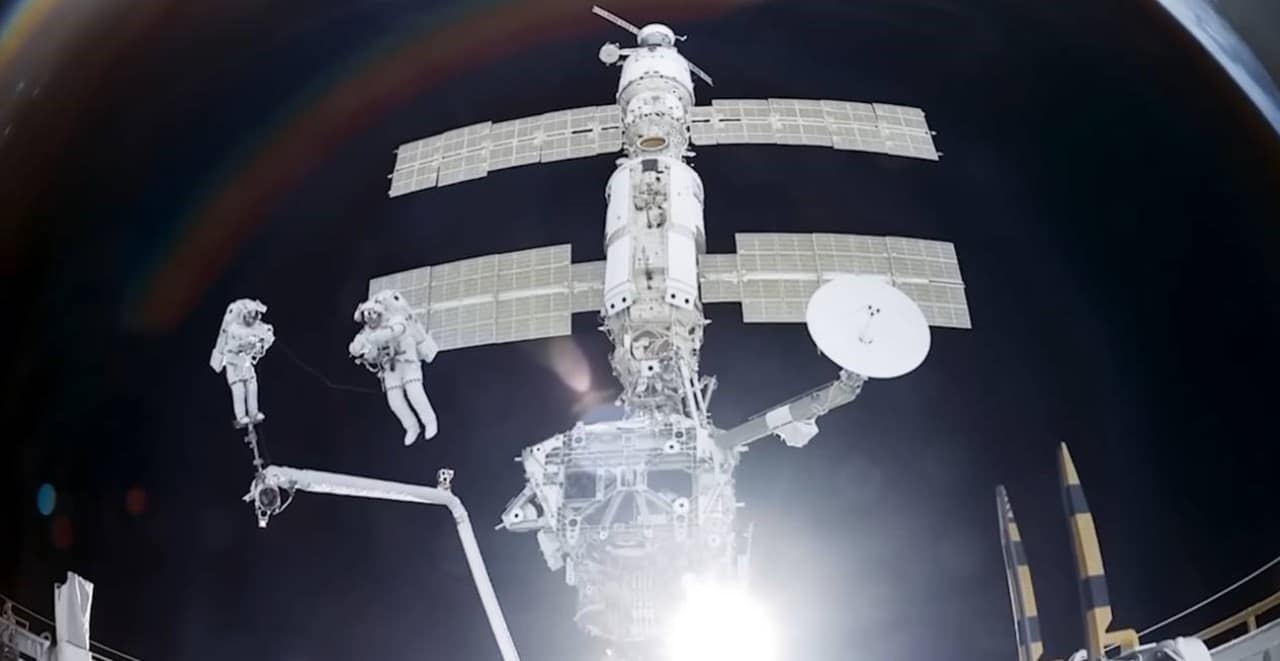
The Russian space agency, Roscosmos, has made a strategic shift in its plans for the future of manned space exploration official. An agency scientific and technical board approved the proposal to use the Russian segment of Estação Espacial Internacional (ISS) as the foundation for the future Russian Orbital Station (ROS). The decision marks a significant change compared to the previous project, which envisaged the construction of a completely new station from scratch.
The new approach consists of decoupling the existing Russian modules from the ISS around 2030, the year scheduled for the controlled deactivation of the multinational station. Essa maneuver will allow Rússia to maintain a continuous presence in Terra’s low orbit, taking advantage of infrastructure already in operation for decades. The measure is seen as a pragmatic solution to optimize financial and technical resources in a complex geopolitical scenario.
Oleg Orlov, director of Instituto of Problemas Biomédicos of Academia Russa of Rússia, which had already announced the extension of its participation in the ISS until 2028, is now aligning its schedule for a gradual and controlled transition, ensuring the continuity of its space operations without interruptions.
The new configuration of the Russian station
The decision to reuse existing modules rather than build an entirely new station represents a fundamental change in Rússia’s space strategy. The original plan, announced in recent years, involved launching multiple new modules from 2027 into polar orbit, which would allow for broader observation of Russian territory, including the strategic Ártico region. However, this approach would require massive investments and the development of new launch vehicles adapted for this specific orbit. By opting for reuse, Roscosmos not only saves billions of rubles, but also drastically simplifies operational logistics. The future ROS will maintain the ISS’s 51.6-degree orbital inclination, which facilitates launches from the already established cosmodromes of Baikonur, in Cazaquistão, and Vostochny, in the east of Rússia. Essa orbital continuity eliminates the need to redesign capsules and rockets, allowing the Soyuz and Progress spacecraft to continue their cargo and crew transport missions without major modifications, accelerating the timeline for the new station’s autonomy.
Key components in the transition
The success of the future ROS will depend on the integrity and functionality of the modules that will be inherited from the ISS. The backbone of the Russian segment is made up of robust yet veteran components. The Zvezda service module, launched in 2000, is the heart of the segment, providing life support, attitude control and propulsion systems for the entire ISS. The multifunctional science module Nauka, docked in 2021 after years of delays, brought modern laboratories and a new bathroom, significantly expanding Russian research capacity. Complementando the structure, the Prichal docking module, added at the end of 2021, functions as a hub with multiple docking ports, being essential for the future expansion of ROS with new components.
In addition to these three pillars, the segment has smaller modules such as the Poisk and the Rassvet, which serve as decompression chambers for extravehicular activities and additional docking docks. The biggest concern for engineers lies in the age of these components. The Zvezda, for example, has shown microcracks and small air leaks that require constant monitoring and repairs. Garantir the longevity and security of these systems will be one of
The timeline for separation
The transition from the ISS to the ROS will follow a carefully planned schedule to ensure the safety and stability of both structures during the process. Rússia is formally committed to the ISS partnership until 2028, which provides a window of time to prepare for separation.
During this period, Roscosmos plans to launch and attach new modules to its segment while it is still part of the ISS. Entre The new components are a science and energy module, designed to provide ROS with the energy autonomy needed after separation.
The uncoupling operation, expected to take place around 2030, will be a highly complex event. Após separation, the remainder of the ISS, led by the Estados Unidos, will be deorbited in a controlled manner to fall over a remote area of the Oceano Pacífico.
Orbital maneuver details
The operation to separate the Russian segment of Estação Espacial Internacional is one of the most complex orbital maneuvers ever planned. The main challenge is that the Russian modules, especially the Zvezda, are responsible for attitude control and propulsion that periodically re-raises the orbit of the entire ISS to compensate for atmospheric drag.
Before separation can occur, international partners, led by NASA, will need to have a fully operational, independent propulsion system for the remaining segment. Atualmente, cargo vehicles like Cygnus’s Northrop Grumman ship have already demonstrated the ability to perform these maneuvers, but a permanent and robust solution will need to be implemented.
On the Russian side, the newly formed ROS will need its own autonomous propulsion system. Roscosmos plans to use modified versions of the Progress cargo ships to take on this role, controlling the new station’s orbit and attitude independently.
Computational simulations and rigorous testing will be conducted over the next few years to validate all procedures. Qualquer error during physical separation could put both the ROS and the remaining segment of the ISS at risk, making coordination between Roscosmos and NASA absolutely crucial to the success of the operation.
New modules to guarantee autonomy
For Russian Orbital Station (ROS) to be a viable and autonomous platform, the addition of new modules before and after separation from the ISS is essential. Esses new components are designed to fill functional gaps that will emerge with the end of dependence on international infrastructure.
The most important of these is a new Módulo of Ciência and Energia, which is expected to launch before 2030. Além will also house new laboratories for research that Rússia considers to be a priority.
Implications of the new strategy
Roscosmos’s decision to create its own station from ISS modules reflects a strategic realignment in the space exploration scenario. The measure signals a gradual departure from the model of broad international cooperation that characterized the ISS for more than two decades, favoring greater national autonomy.
This change allows Rússia to define its own research and operational priorities, without the need for consensus among multiple partners. The Russian space agency has already indicated that ROS could be open to partnerships with other countries, especially BRICS nations and other strategic allies, in a different model than the ISS consortium.
The future of Russian operations
The creation of ROS is a central pillar for the continuity of the Rússia manned space program. The station will serve as an essential platform for developing and testing technologies needed for future deep space missions, including potential trips to Lua and Marte, as well as meeting national security demands and observation of Terra.



