
Atypical properties of the interstellar comet 3I/ATLAS raise debates about its natural origin


A visitor from another star system, called 3I/ATLAS, is defying conventional scientific explanations due to a set of anomalous features observed since its discovery. The object, which is the third confirmed interstellar comet to cross our solar system, exhibits behavior that deviates significantly from known standards for natural celestial bodies, generating intense debate in the astronomical community about its true nature and origin.
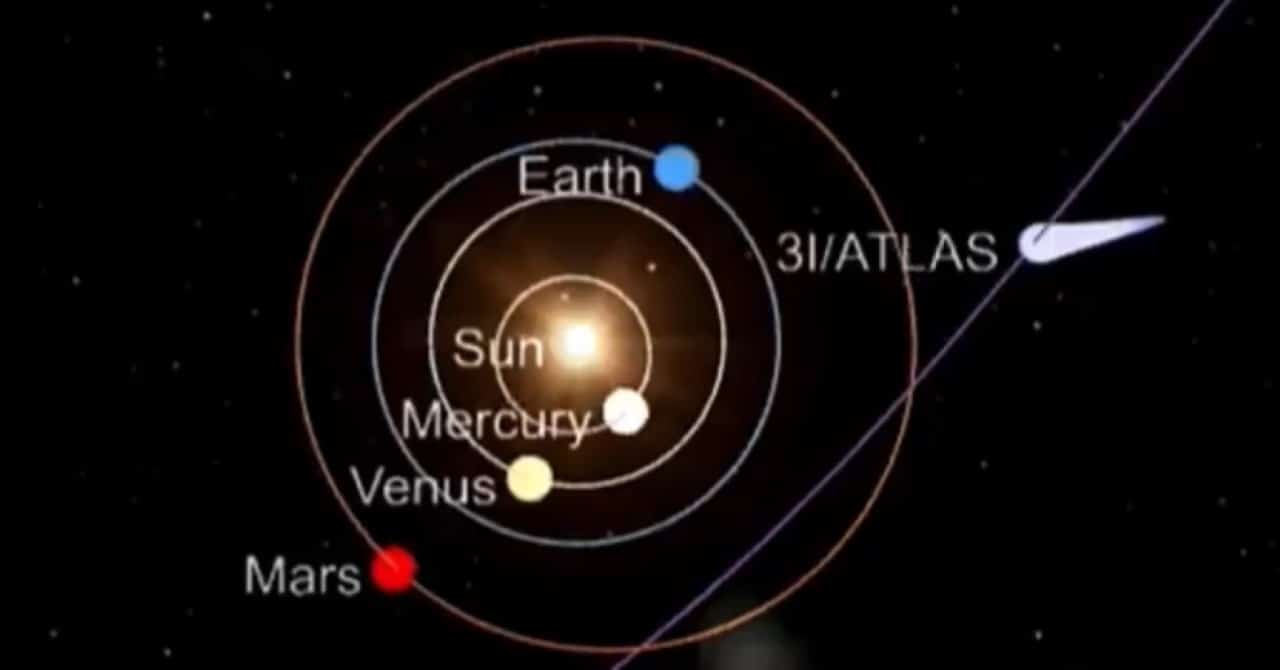
Detected in mid-2025 by the ATLAS astronomical survey system, the comet followed a retrograde hyperbolic trajectory, moving in the opposite direction to most planets and at an excess speed of approximately 58 km/s. Sua passed through the closest point to Sol, the perihelion, occurred in October 2025, and its closest approach to Terra took place in December, at a safe distance of around 269 million kilometers.
Ongoing analysis of data collected during its passage reveals a series of geometric coincidences, physical properties, and chemical composition that do not easily align with existing cometary models. Essas peculiarities, combined, make 3I/ATLAS one of the most intriguing objects ever studied in deep space.
A trajectory with unlikely alignments
One of the most notable aspects of 3I/ATLAS is its orbit. The comet moved on a plane inclined just 5 degrees relative to the ecliptic, the orbital plane of the planets in the solar system. The probability of a random interstellar object showing such an alignment is extremely low, estimated at just 0.2%, which immediately caught the attention of researchers.
In addition to this orbital inclination, the object’s trajectory presented other rare geometric coincidences. Sua route included relatively close passes of Marte and Júpiter, with a close approach to the gas giant that nearly coincided with the radius of its sphere of
This orbital precision is unusual when compared to previous interstellar visitors, 1I/’Oumuamua and 2I/Borisov, whose trajectories were more consistent with a random entry into the solar system. The combination of these factors suggests a path that is, at the very least, statistically rare.
The gravitational deflection suffered by the comet during its passage also appears to correspond precisely to the angle of its emission jets, another characteristic that contributes to the picture of an object with highly ordered and atypical behavior for a wandering natural body.
Emission and rotation jets with unusual stability
Observations of the jets of material expelled by 3I/ATLAS revealed more anomalies. The comet exhibited collimated jets, that is, highly focused, that pointed directly towards Sol, both before and after reaching perihelion. Essas structures, known as anti-tails, extended up to 1 million kilometers and maintained a remarkably stable symmetry and direction, with their bases remaining thermally isolated for months, a phenomenon difficult to explain through conventional sublimation processes.
The rotation of the object also proved to be peculiar. The Seu axis of rotation was aligned less than 8 degrees from the direction of the Sol at the time of its entry into the solar system, a configuration with a naturally occurring probability of only 0.5%. A slight wobble detected in the jets confirmed that one of their rotational poles was facing Sol, further limiting the possibilities of a random orientation. Essa stability contrasts sharply with the more erratic variation of the jets observed in comets in our own solar system, suggesting distinct emission mechanisms or a different internal structure.
Chemical composition challenges cometary models
Spectroscopic analysis of the plume of gas and dust surrounding 3I/ATLAS revealed a chemical composition that differentiates it from thousands of comets already studied. One of the most surprising discoveries was the high proportion of nickel in relation to iron, with a ratio of nickel to cyanide much higher than that recorded in any known comet. Essa’s chemical signature more closely resembles industrial metal alloys produced at Terra than primordial materials expected in a cometary body. Adicionalmente, the object showed a severe depletion of water, which made up only 4% of its gas plume, contrasting sharply with typical comets, which are predominantly composed of water ice. Apesar from the lack of water, the emissions included atomic nickel vapor and other elements in concentrations similar to those of solar comets, but with marked imbalances that point to an origin in a stellar environment with conditions very different from those that formed our solar system.
Physical properties and anomalous acceleration
3I/ATLAS has been shown to have a mass considerably greater than previous interstellar objects, combined with a high hyperbolic velocity. The Essa combination resulted in a significant non-gravitational acceleration, that is, a deviation from its trajectory that cannot be explained solely by the attraction of the Sol and the planets.
For this acceleration to be caused by natural processes, such as the sublimation of ice by solar radiation, mass evaporation would be required on a massive and continuous scale, something that the data does not fully support. Sua negative optical polarization also reached an extreme value, unprecedented among comets ever observed.
The object also exhibited a rapidly increasing brightness and a bluish color than Sol when it was near perihelion, adding more layers of complexity to its physical profile. Essas characteristics, when analyzed together, paint the picture of a body with extreme physical properties.
Origin of the object and intriguing coincidences
By tracing 3I/ATLAS’s trajectory backwards, astronomers determined that its direction of arrival into the solar system lines up just 9 degrees from the origin of the famous “Wow signal!” 1977, a narrowband radio transmission whose origin remains a mystery.
Although this proximity is considered a statistical coincidence, with a probability of 0.6%, it adds to the list of curious aspects of the object. Sua’s origin points to Via Láctea’s thin or thick disk, which suggests the comet may be older than the solar system itself.
The legacy of 3I/ATLAS for science
Regardless of its nature, 3I/ATLAS already represents a milestone for interstellar studies. Ele provides valuable and unprecedented data on the formation of celestial bodies in other stellar systems, offering clues about chemical and physical processes occurring in environments far from our own.
Comparisons with ‘Oumuamua and Borisov highlight the incredible diversity among interstellar visitors, showing that each object can carry unique information about its system of origin. Observations at different wavelengths, including X-rays and ultraviolet, detected unprecedented emissions for comets of this type, opening new fronts of research. Studies on 3I/ATLAS will fundamentally contribute to understanding the distribution of organic and volatile materials in the galaxy.
Continuous monitoring by global observatories
Astronomers from around the world have mobilized the most advanced observatories, including the Hubble and James Webb (JWST) space telescopes, to monitor 3I/ATLAS intensely. Imagens recent images captured by these missions show a green coma, characteristic of the presence of diatomic carbon, and highly structured dust and ion tails. The comet continues to be watched as it moves away, in a race against time to collect as much information as possible before it disappears into interstellar space forever.



