
Extraterrestrial probe? Avi Loeb argues that comet 3I/ATLAS may have been modified by aliens


The astronomical community is once again debating the possibility of extraterrestrial technology in our Sistema Solar. Astrophysicist Avi Loeb of Universidade Harvard has proposed a bold hypothesis that the interstellar comet 3I/ATLAS, the third object confirmed to come from another star system, may not be entirely natural. The theory suggests that the celestial body may have been engineered by an alien civilization to act as an exploration probe.
Discovered in July 2025, 3I/ATLAS captured the attention of scientists for its anomalous behavior and unusual physical characteristics. Segundo Loeb, these peculiarities deviate from what is expected for a natural comet, justifying the consideration of an artificial origin. The central idea is that an advanced civilization would have modified a water-rich comet to serve as a camouflaged interstellar vehicle.
The object’s trajectory, which included a close pass at Terra in December 2025, allowed for detailed observations that fuel the controversy. Enquanto Most scientists seek natural explanations for the observed phenomena, Loeb’s proposal reignites the debate about how to search for extraterrestrial intelligence, focusing on physical artifacts rather than just radio signals.
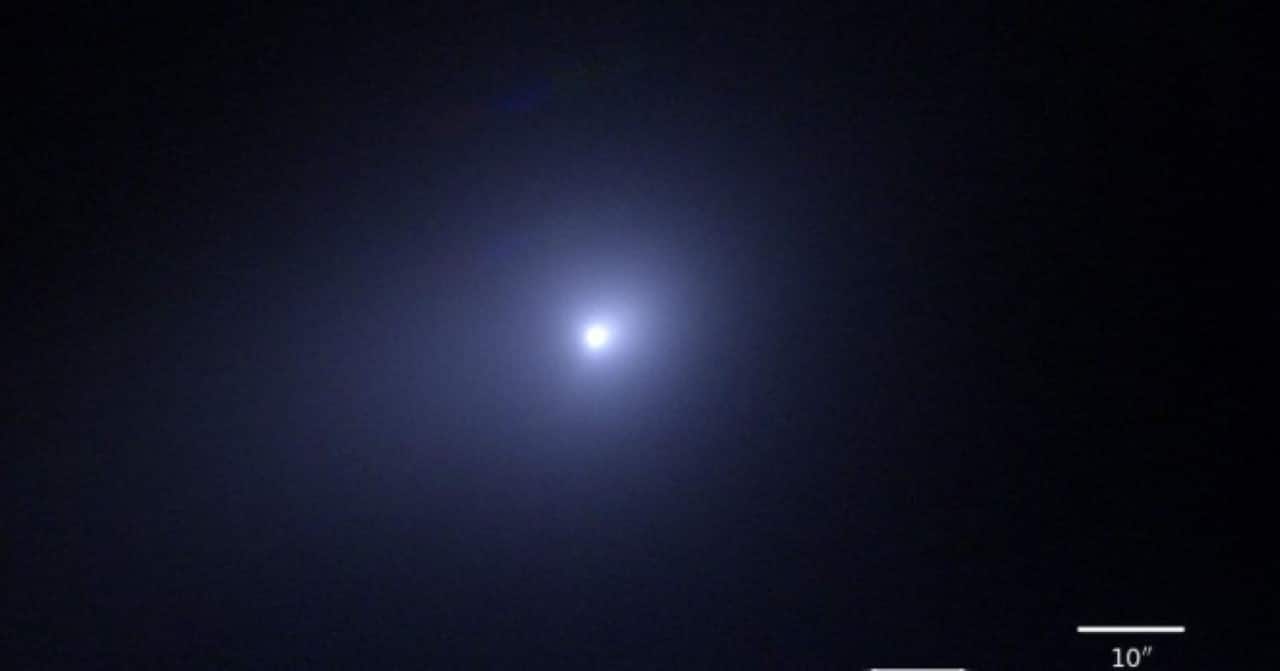
The discovery and trajectory of the interstellar visitor
Comet 3I/ATLAS was officially identified in mid-2025 by the astronomical survey system ATLAS (Asteroid Terrestrial-impact Last Alert System), located at Chile. Sua’s classification as the third confirmed interstellar visitor, after ‘Oumuamua in 2017 and Borisov in 2019, was quickly established by its very high speed, exceeding 60 km/s, and its hyperbolic orbit, which indicates an origin external to our Sistema Solar.
After entering the system, the object followed a trajectory that took it to its perihelion, the point of closest approach to Sol, in November 2025.
Unusual features that intrigue scientists
Initial analyzes by 3I/ATLAS revealed a celestial body of considerable dimensions, with an estimated diameter of between 10 and 20 kilometers, significantly larger than most previously detected interstellar objects. Sua composition proved to be rich in frozen water, something expected for a comet, but spectrometry also indicated a proportion of metals, such as nickel and iron, which some researchers associate with industrial alloys. Outro The strangest factor was its initial behavior: when approaching Sol, the object did not display the typical cometary tail, which only manifested itself later and in a very intense way. Observações made by Telescópio Espacial Hubble and radio telescopes confirmed ice sublimation activity through the detection of hydroxyl radicals, but the pattern of material release did not follow conventional models, adding yet another layer of mystery to the cosmic visitor.
The anomalies that support the theory of Loeb
At least 18 peculiarities have been documented in the behavior of 3I/ATLAS, but a few stand out as pillars of the Avi Loeb hypothesis. One of the most significant is the presence of jets of gas and dust expelled from its surface, positioned 120 degrees apart. Essa geometric symmetry is extremely unlikely to occur in natural sublimation processes, which are generally chaotic and irregular.
Another notable anomaly is the periodic variation in its brightness. The data suggests that the object has a stable rotation, with a period of approximately 16 hours. Cometas and natural asteroids often have an irregular and chaotic rotation, known as “tumbling”. The rotational stability of 3I/ATLAS could indicate an artificially balanced internal structure.
The object’s orbital alignment also drew attention. Sua trajectory took it to pass in relative proximity to Vênus, Terra and Marte, the three planets located in the habitable zone of Sistema Solar. Para Loeb and his supporters, this trajectory seems optimized for a reconnaissance mission, a coincidence they consider too suspicious to ignore.
The concept of the cosmic “horse of Troia” probe
To explain how alien technology could reach us in such a discreet way, Avi Loeb uses Troia’s horse analogy. Ele argues that an intelligent civilization would not send a shiny metallic ship, but would rather utilize the resources of the cosmos itself. The idea would be to capture a natural comet, a body rich in water and organic matter, and equip it with the necessary technology for propulsion, navigation and data collection.
This approach would offer multiple strategic advantages. The comet’s icy body would serve as a robust shield against cosmic radiation and micrometeoroid impacts during the long interstellar journey. Além In addition, frozen water could be processed to generate hydrogen and oxygen, serving as fuel for orbital maneuvers or to sustain internal systems, making the probe self-sufficient and capable of operating for millennia.
Skepticism and alternative views in astronomy
Despite the appeal of the Loeb hypothesis, the vast majority of the scientific community maintains a skeptical stance. The most accepted explanation is that 3I/ATLAS is a natural comet, whose unusual characteristics derive from physical processes that we still do not fully understand, especially as it is an object formed in a star system different from ours.
Experts argue that the lack of data on the diversity of comets on other stars makes it hasty to classify any behavior as “anomalous.” Processos such as internal fractures or unique chemical composition could explain the jets’ symmetry and brightness variations.
To date, intensive observations by powerful radio telescopes such as MeerKAT on África of Sul have not detected any type of artificial radio emission or heat signature that could indicate the presence of technology. The absence of these signs is considered strong evidence against the hypothesis of a technological origin.
For many astronomers, the confirmed presence of a coma and the detection of hydroxyl are overwhelming evidence that the object behaves, in essence, like a comet. Eles defend the principle of Navalha of Occam, which favors the simplest and most natural explanation to the detriment of more complex and extraordinary theories.
Observation window and next steps
The opportunity to study 3I/ATLAS is running out. The ideal observation window remains open until March 2026, during which time the object will approach Júpiter before being ejected out of Sistema Solar on its return trajectory to interstellar space. Cientistas from around the world continue to monitor it intensely, seeking to obtain more accurate spectral data and better understand its rotational dynamics before it disappears forever.
The legacy of ‘Oumuamua and the study of interstellar objects
The debate surrounding 3I/ATLAS is an echo of the controversy generated by ‘Oumuamua in 2017. The first interstellar visitor also displayed characteristics that defied simple explanations, such as its extremely elongated shape and a non-gravitational acceleration that Loeb also attributed to a possible technology, such as a solar sail. The argument over ‘Oumuamua was never fully resolved, leaving a precedent for unconventional hypotheses.
In contrast, the second object, 2I/Borisov, detected in 2019, showed all the characteristics of a classic comet, with a prominent tail and familiar chemical composition. The increasing frequency of detection of these visitors, driven by scanning telescopes like ATLAS and the upcoming Observatório Vera C. Rubin, promises to provide a much larger catalog of these objects, helping science determine what is common and what is truly anomalous in the universe.



