
Interstellar comet 3I/ATLAS has its observation impacted by strong X1.9 class solar flare


A high-intensity solar event is complicating astronomers’ efforts to study a rare visitor from outside our Sistema Solar. Administração Nacional Oceânica and
The explosion, originating in an active region of Sol, triggered a massive coronal mass ejection (CME), which consists of a cloud of plasma and magnetic fields projected into space. Cientistas around the world are now on high alert, monitoring the possible impacts of this radiation on the comet and, mainly, on the delicate instruments used for its observation.
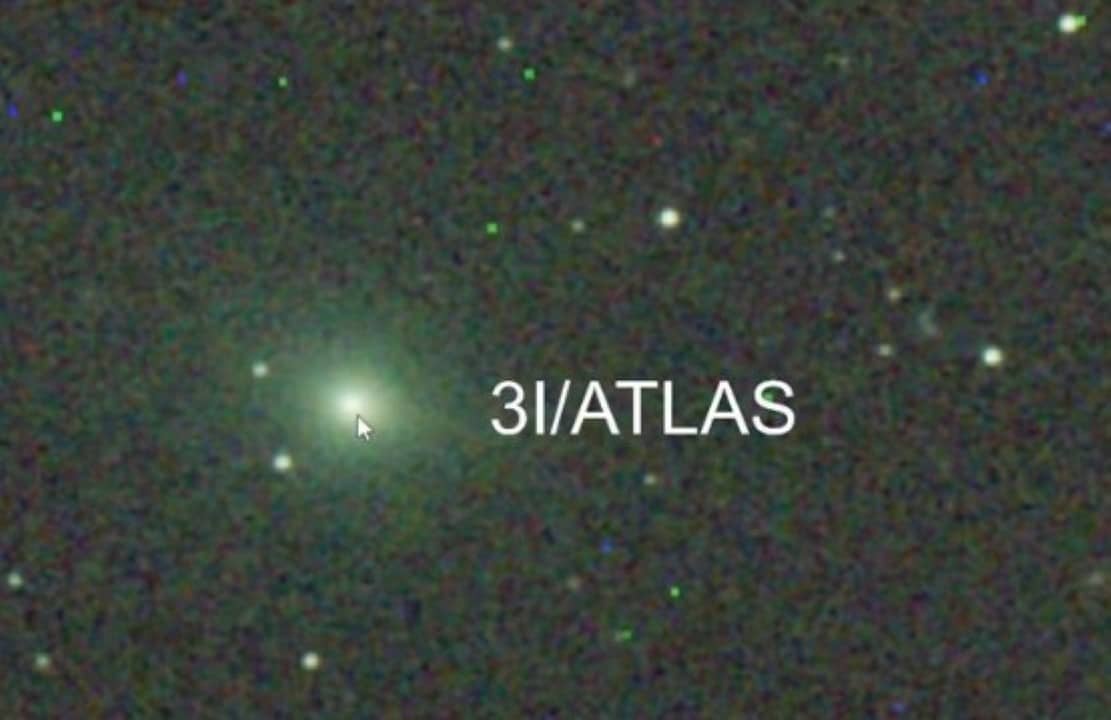
The discovery of 3I/ATLAS, carried out in July 2025 by the astronomical survey system at Chile, generated great expectations in the scientific community. Sendo the third interstellar object confirmed to visit our system, it offers a unique opportunity to analyze the composition of celestial bodies formed around other stars.
The fury of the sun and its immediate effects
The X-class flare is the highest category on the solar flare measurement scale, and the X1.9 event represents a colossal energy release, comparable to billions of atomic bombs exploding simultaneously. Imagens captured by space observatories, such as NASA’s Solar Dynamics Observatory (SDO), showed a shock wave propagating across the solar surface, destabilizing magnetic filaments and even causing a secondary explosion on the opposite side of the star. Esse phenomenon, known as “coronal dimming” or “dimming”, is the visual signature of the evacuation of plasma from the solar corona, material now traveling through space.
Although the coronal mass ejection is not aimed exactly at Terra, the active region of Sol responsible for the eruption will rotate towards our planet in the coming days. Isso increases the likelihood of geomagnetic disturbances, which can affect communications satellites and navigation systems. Astronomers’ main concern, however, is direct interference with the environment around comet 3I/ATLAS. The increase in the solar wind, which already exceeds the speed of 650 km/s, and the fluctuation of magnetic fields can change the morphology of the comet’s tail and mask crucial data about its chemical composition.
Anomalous characteristics of 3I/ATLAS
Comet 3I/ATLAS was already an object of intense study due to its peculiar characteristics, even before the solar flare. Sua hyperbolic trajectory, which confirms its extrasolar origin, exhibits a subtle and inexplicable acceleration, which cannot be attributed solely to the sublimation of ice, the usual engine of comets. Espectrômetros detected rotational pulses and non-radial gas jets emerging from its coma, the gaseous atmosphere surrounding the core.
The comet’s composition also intrigues researchers. The micrometric dust in its coma has a reddish color, similar to that of D-type asteroids, but spectral analyzes revealed the presence of tholins, complex organic molecules formed by the irradiation of simple compounds. Essa composition suggests a very different training environment than our Sistema Solar.
The comet’s activity has been closely monitored. Sua coma has grown from 13,000 kilometers in diameter in June to more than 18,000 kilometers in July 2025, a remarkable expansion considering its distance from Sol. The stability of the core, which did not show fragmentations or “outbursts” (sudden bursts of activity) until August, suggests a robust internal structure.
Researchers at Instituto from Astrofísica from Canarias noticed that the object’s reddish color has been evolving, indicating dynamic changes on its surface. Cada one of these anomalies reinforces the scientific value of 3I/ATLAS as a direct probe of a distant planetary system, offering clues about planetary formation processes that we cannot directly observe.
Influence of the solar wind on observations
The solar wind intensified by the recent eruption poses a significant challenge. The charged particles flowing from Sol interact directly with the comet’s ionic tail, which is made up of ionized gases. Essa interaction can deflect and deform the tail, making it difficult to analyze its composition. Além Furthermore, the increase in energetic electrons in geosynchronous orbit has already registered peaks of 8,300 pfu (particle flux units), which can saturate the detectors of space telescopes such as the Hubble and the James Webb, compromising the quality of the readings.
Another technical factor is the magnetic component Bz of the solar wind, which registered a drop to -6 nT (nanoteslas). A negative value indicates that the magnetic field of the solar wind is oriented opposite to the magnetic field of Terra, which facilitates the occurrence of magnetic reconnections. Esse process releases energy and can drastically alter the interaction of the solar plasma with the comet’s magnetosphere, masking the chemical signatures of its nucleus.
Teams at Agência Espacial Europeia (ESA) are adjusting the operations of satellites such as Juice and Europa Clipper, which were scheduled to observe the comet’s tail. The objective is to calibrate the instruments to filter out the extra “noise” caused by solar activity and still collect valuable data on the organic elements preserved in the core’s ice, which are remnants of their original star system.
Scientific preparations for the passage
Despite the challenges posed by solar activity, the astronomical community is mobilized for the passage of 3I/ATLAS. Redes global telescopes, including the powerful Vera C. The comet’s luminosity is expected to fall below magnitude 12, making it invisible to the naked eye and requiring the use of medium and large telescopes for detailed observation.
NASA is integrating data from multiple missions, such as Parker Solar Probe, which studies Sol up close, and the SOHO observatory, to build more accurate models of the eruption’s impact on the interplanetary environment. Current predictions indicate that, despite the intense activity and gas jets, the nucleus of 3I/ATLAS should maintain its structural integrity, unlike other comets that fragmented as they approached Sol.
Anomalies detected on the comet
The resilience of 3I/ATLAS is one of its most notable anomalies. The nucleus, estimated to be about 3.5 miles in diameter, has withstood thermal and gravitational stresses that have led to the disintegration of other comets, such as C/2025 K1. Imagens recent reports from the Gemini South telescope confirmed that the comet maintains a broad and cohesive coma, with no signs of fragmentation even after passing through perihelion, its closest approach to Sol, on October 29. Essa robustness raises hypotheses about its internal composition. One theory suggests that an outer crust of carbon dioxide ice may be protecting deeper layers of water ice, regulating sublimation and preventing catastrophic disintegration. Observações with Telescópio Espacial James Webb are focused on measuring surface temperature to validate or disprove this idea. Além In addition, radio emissions captured by the MeerKAT radio telescope, on África of
Space telescope observations
The effort to decipher the secrets of 3I/ATLAS is a multi-agency, multi-national collaboration. Telescópio Espacial Hubble captured sharp images of the comet in July, when it was 446 million kilometers from Terra, revealing a broad tail of dust pointing east. Simultaneamente, James Webb is using its infrared spectrometers to identify complex organic molecules that may have been preserved in the nucleus since its formation.
The TESS satellite (Transiting Essas Early observations are key to understanding how and when interstellar comets “wake up” upon entering our system. Sondas as well as Hera and Europa Clipper also carried out measurements as they passed through the ion tail in November, collecting data on the magnetic field that will only reach Terra in February 2026, due to communication restrictions.
Implications for planetary defense
The passage of 3I/ATLAS, although it does not pose any risk of collision, serves as an important exercise for planetary defense systems. Rede Internacional of Alerta of Asteroides (IAWN), coordinated by ESA and NASA, activated its monitoring protocols to track the object with maximum precision, integrating data from observatories such as ATLAS and Rubin. Este event allows testing and improving the ability to detect and predict the trajectory of interstellar objects, which enter Sistema Solar at high speeds and with unpredictable trajectories. The simultaneous solar flare also reinforces the need to develop satellites and instruments with enhanced radiation shielding, ensuring that observation systems remain operational during extreme solar events. The scientific community uses this opportunity to refine models and prepare humanity for the eventuality of an interstellar object on a collision course.



