
Interstellar object 3I/ATLAS reaches rare solar opposition phase and generates intense brightness in observations

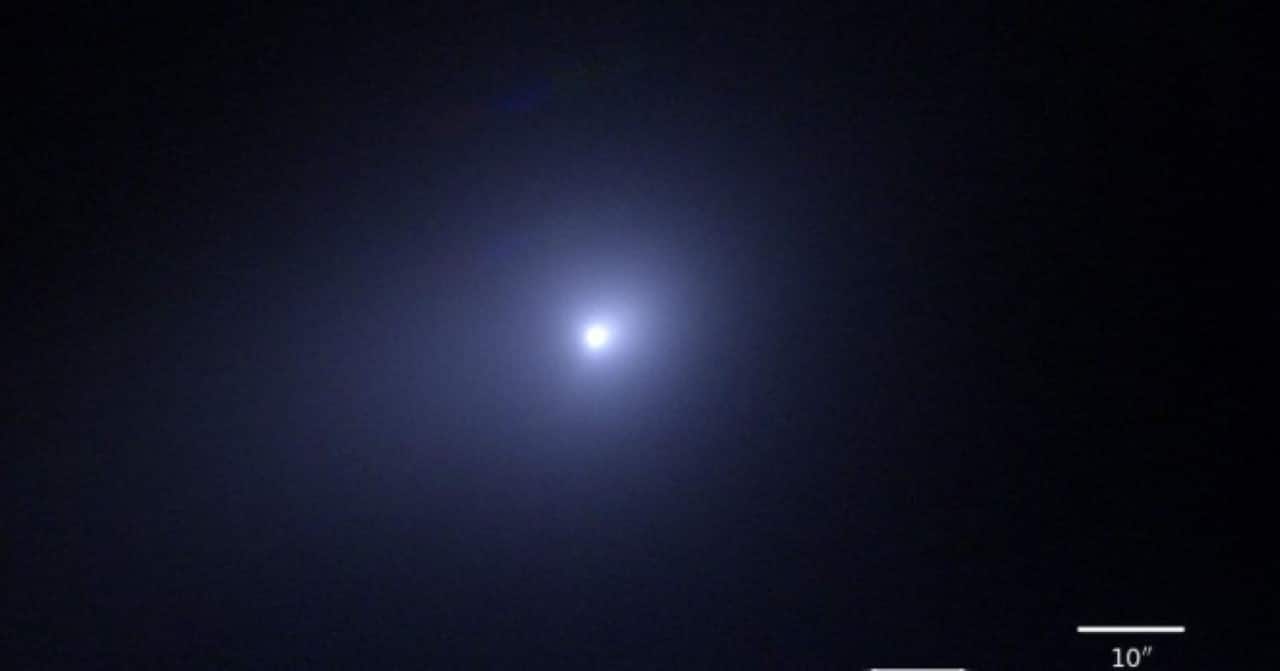
The interstellar object known as 3I/ATLAS reached, on January 22, 2026, a rare phase of solar opposition, aligning itself almost perfectly with the line between Sol and Terra. Esse event, likened to a “full moon” for distant celestial bodies, caused a significant increase in the object’s brightness, facilitating detailed observations by telescopes around the world. Astrônomos highlight that the alignment, with a deviation of just 0.69 degrees, offers a unique opportunity to study particles and structures associated with visitors from outside Sistema Solar.
The phenomenon occurred exactly as predicted in recent studies, based on orbital data collected since the object’s discovery in July 2025. Observatórios professionals recorded the burst of luminosity, which could help clarify the composition of the material ejected by 3I/ATLAS.
Researchers have been tracking the object for months, using instruments like the Telescópio Espacial Hubble to capture high-resolution images.

Object discovery and classification
3I/ATLAS was identified in July 2025 by the ATLAS telescope system, at Chile, marking it as the third confirmed object of interstellar origin to pass through Sistema Solar. Sua hyperbolic trajectory, with a high speed compared to Sol, quickly confirmed that it does not belong to our planetary system. Especialistas from NASA and international agencies initially classified it as a comet, due to the presence of a tail and gaseous activity.
The “3I” designation follows the sequence established for interstellar objects, following 1I/’Oumuamua in 2017 and 2I/Borisov in 2019. Initial Observações revealed ejections of material, including cyanide, typical of comets, but with characteristics that differ from known patterns.
Trajectory through Sistema Solar
3I/ATLAS made its closest approach to Sol, called perihelion, in October 2025, about 1.4 astronomical units away. Após this point, the object followed in the opposite direction, passing close to the orbit of Terra in December of the same year. In March 2026, it will approach Júpiter, approximately 50 million kilometers away, before definitively leaving Sistema Solar.
The high speed, combined with influences from the solar wind and radiation, prevents ejected natural particles from reaching Terra. Astrônomos continuously monitor the orbit to predict future behavior and rule out any risk.
Significance of the opposition phase
Solar opposition represents the moment when the object is completely illuminated from the terrestrial point of view, maximizing the reflection of sunlight. In the case of 3I/ATLAS, the precise alignment resulted in rapid brightness growth, allowing analysis of the particle structure in the tail and anti-tail. Esse phenomenon occurs rarely for interstellar objects due to the high speed and trajectory not linked to the Sol.
Studies indicate that the luminous outbreak can restrict models about the chemical and physical composition of the ejected material. Observações during this phase complements data collected by Hubble in previous months.
Anomalies observed in images
Images from Telescópio Hubble revealed unusual structures in 3I/ATLAS throughout 2025 and early 2026. Entre feature mini-jets emerging at symmetrical angles of approximately 120 degrees. Essas formations maintained a consistent pattern across multiple captures, raising questions about ejection mechanisms.
The object’s tail continued to grow after perihelion, with changes in the color and polarization of the reflected light. Medições indicated subtle non-gravitational acceleration, similar to previous cases of comets, but with an intensity that requires additional explanation.
Research has recorded high levels of polarization, higher than typical Sistema Solar comets. Sinais detected radios were classified as natural, with no artificial evidence.
Contributions by Avi Loeb to the discussion
Astrophysicist Avi Loeb of Universidade Harvard has published analysis detailing the January 22 alignment in collaboration with Mauro Barbieri. The work, accepted in a scientific journal, emphasizes the potential of the phase to clarify the nature of the anti-tail and associated particles. Loeb shared data with professional observers to maximize telescopic captures during the event.
In complementary texts, the researcher explores alternative hypotheses for observed anomalies, including the possibility of unnatural origins. Ele maintains a cautious approach, prioritizing evidence collected through observations.
Post-alignment observations
After solar opposition, astronomers continue to monitor 3I/ATLAS as it moves away from the inner Sol. Missões as SPHEREx performed infrared captures between December 2025, revealing full cometary activity after perihelion. Preliminary Dados indicate maintenance of ejections, although with reduced intensity.
Ground-based and space-based telescopes coordinate efforts to record final variations before the object becomes too faint. Resultados consolidated documents should be published in the coming months.
Main registered characteristics
3I/ATLAS has several peculiarities that distinguish it from common solar comets:
- Hyperbolic trajectory with speed greater than 50 km/s relative to Sol.
- Presence of extended anti-tail, pointing towards Terra during opposition.
- Symmetrical mini-jets observed in Hubble images from December 2025 and January 2026.
- High linear polarization of reflected light, unusual in known natural objects.
- Radial acceleration detected, possibly linked to asymmetric sublimation.
These characteristics fuel ongoing research into the formation and evolution of interstellar objects.
Legacy to interstellar astronomy
The passage of 3I/ATLAS reinforces the importance of detection systems like ATLAS to identify rare visitors. Cada new object adds valuable data on chemical composition of distant planetary systems. Futuras missions plan to intercept or closely observe similar ones, expanding knowledge about the interstellar medium.
The January 2026 solar opposition phase remains an observational landmark, offering unique insights into the dynamics of high-speed ejections.



